van Ruissen Marel C E, Bos Lieuwe D, Dickson Robert P, Dondorp Arjen M, Schultsz Constance, Schultz Marcus J
Amsterdam Institute for Global Health and Development (AIGHD), Academic Medical Center, Amsterdam, The Netherlands.
Department of Pulmonology, Academic Medical Center, Amsterdam, The Netherlands.
Intensive Care Med Exp. 2019 Jul 25;7(Suppl 1):37. doi: 10.1186/s40635-019-0238-1.
To describe the possible modes of action of probiotics and provide a systematic review of the current evidence on the efficacy of probiotics to prevent ventilator-associated pneumonia (VAP) in critically ill patients.
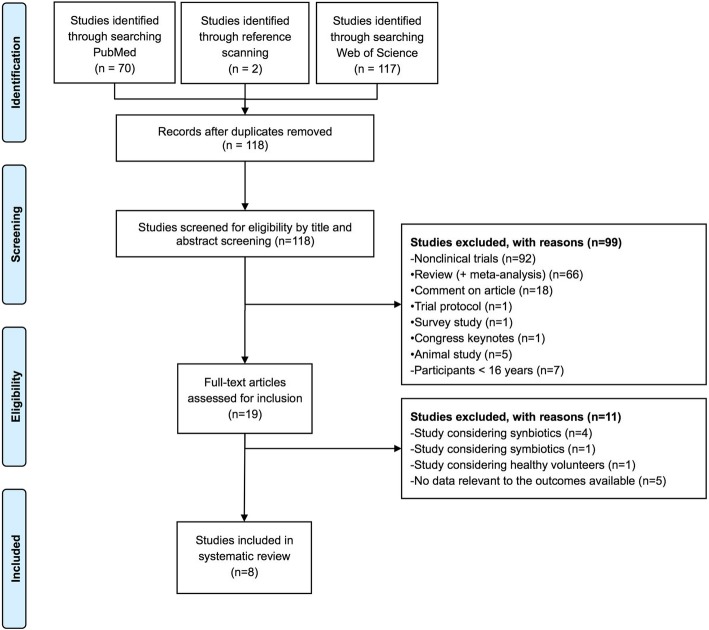
We conducted an unrestricted search of the English language medical literature. For each individual study, the relative risk of VAP was calculated using the reported primary outcome data.
The search identified a total of 72 articles. Eight articles enrolling a total of 1229 patients fulfilled the inclusion and exclusion criteria. In four trials, the investigators were blinded for the intervention, and two trials used an intention-to-treat analysis. Loss to follow-up with regard to the primary endpoint ranged from 0 to 14% in the intervention groups and from 0 to 16% in the control groups. The incidence of VAP expressed as the percentage of studied patients was reported in seven trials. The incidence of VAP ranged from 4 to 36% in the intervention groups and from 13 to 50% in the control groups. The relative risk for VAP ranged between 0.30 and 1.41. Three trials showed a significant difference in favor of probiotic therapy between the intervention and the control groups.
The incidence of VAP tended to be lower in patients treated with probiotics in most trials identified by the systematic search. Due to the heterogeneity of the studies and the low quality of evidence, it remains difficult to draw firm conclusions. The efficacy of preventive probiotics should be studied in more detail in future trials. Application of probiotics for the prevention of VAP seems to be safe with only few side effects reported in the selected trials.
描述益生菌可能的作用模式,并对目前关于益生菌预防重症患者呼吸机相关性肺炎(VAP)疗效的证据进行系统综述。
我们对英文医学文献进行了无限制检索。对于每项单独研究,使用报告的主要结局数据计算VAP的相对风险。
检索共识别出72篇文章。八项文章共纳入1229例患者,符合纳入和排除标准。在四项试验中,研究人员对干预措施不知情,两项试验采用意向性分析。干预组主要终点的失访率为0%至14%,对照组为0%至16%。七项试验报告了以研究患者百分比表示的VAP发生率。干预组VAP发生率为4%至36%,对照组为13%至50%。VAP的相对风险在0.30至1.41之间。三项试验显示干预组和对照组之间益生菌治疗有显著差异。
在系统检索确定的大多数试验中,接受益生菌治疗的患者VAP发生率往往较低。由于研究的异质性和证据质量较低,仍然难以得出确凿结论。预防性益生菌的疗效应在未来试验中更详细地研究。在所选试验中,仅报告了少数副作用,应用益生菌预防VAP似乎是安全的。