Department of Surgery, Gachon University Gil Medical Center, Gachon University College of Medicine, Incheon, Korea.
Yonsei Med J. 2019 Aug;60(8):782-790. doi: 10.3349/ymj.2019.60.8.782.
Although laparoscopic adjustable gastric bands are considered a standard treatment for severe obesity, their use remains controversial. We evaluated rates of band explantation and the incidences of complications leading to and following band explantation.
This retrospective review was performed on patients that underwent adjustable gastric band explantation. For each of the three groups of patients that underwent explantation, we compared demographic and anthropometric data, band duration in situ, operative approach, and morbidities.
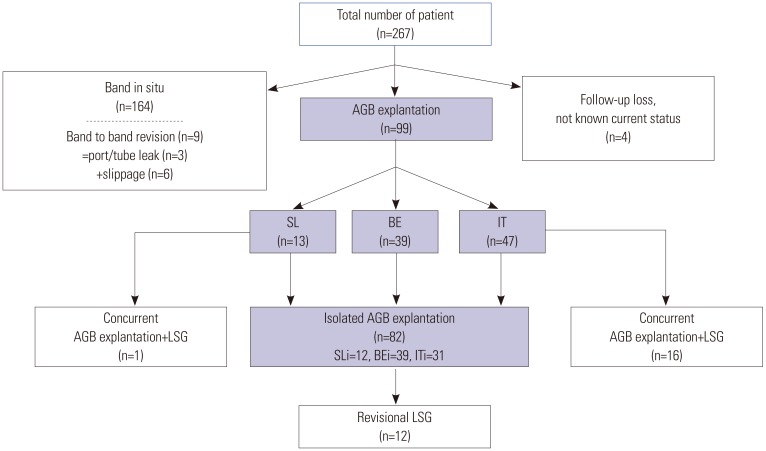
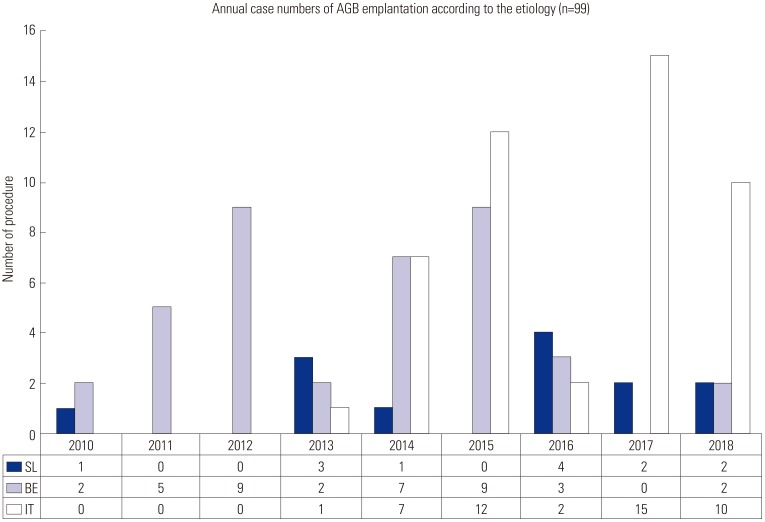
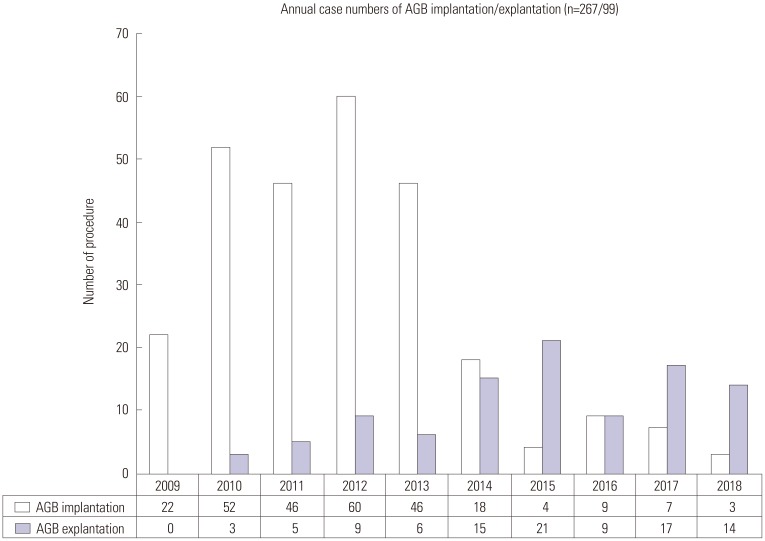
Between January 2009 and October 2018, a total of 267 patients underwent primary laparoscopic adjustable gastric band surgery. Of these 267 patients, 99 (37.1%) underwent band explantation. Numbers (%) of patients in the slippage (SL), band erosion (BE), and intolerance (IT) groups were 13 (13.1%), 39 (39.4), and 47 (47.5%), respectively. Mean %EBMIL values at explantation in these groups were 74.6±45.5, 79.7±40.3, and 36.1±46.0, respectively (<0.001), and mean times for maintaining bands in situ were 45.1±28.0, 39.4±24.3, and 51.2±22.7 months, respectively. Isolated band removal was performed for slippage (SLi, n=12), band erosion (BEi, n=39), and intolerance (ITi, n=31). The numbers (%) of patients in the SLi, BEi, and ITi groups that experienced a surgical complication (Clavien-Dindo class ≥1) were 0 (0.0%), 24 (61.5%), and 3 (9.7%), respectively (<0.001). In the BEi group, four patients (4/39, 10.3%) underwent reoperation after AGB removal.
During our 10 years of experience, 37.1% of adjustable gastric band had to be removed. Intra-abdominal abscess and intragastric bleeding were rare but serious complications after explantation. Potential candidates for adjustable gastric band should be informed of the high long-term risk of band explantation and its associated morbidities.
尽管腹腔镜可调胃束带被认为是治疗重度肥胖的标准方法,但它的使用仍存在争议。我们评估了胃束带取出率以及导致和随后胃束带取出的并发症发生率。
本回顾性研究对接受可调胃束带取出的患者进行了评估。对于接受取出术的三组患者,我们比较了人口统计学和人体测量学数据、带在体内的持续时间、手术方法和并发症。
在 2009 年 1 月至 2018 年 10 月期间,共有 267 名患者接受了腹腔镜可调胃束带初次手术。在这 267 名患者中,有 99 名(37.1%)接受了胃束带取出术。胃束带滑脱(SL)、胃束带侵蚀(BE)和不耐受(IT)组的患者数量(%)分别为 13(13.1%)、39(39.4%)和 47(47.5%)。在这些组中,胃束带取出时的平均%EBMIL 值分别为 74.6±45.5、79.7±40.3 和 36.1±46.0(<0.001),胃束带在体内的平均时间分别为 45.1±28.0、39.4±24.3 和 51.2±22.7 个月,分别(<0.001)。对于胃束带滑脱(SLi,n=12)、胃束带侵蚀(BEi,n=39)和不耐受(ITi,n=31),我们分别进行了单独的胃束带取出。胃束带滑脱(SLi)、胃束带侵蚀(BEi)和不耐受(ITi)组的患者中发生手术并发症(Clavien-Dindo 分级≥1)的数量(%)分别为 0(0.0%)、24(61.5%)和 3(9.7%)(<0.001)。在 BEi 组中,有 4 名患者(4/39,10.3%)在胃束带去除后需要再次手术。
在我们 10 年的经验中,37.1%的可调胃束带需要取出。腹腔脓肿和胃内出血是胃束带取出后罕见但严重的并发症。可调胃束带的潜在候选者应被告知长期高胃束带取出率及其相关并发症的风险。