From the Department of Epidemiology, Harvard T.H. Chan School of Public Health, Boston, MA.
Department of Biostatistics, Harvard T.H. Chan School of Public Health, Boston, MA.
Epidemiology. 2019 Nov;30(6):835-837. doi: 10.1097/EDE.0000000000001064.
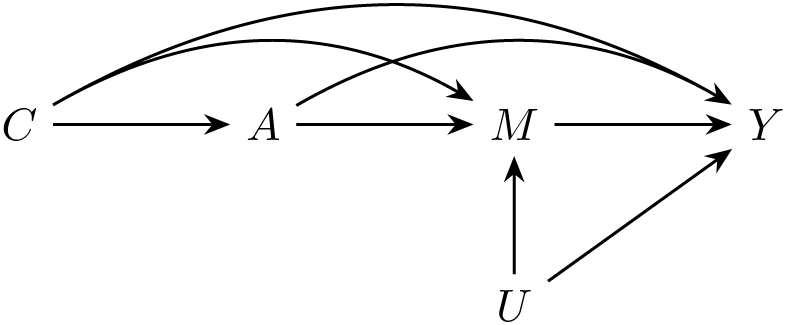
Mediation analysis is a powerful tool for understanding mechanisms, but conclusions about direct and indirect effects will be invalid if there is unmeasured confounding of the mediator-outcome relationship. Sensitivity analysis methods allow researchers to assess the extent of this bias but are not always used. One particularly straightforward technique that requires minimal assumptions is nonetheless difficult to interpret, and so would benefit from a more intuitive parameterization.
We conducted an exhaustive numerical search over simulated mediation effects, calculating the proportion of scenarios in which a bound for unmeasured mediator-outcome confounding held under an alternative parameterization.
In over 99% of cases, the bound for the bias held when we described the strength of confounding directly via the confounder-mediator relationship instead of via the conditional exposure-confounder relationship.
Researchers can conduct sensitivity analysis using a method that describes the strength of the confounder-outcome relationship and the approximate strength of the confounder-mediator relationship that, together, would be required to explain away a direct or indirect effect.
中介分析是理解机制的有力工具,但如果中介与结局关系存在未测量的混杂,那么关于直接和间接效应的结论将是无效的。敏感性分析方法允许研究人员评估这种偏差的程度,但并不总是被使用。一种特别直接的技术,需要最小的假设,但很难解释,因此将受益于更直观的参数化。
我们对模拟的中介效应进行了详尽的数值搜索,计算了在替代参数化下,对未测量的中介-结局混杂有界的情况下,出现的场景比例。
在超过 99%的情况下,当我们直接通过混杂因素-中介物关系而不是通过条件暴露-混杂因素关系来描述混杂的强度时,这个界限是有效的。
研究人员可以使用一种方法进行敏感性分析,该方法描述了混杂因素与结局关系的强度,以及解释直接或间接效应所需的混杂因素-中介物关系的近似强度。