Department of Genetics and Pathology, Pomeranian Medical University, Szczecin, Poland.
Read-Gene SA, Grzepnica, Poland.
Int J Cancer. 2020 May 15;146(10):2721-2727. doi: 10.1002/ijc.32595. Epub 2019 Aug 26.
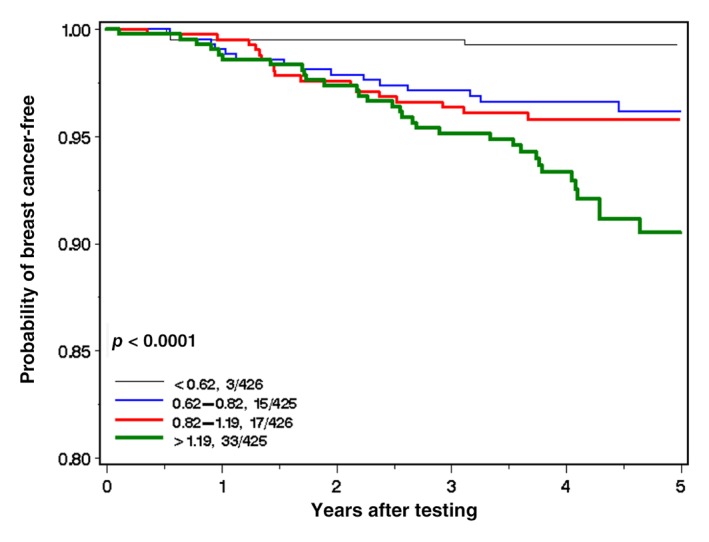
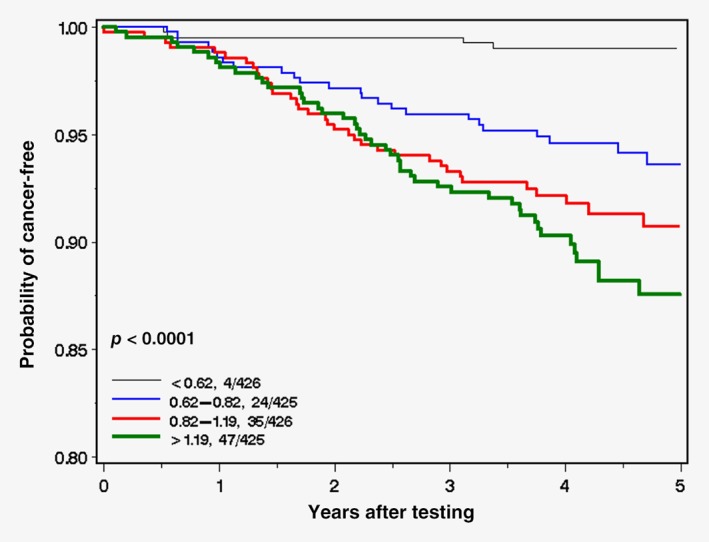
Arsenic is recognized as a potent carcinogen at high concentrations, but the relationship between environmental arsenic and breast cancer risk has not well been studied. Most research has focused on the effect of arsenic in populations with high endemic exposure, and not in populations with arsenic levels within normal limits. We sought to determine if blood arsenic levels predict the risk of breast and other cancers risk among women in northern Poland. The cohort consisted of 1,702 healthy women, aged 40 and above, identified between 2010 and 2017. Blood arsenic level was determined by inductively coupled plasma mass spectrometry. After an average of 4.5 years of follow-up (range 0.7-7.3 years), there were 110 incident cases of cancer diagnosed in the cohort, including 68 cases of breast cancer. Women in the highest quartile of arsenic had a highly significant 13-fold increased risk of developing breast cancer, compared to women in the lowest quartile (hazard ratio [HR] = 13.2; 95% confidence interval [CI] 4.02-43.0). Results were similar for arsenic and all incident cancers (HR quartile 4 vs. quartile 1 = 13.3; 95% CI 4.78-37.0). If confirmed, our study suggests that the blood arsenic level may be a useful predictive marker of cancer risk in women.
砷被认为是一种高浓度的强致癌物质,但环境砷与乳腺癌风险之间的关系尚未得到很好的研究。大多数研究都集中在高地方性暴露人群中砷的影响上,而不是在砷水平正常范围内的人群中。我们试图确定血液中的砷含量是否可以预测波兰北部女性患乳腺癌和其他癌症的风险。该队列由 1702 名年龄在 40 岁及以上的健康女性组成,于 2010 年至 2017 年间确定。通过电感耦合等离子体质谱法测定血液中的砷含量。在平均 4.5 年的随访(范围 0.7-7.3 年)后,队列中有 110 例癌症病例被确诊,其中包括 68 例乳腺癌。与最低四分位数的女性相比,砷含量最高四分位数的女性患乳腺癌的风险增加了 13 倍,具有高度显著意义(风险比 [HR] = 13.2;95%置信区间 [CI] 4.02-43.0)。砷与所有新发病例癌症的结果相似(HR 四分位数 4 与四分位数 1 = 13.3;95%CI 4.78-37.0)。如果得到证实,我们的研究表明,血液中的砷含量可能是女性癌症风险的一个有用的预测标志物。