Ariciu Ana-Maria, Woen David H, Huh Daniel N, Nodaraki Lydia E, Kostopoulos Andreas K, Goodwin Conrad A P, Chilton Nicholas F, McInnes Eric J L, Winpenny Richard E P, Evans William J, Tuna Floriana
School of Chemistry, The University of Manchester, Oxford Road, Manchester, M13 9PL, UK.
Photon Science Institute, The University of Manchester, Oxford Road, Manchester, M13 9PL, UK.
Nat Commun. 2019 Jul 26;10(1):3330. doi: 10.1038/s41467-019-11309-3.
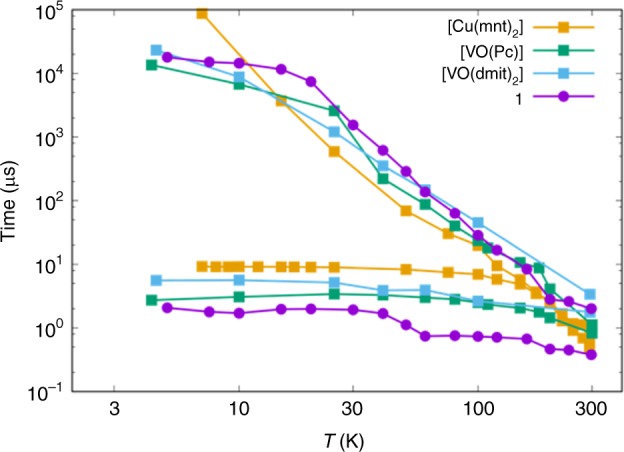
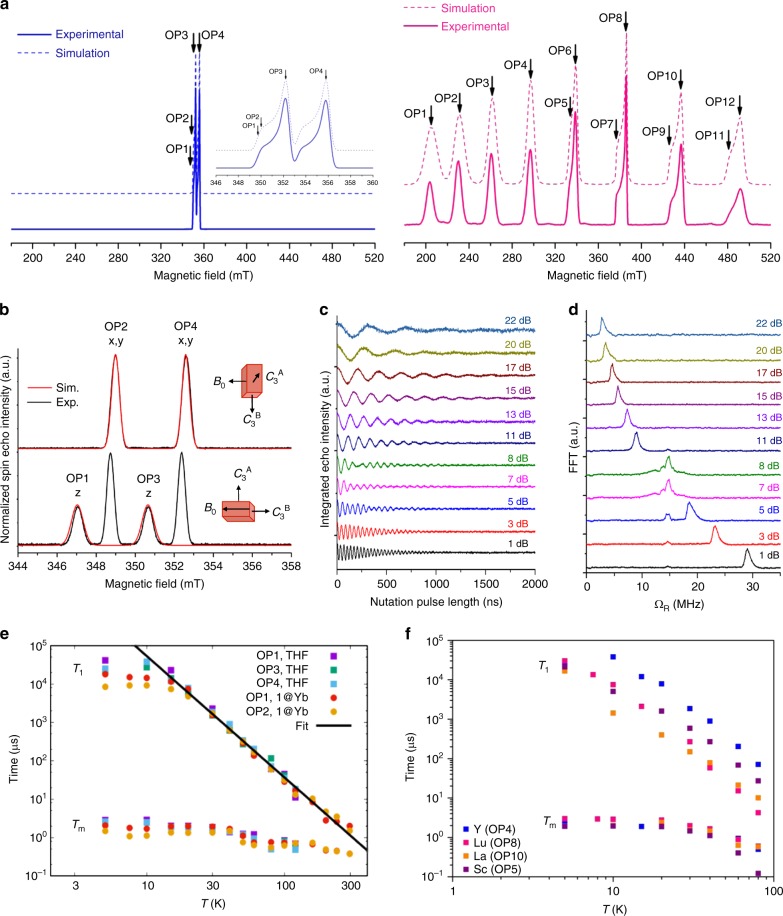
The proposal that paramagnetic transition metal complexes could be used as qubits for quantum information processing (QIP) requires that the molecules retain the spin information for a sufficient length of time to allow computation and error correction. Therefore, understanding how the electron spin-lattice relaxation time (T) and phase memory time (T) relate to structure is important. Previous studies have focused on the ligand shell surrounding the paramagnetic centre, seeking to increase rigidity or remove elements with nuclear spins or both. Here we have studied a family of early 3d or 4f metals in the +2 oxidation states where the ground state is effectively a S state. This leads to a highly isotropic spin and hence makes the putative qubit insensitive to its environment. We have studied how this influences T and T and show unusually long relaxation times given that the ligand shell is rich in nuclear spins and non-rigid.
顺磁性过渡金属配合物可作为量子信息处理(QIP)的量子比特这一提议,要求分子能够在足够长的时间内保留自旋信息,以便进行计算和纠错。因此,了解电子自旋 - 晶格弛豫时间(T)和相位记忆时间(T)如何与结构相关很重要。先前的研究集中在顺磁中心周围的配体壳层,试图增加其刚性或去除具有核自旋的元素或两者兼而有之。在这里,我们研究了处于 +2 氧化态的一族早期 3d 或 4f 金属,其基态实际上是一个 S 态。这导致了高度各向同性的自旋,因此使假定的量子比特对其环境不敏感。我们研究了这如何影响 T 和 T,并表明鉴于配体壳层富含核自旋且不刚性,弛豫时间异常长。