Department of Pathology, Johns Hopkins University School of Medicine, Baltimore, Maryland.
Department of Pathology and Laboratory Medicine, Mayo Clinic, Rochester, Minnesota.
Am J Hematol. 2019 Oct;94(10):1141-1148. doi: 10.1002/ajh.25592. Epub 2019 Aug 7.
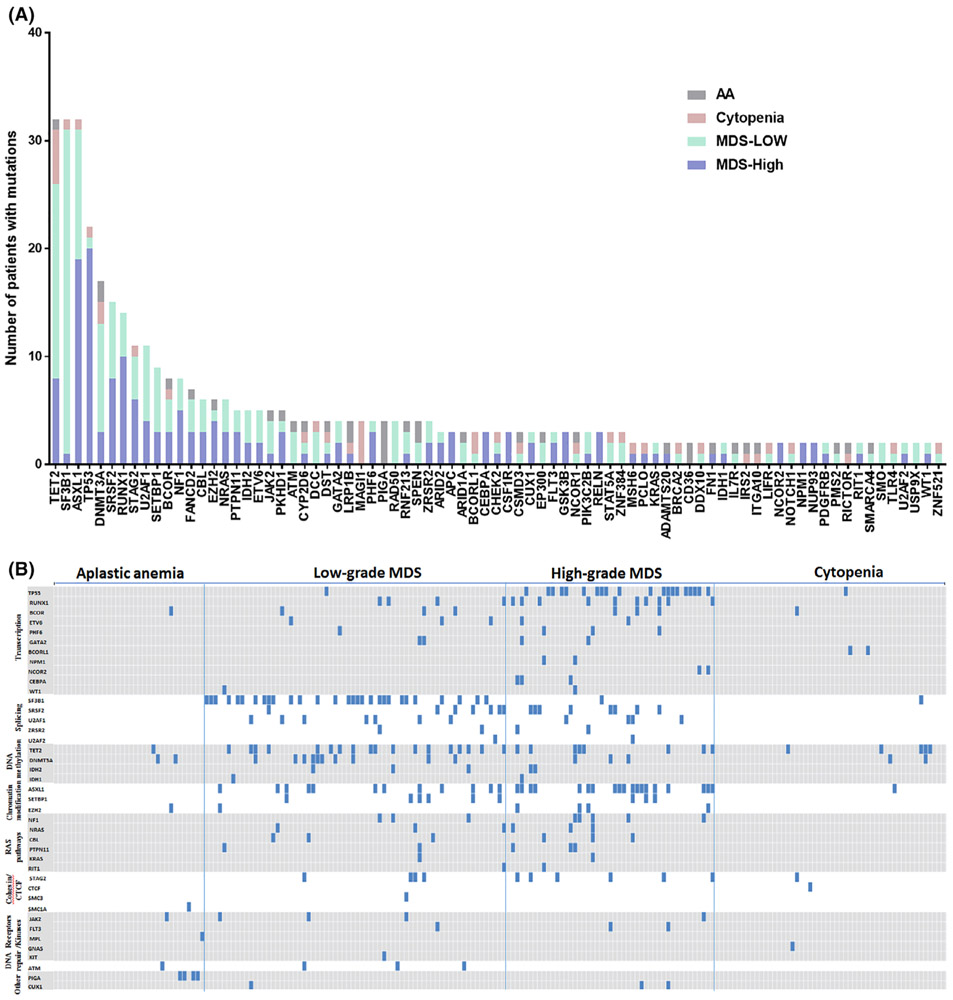
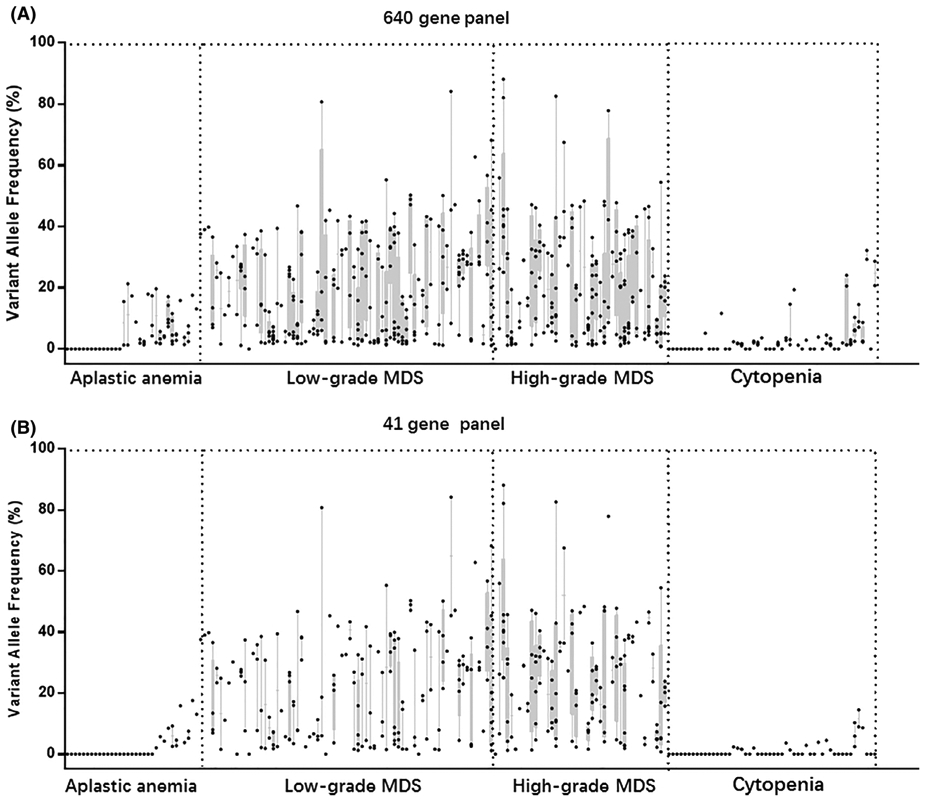
The diagnostic utility of somatic mutations in the context of cytopenias is unclear: clonal hematopoiesis can be found in healthy individuals, patients with aplastic anemia (AA), clonal cytopenia of undetermined significance (CCUS) and myelodysplastic syndrome (MDS). We examined a cohort of 207 well-characterized cytopenic patients with a 640-gene next generation sequencing (NGS) panel and compared its diagnostic utility with a "virtual" 41 gene panel. The TET2, SF3B1, ASXL1, and TP53 were the most commonly mutated genes (frequency > 10%). Mutations in the 640-gene panel show high sensitivity (98.3%) but low specificity (47.6%) for diagnosis of MDS. Notably, mutations of splicing factors and genes in the RAS pathway are relatively specific to MDS. Furthermore, high variant allele frequency (VAF) predicts MDS: when the VAF is set at 20%, the positive predictive value (PPV) for MDS is 95.9%, with a specificity of 95.3%. The presence of two or more somatic mutations with ≥10% VAF showed a PPV of 95.2%. While the "virtual" 41-gene panel showed a mild decrease in sensitivity (95.7% vs 98.3%), 100% specificity was observed when either VAF was set at ≥20% (100% vs 95.3%), or two or more somatic mutations had VAFs ≥ 10%. Our study shows targeted gene panel sequencing improves the diagnostic approach and accuracy for unexplained cytopenia, with its high sensitivity and high PPV for MDS when applying VAF cutoffs. Furthermore, a 41-gene panel was shown to have at least comparable performance characteristics to the large 640-gene panel.
克隆性造血可发生于健康个体、再生障碍性贫血(AA)患者、意义未明的克隆性血细胞减少症(CCUS)和骨髓增生异常综合征(MDS)患者中。我们研究了一组 207 例特征明确的血细胞减少症患者,采用 640 基因下一代测序(NGS)面板进行检测,并将其诊断效用与“虚拟”的 41 基因面板进行了比较。TET2、SF3B1、ASXL1 和 TP53 是最常见的突变基因(频率>10%)。640 基因面板的突变对 MDS 的诊断具有很高的敏感性(98.3%),但特异性(47.6%)较低。剪接因子和 RAS 通路基因的突变相对特异于 MDS。此外,高变异等位基因频率(VAF)可预测 MDS:当 VAF 设定为 20%时,MDS 的阳性预测值(PPV)为 95.9%,特异性为 95.3%。当 VAF≥10%时,存在两个或两个以上体细胞突变的情况下,PPV 为 95.2%。虽然“虚拟”的 41 基因面板敏感性略有下降(95.7% vs 98.3%),但当 VAF 设定为≥20%(100% vs 95.3%)或两个或两个以上体细胞突变的 VAF≥10%时,特异性为 100%。我们的研究表明,靶向基因 panel 测序提高了对不明原因血细胞减少症的诊断方法和准确性,当应用 VAF 截止值时,其对 MDS 的敏感性和 PPV 均较高。此外,41 基因面板的性能特征至少与较大的 640 基因面板相当。