Li Lin, Zhang Shu, Cui Jie, Chen Li-Zhen, Wang Xiaoyan, Fan Mingxia, Wei Gao-Xia
Key Laboratory of Adolescent Health Assessment and Exercise Intervention of Ministry of Education, East China Normal University, Shanghai, China.
School of Physical Education and Health Care, East China Normal University, Shanghai, China.
Front Physiol. 2019 Jul 10;10:902. doi: 10.3389/fphys.2019.00902. eCollection 2019.
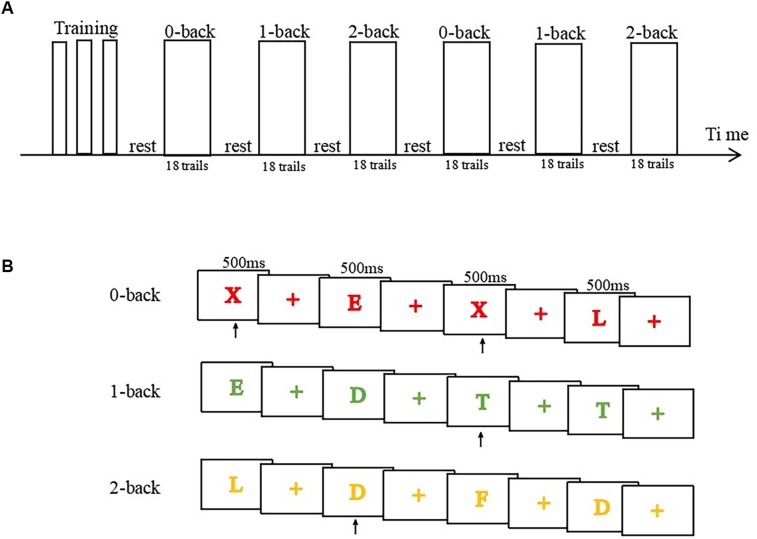
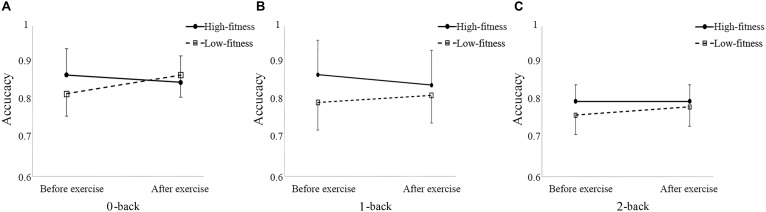
Cognitive gains are reported to be induced by acute aerobic exercise, but the role of fitness in the effect of acute aerobic exercise on executive function remains unknown. Therefore, we aimed to examine the effect of fitness on acute exercise-induced changes in executive function from neural mechanism approach. Twenty-four female college students were assigned to high-fitness or low-fitness groups based on their cardiovascular fitness level, and then underwent functional magnetic resonance imaging while performing N-back tasks before and after 30 min of acute exercise. The behavioral results revealed significant interaction effects of group by time in the 0-back and 1-back tasks, but not in the 2-back task. The accuracy was significantly higher in the high-fitness group than in the low-fitness group before exercise in the 1-back and 2-back tasks. At the neural level, significant interaction effects of group by time were observed in all tasks. The 0-back and 1-back tasks activated the right cerebellum while the 2-back task activated subcortical regions. Our findings suggest that fitness moderates the effect of aerobic exercise on cognitive function, and provide the first neural evidence to support the influence of fitness on exercise-induced cognitive performance.
据报道,急性有氧运动可带来认知能力的提升,但身体素质在急性有氧运动对执行功能的影响中所起的作用仍不明确。因此,我们旨在从神经机制的角度研究身体素质对急性运动引起的执行功能变化的影响。根据心血管健康水平,将24名女大学生分为高身体素质组或低身体素质组,然后在急性运动30分钟前后进行N-back任务时接受功能磁共振成像检查。行为学结果显示,在0-back和1-back任务中,组间与时间存在显著的交互作用,但在2-back任务中不存在。在1-back和2-back任务中,运动前高身体素质组的准确性显著高于低身体素质组。在神经层面,所有任务中均观察到组间与时间的显著交互作用。0-back和1-back任务激活了右侧小脑,而2-back任务激活了皮层下区域。我们的研究结果表明,身体素质会调节有氧运动对认知功能的影响,并提供了首个神经学证据来支持身体素质对运动诱导的认知表现的影响。