Wang Liusheng, Chen Qian, Chen Yan, Zhong Ruitao
Department of Psychology, Nantong University, Nantong, China.
School of Psychology, Jiangxi Normal University, Nanchang, China.
Front Psychol. 2019 Jul 9;10:1573. doi: 10.3389/fpsyg.2019.01573. eCollection 2019.
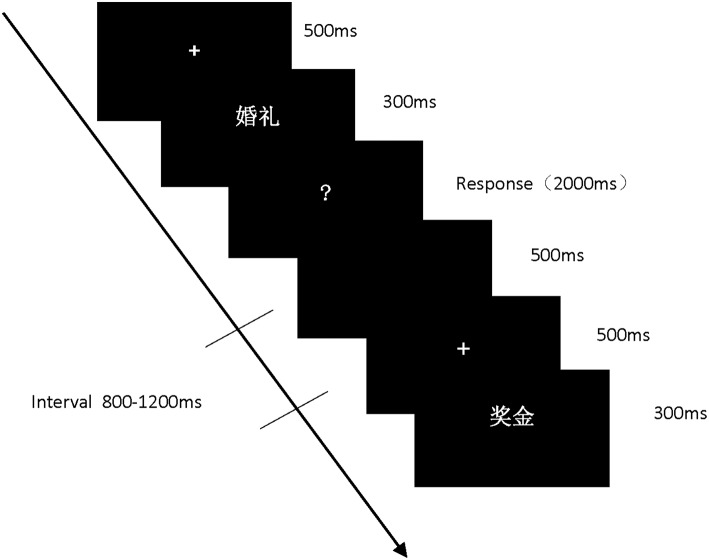
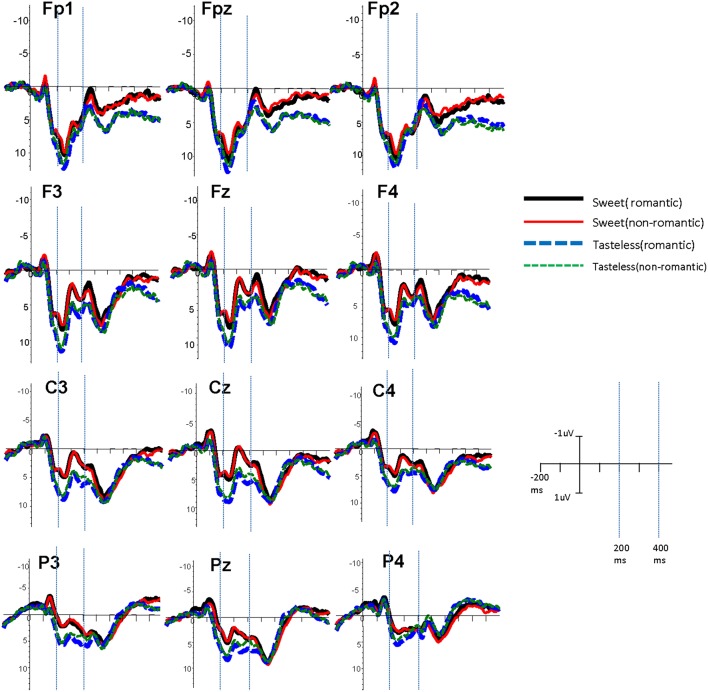
Previous studies have found that sweet perception affects the subjective evaluation of interpersonal intimacy and romantic semantic processing. However, the cognitive processes involved in this effect are unclear. The aim of the current study was to investigate the sweet-love embodied effect in semantic processing and its underlying mechanism by Event-Related potentials technique. Participants were randomly exposed to sweet-taste or tasteless conditions, during which they performed a lexical decision-task that involved romantic and non-romantic words. The results showed an enhanced N400 for romantic words compared to non-romantic words in the sweet-taste condition, and a larger P200 for romantic words relative to non-romantic words. The results demonstrate that taste sensations can cross-modally facilitate the semantic processing of romance. These findings support the embodied effect of sweet-love and are discussed from the perspective of embodied cognition with knowledge activation of concept and semantic richness.
先前的研究发现,甜味感知会影响人际亲密度的主观评价以及浪漫语义加工。然而,这种效应所涉及的认知过程尚不清楚。本研究的目的是通过事件相关电位技术,探究语义加工中的甜蜜-爱情具身效应及其潜在机制。参与者被随机暴露于甜味或无味条件下,在此期间他们执行一项涉及浪漫和非浪漫词汇的词汇判断任务。结果显示,在甜味条件下,与非浪漫词汇相比,浪漫词汇诱发的N400增强;与非浪漫词汇相比,浪漫词汇诱发的P200更大。结果表明,味觉能够跨通道促进浪漫语义的加工。这些发现支持了甜蜜-爱情的具身效应,并从具身认知的角度,结合概念的知识激活和语义丰富性进行了讨论。