Tang Silin, Orsi Renato H, Luo Hao, Ge Chongtao, Zhang Guangtao, Baker Robert C, Stevenson Abigail, Wiedmann Martin
Mars Global Food Safety Center, Beijing, China.
Department of Food Science, College of Agriculture and Life Sciences, Cornell University, Ithaca, NY, United States.
Front Microbiol. 2019 Jul 12;10:1591. doi: 10.3389/fmicb.2019.01591. eCollection 2019.
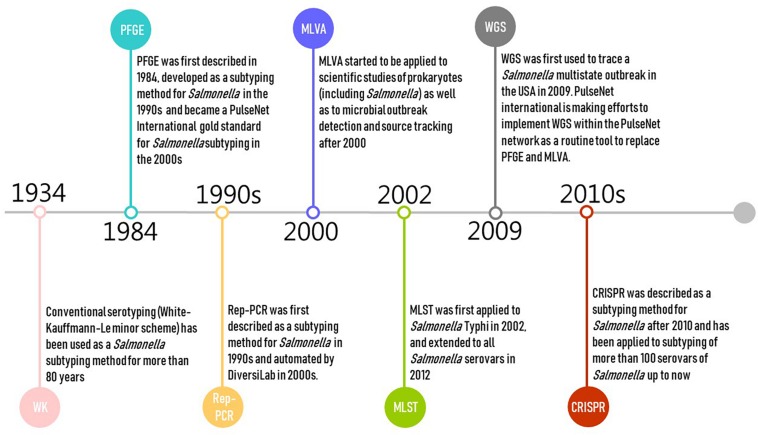
The food industry is facing a major transition regarding methods for confirmation, characterization, and subtyping of . Whole-genome sequencing (WGS) is rapidly becoming both the method of choice and the gold standard for subtyping; however, routine use of WGS by the food industry is often not feasible due to cost constraints or the need for rapid results. To facilitate selection of subtyping methods by the food industry, we present: (i) a comparison between classical serotyping and selected widely used molecular-based subtyping methods including pulsed-field gel electrophoresis, multilocus sequence typing, and WGS (including WGS-based serovar prediction) and (ii) a scoring system to evaluate and compare subtyping assays. This literature-based assessment supports the superior discriminatory power of WGS for source tracking and root cause elimination in food safety incident; however, circumstances in which use of other subtyping methods may be warranted were also identified. This review provides practical guidance for the food industry and presents a starting point for further comparative evaluation of characterization and subtyping methods.
食品行业在……的确认、特征描述和亚型分型方法方面正面临重大转变。全基因组测序(WGS)正迅速成为亚型分型的首选方法和金标准;然而,由于成本限制或对快速结果的需求,食品行业常规使用WGS往往不可行。为便于食品行业选择亚型分型方法,我们提出:(i)经典血清分型与选定的广泛使用的基于分子的亚型分型方法(包括脉冲场凝胶电泳、多位点序列分型和WGS(包括基于WGS的血清型预测))之间的比较,以及(ii)一个评分系统,用于评估和比较亚型分型检测。这项基于文献的评估支持WGS在食品安全事件的源头追踪和根本原因消除方面具有卓越的鉴别能力;然而,也确定了其他亚型分型方法可能适用的情况。本综述为食品行业提供了实用指南,并为进一步比较评估……的特征描述和亚型分型方法提供了一个起点。