Fall Ibrahima Socé, Rajatonirina Soatiana, Yahaya Ali Ahmed, Zabulon Yoti, Nsubuga Peter, Nanyunja Miriam, Wamala Joseph, Njuguna Charles, Lukoya Charles Okot, Alemu Wondimagegnehu, Kasolo Francis Chisaka, Talisuna Ambrose Otau
World Health Organization, Regional Office for Africa, Health Emergencies programme, Brazzaville, Congo.
Global Public Health Solutions, Atlanta, Georgia, USA.
BMJ Glob Health. 2019 Jul 3;4(4):e001427. doi: 10.1136/bmjgh-2019-001427. eCollection 2019.
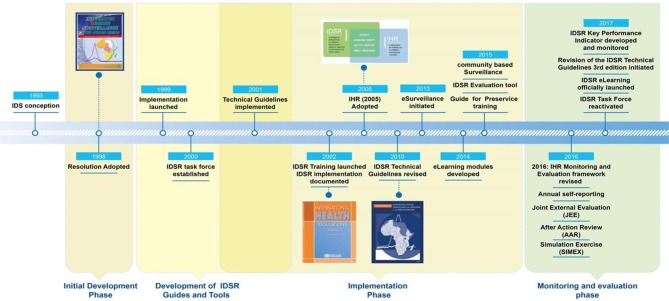
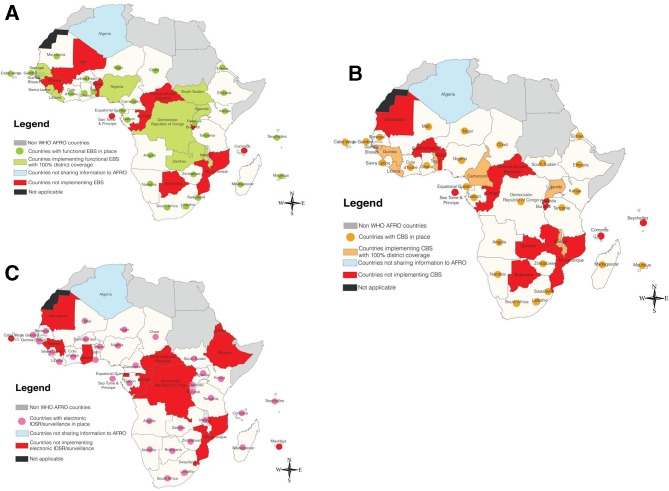
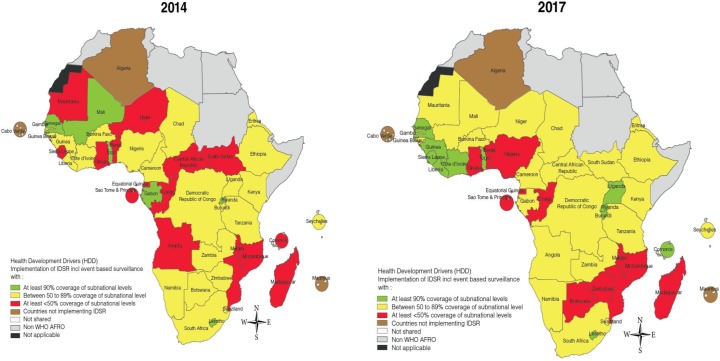
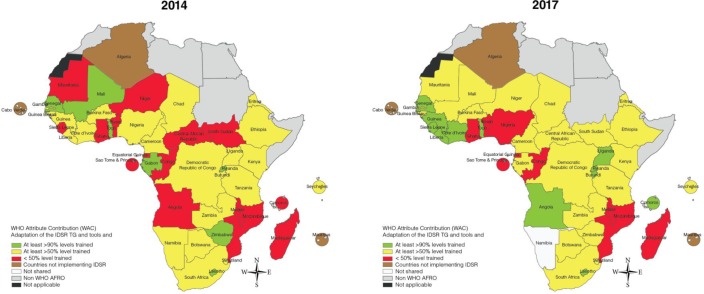
In 1998, the WHO African region adopted a strategy called Integrated Disease Surveillance and Response (IDSR). Here, we present the current status of IDSR implementation; and provide some future perspectives for enhancing the IDSR strategy in Africa. In 2017, we used two data sources to compile information on the status of IDSR implementation: a pretested rapid assessment questionnaire sent out biannually to all countries and quarterly compilation of data for two IDSR key performance indicators (KPI). The first KPI measures country IDSR performance and the second KPI tracks the number of countries that the WHO secretariat supports to scale up IDSR. The KPI data for 2017 were compared with a retrospective baseline for 2014. By December 2017, 44 of 47 African countries (94%) were implementing IDSR. Of the 44 countries implementing IDSR, 40 (85%) had initiated IDSR training at subnational level; 32 (68%) had commenced community-based surveillance; 35 (74%) had event-based surveillance; 33 (70%) had electronic IDSR; and 32 (68%) had a weekly/monthly bulletin for sharing IDSR data. Thirty-two countries (68%) had achieved the timeliness and completeness threshold of at least 80% of the reporting units. However, only 12 countries (26%) had the desired target of at least 90% IDSR implementation coverage at the peripheral level. After 20 years of implementing IDSR, there are major achievements in the indicator-based surveillance systems. However, major gaps were identified in event-based surveillance. All African countries should enhance IDSR everywhere.
1998年,世界卫生组织非洲区域采用了一项名为“综合疾病监测与应对”(IDSR)的战略。在此,我们介绍IDSR实施的现状,并为加强非洲的IDSR战略提供一些未来展望。2017年,我们使用两个数据源来汇编关于IDSR实施状况的信息:每半年向所有国家发送一次经过预测试的快速评估问卷,以及每季度汇编两个IDSR关键绩效指标(KPI)的数据。第一个KPI衡量国家IDSR的绩效,第二个KPI跟踪世界卫生组织秘书处支持扩大IDSR规模的国家数量。将2017年的KPI数据与2014年的回顾性基线进行了比较。到2017年12月,47个非洲国家中有44个(94%)正在实施IDSR。在实施IDSR的44个国家中,40个(85%)已在国家以下层面开展了IDSR培训;32个(68%)已开始基于社区的监测;35个(74%)已开展基于事件的监测;33个(70%)拥有电子IDSR;32个(68%)有每周/每月的公报来分享IDSR数据。32个国家(68%)达到了报告单位至少80%的及时性和完整性阈值。然而,只有12个国家(26%)实现了外围层面至少90%的IDSR实施覆盖率这一理想目标。在实施IDSR 20年后,基于指标的监测系统取得了重大成就。然而,在基于事件监测方面发现了重大差距。所有非洲国家都应在各地加强IDSR。