Faculty of Health Sciences, University of Sydney, 75 East Street, Lidcombe, NSW, 2141, Australia.
Centre for Primary Health Care and Equity, University of New South Wales Australia, Sydney, NSW, 2052, Australia.
BMC Health Serv Res. 2019 Jul 29;19(1):526. doi: 10.1186/s12913-019-4337-1.
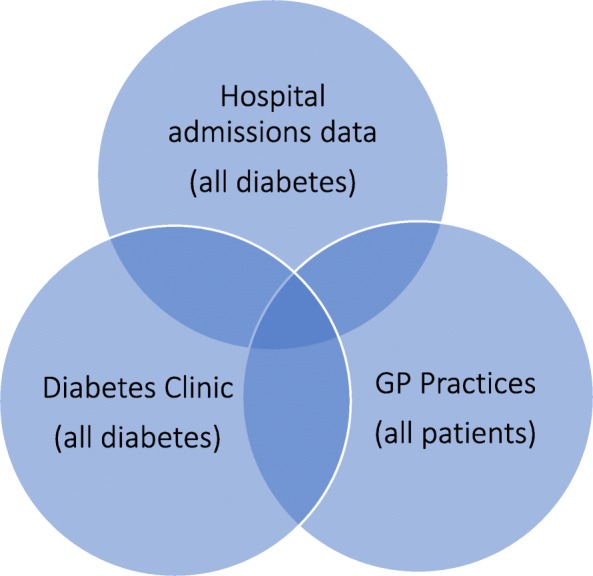
Linking process of care data from general practice (GP) and hospital data may provide more information about the risk of hospital admission and re-admission for people with type-2 diabetes mellitus (T2DM). This study aimed to extract and link data from a hospital, a diabetes clinic (DC). A second aim was to determine whether the data could be used to predict hospital admission for people with T2DM.
Data were extracted using the GRHANITE™ extraction and linkage tool. The data from nine GPs and the DC included data from the two years prior to the hospital admission. The date of the first hospital admission for patients with one or more admissions was the index admission. For those patients without an admission, the census date 31/03/2014 was used in all outputs requiring results prior to an admission. Readmission was any admission following the index admission. The data were summarised to provide a comparison between two groups of patients: 1) Patients with a diagnosis of T2DM who had been treated at a GP and had a hospital admission and 2) Patients with a diagnosis of T2DM who had been treated at a GP and did not have a hospital admission.
Data were extracted for 161,575 patients from the three data sources, 644 patients with T2DM had data linked between the GPs and the hospital. Of these, 170 also had data linked with the DC. Combining the data from the different data sources improved the overall data quality for some attributes particularly those attributes that were recorded consistently in the hospital admission data. The results from the modelling to predict hospital admission were plausible given the issues with data completeness.
This project has established the methodology (tools and processes) to extract, link, aggregate and analyse data from general practices, hospital admission data and DC data. This study methodology involved the establishment of a comparator/control group from the same sites to compare and contrast the predictors of admission, addressing a limitation of most published risk stratification and admission prediction studies. Data completeness needs to be improved for this to be useful to predict hospital admissions.
将一般实践(GP)和医院数据的护理流程联系起来,可能会为 2 型糖尿病(T2DM)患者的住院和再入院风险提供更多信息。本研究旨在从一家医院和一家糖尿病诊所(DC)中提取和链接数据。第二个目的是确定这些数据是否可用于预测 T2DM 患者的住院情况。
使用 GRHANITE™提取和链接工具提取数据。来自 9 家全科医生和 DC 的数据包括住院前两年的数据。有一次或多次住院的患者的第一次住院日期为索引住院日期。对于那些没有住院的患者,所有需要在住院前进行结果的输出中,使用 2014 年 3 月 31 日的普查日期。索引住院后的再次住院为任何再次住院。对数据进行总结,以比较两组患者:1)在 GP 接受治疗且有住院经历的 T2DM 患者;2)在 GP 接受治疗且无住院经历的 T2DM 患者。
从三个数据源中提取了 161575 名患者的数据,有 644 名 T2DM 患者的数据在 GP 和医院之间进行了链接。其中,有 170 名患者的数据还与 DC 进行了链接。结合不同数据源的数据,提高了某些属性的整体数据质量,特别是那些在住院记录中记录一致的属性。考虑到数据完整性的问题,预测住院的模型结果是合理的。
本项目建立了从一般实践、住院记录数据和 DC 数据中提取、链接、汇总和分析数据的方法(工具和流程)。本研究方法涉及从同一地点建立一个对照/对照组,以比较和对比入院的预测因素,解决了大多数已发表的风险分层和入院预测研究的局限性。为了有效地预测住院,需要提高数据的完整性。