Chen Jingbo, Wu Yongjiang, Sun Yawang, Dong Xianwen, Wang Zili, Zhang Zhu, Xiao Yanli, Dong Guozhong
College of Animal Science and Technology, Southwest University, Beibei, 400716, China.
Institute for Herbivorous Livestock Research, Chongqing Academy of Animal Science, Chongqing, 402460, China.
BMC Vet Res. 2019 Jul 29;15(1):267. doi: 10.1186/s12917-019-2007-5.
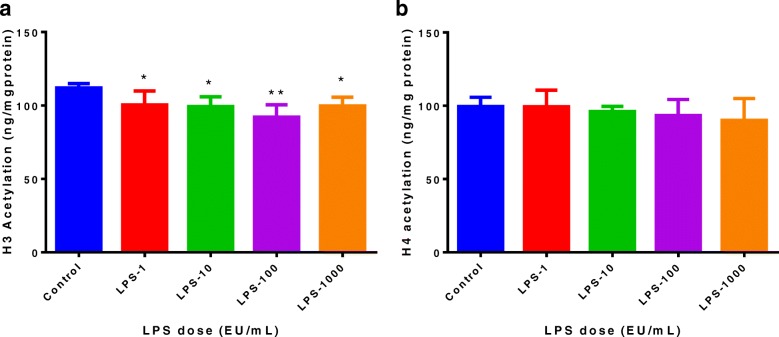
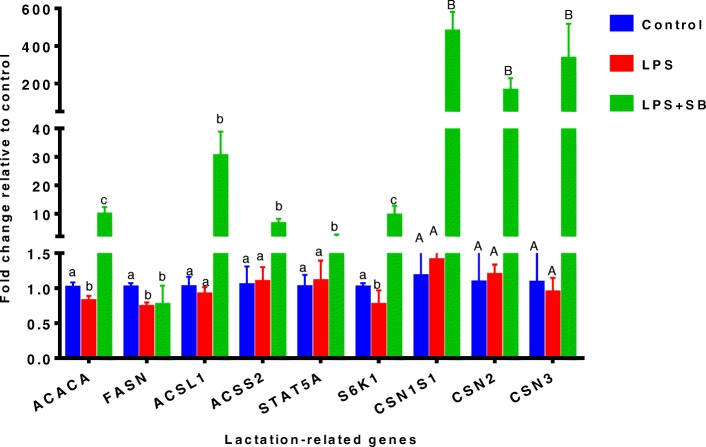
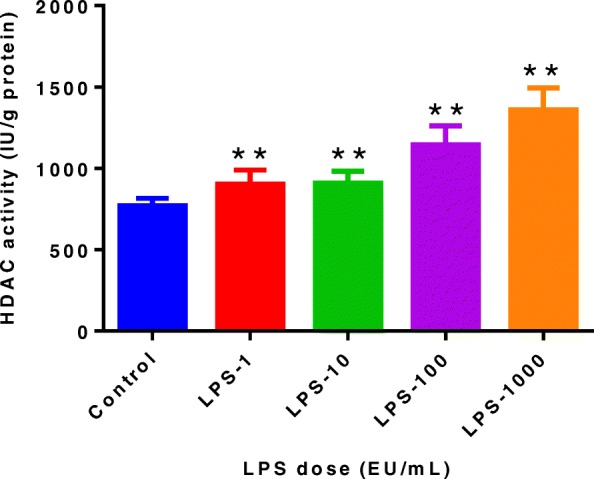
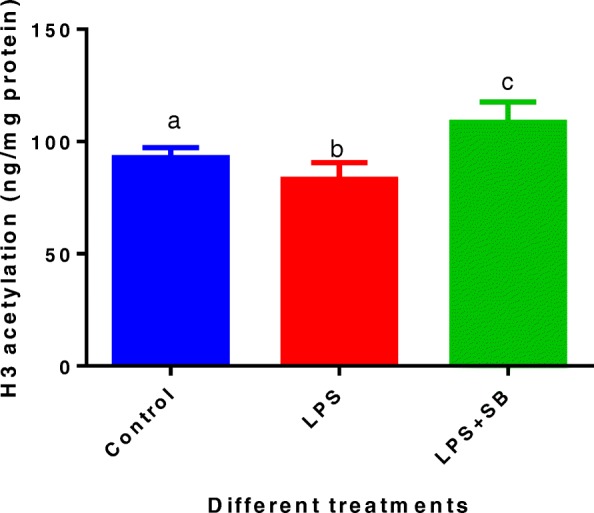
In practical production, dairy cows are frequently exposed to bacterial endotoxin (lipopolysaccharide, LPS) when they are subjected to high-concentrate diets, poor hygienic environments, as well as mastitis and metritis. Histone acetylation is an important epigenetic control of DNA transcription and a higher histone acetylation is associated with facilitated transcription. LPS might reduce histone acetylation in the mammary epithelial cells, resulting in lower transcription and mRNA expression of lactation-related genes. This study was conducted to investigate the effect of LPS on histone acetylation in bovine mammary epithelial cells and the efficacy of sodium butyrate (SB) in suppressing the endotoxin-induced adverse effect. Firstly, the bovine mammary epithelial cell line MAC-T cells were treated for 48 h with LPS at different doses of 0, 1, 10, 100, and 1000 endotoxin units (EU)/mL (1 EU = 0.1 ng), and the acetylation levels of histones H3 and H4 as well as the histone deacetylase (HDAC) activity were measured. Secondly, the MAC-T cells were treated for 48 h as follows: control, LPS (100 EU/mL), and LPS (100 EU/mL) plus SB (10 mmol/L), and the acetylation levels of histones H3 and H4 as well as milk gene mRNA expressions were determined.
The results showed that HDAC activity increased linearly with increasing LPS doses (P < 0.01). The histone H3 acetylation levels were significantly reduced by LPS, while the histone H4 acetylation levels were not affected by LPS (P > 0.05). Sodium butyrate, an inhibitor of HDAC, effectively suppressed the endotoxin-induced decline of histone H3 acetylation (P < 0.05). As a result, SB significantly enhanced the mRNA expression of lactation-related genes (P < 0.05).
The results suggest one of the adverse effects of LPS on the lactation of bovine mammary gland epithelial cells was due to decreasing histone H3 acetylation through increasing HDAC activity, whereas the endotoxin-induced adverse effects were effectively suppressed by SB.
在实际生产中,奶牛在采食高浓度日粮、处于卫生条件差的环境以及患乳腺炎和子宫炎时,经常会接触到细菌内毒素(脂多糖,LPS)。组蛋白乙酰化是DNA转录的一种重要表观遗传调控,较高的组蛋白乙酰化与转录促进相关。LPS可能会降低乳腺上皮细胞中的组蛋白乙酰化,导致与泌乳相关基因的转录和mRNA表达降低。本研究旨在探讨LPS对牛乳腺上皮细胞组蛋白乙酰化的影响以及丁酸钠(SB)抑制内毒素诱导的不良反应的效果。首先,将牛乳腺上皮细胞系MAC-T细胞用0、1、10、100和1000内毒素单位(EU)/mL(1 EU = 0.1 ng)的不同剂量LPS处理48小时,并测量组蛋白H3和H4的乙酰化水平以及组蛋白去乙酰化酶(HDAC)活性。其次,将MAC-T细胞按以下方式处理48小时:对照组、LPS(100 EU/mL)以及LPS(100 EU/mL)加SB(10 mmol/L),并测定组蛋白H3和H4的乙酰化水平以及乳基因mRNA表达。
结果表明,HDAC活性随LPS剂量增加呈线性增加(P < 0.01)。LPS显著降低了组蛋白H3的乙酰化水平,而组蛋白H4的乙酰化水平不受LPS影响(P > 0.05)。HDAC抑制剂丁酸钠有效抑制了内毒素诱导的组蛋白H3乙酰化下降(P < 0.05)。结果,SB显著增强了与泌乳相关基因的mRNA表达(P < 0.05)。
结果表明,LPS对牛乳腺上皮细胞泌乳的不良反应之一是通过增加HDAC活性降低组蛋白H3乙酰化,而SB有效抑制了内毒素诱导的不良反应。