Prisma Health - Upstate, Institute for Translational Oncology Research, 900 W. Faris Rd., 3rd Floor, Greenville, SC, 29605, USA.
Department of Medicine, Memorial Sloan-Kettering Cancer Center, New York, NY, USA.
Invest New Drugs. 2020 Jun;38(3):831-843. doi: 10.1007/s10637-019-00840-1. Epub 2019 Jul 29.
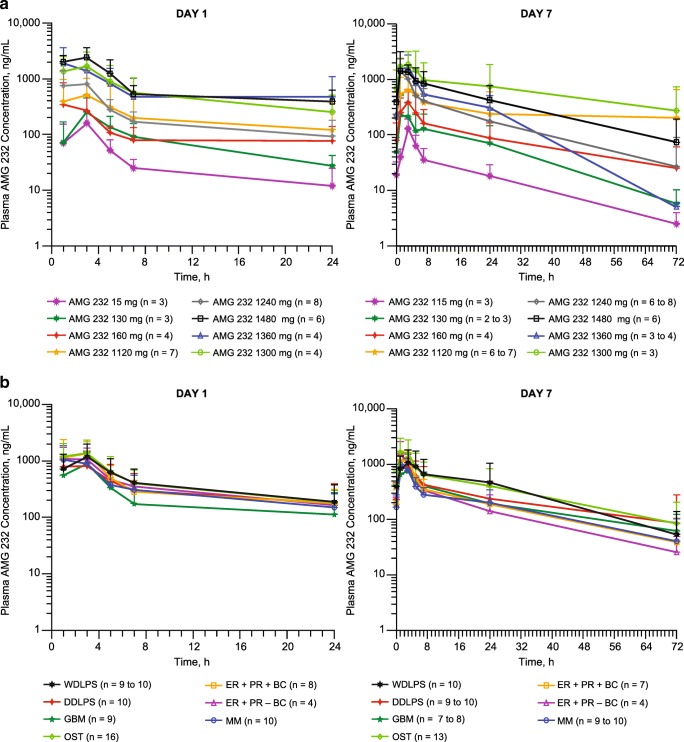
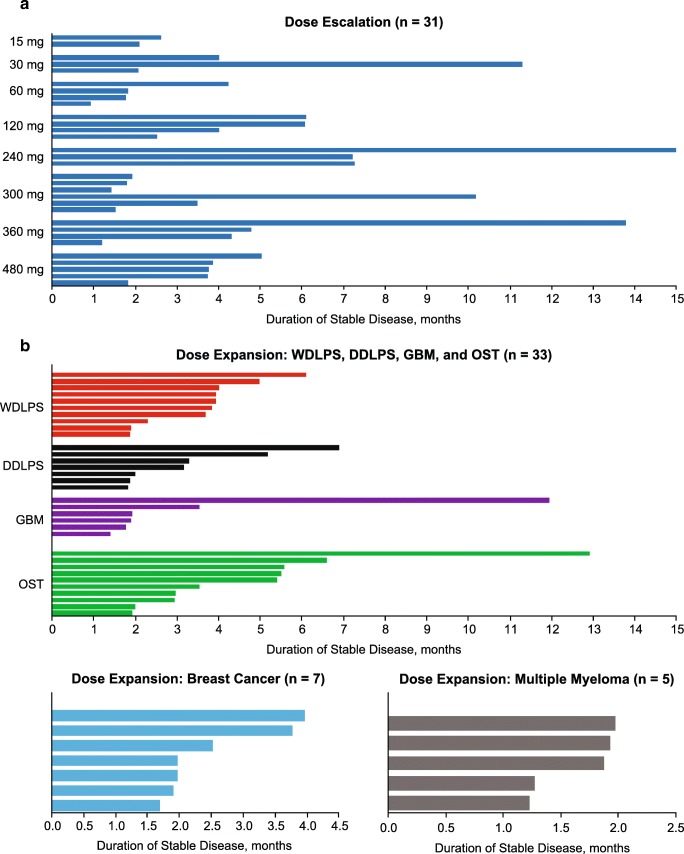
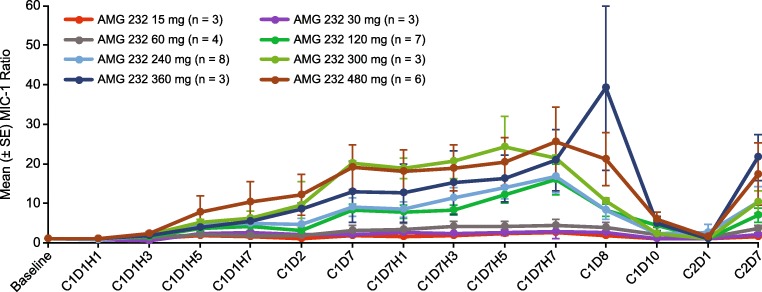
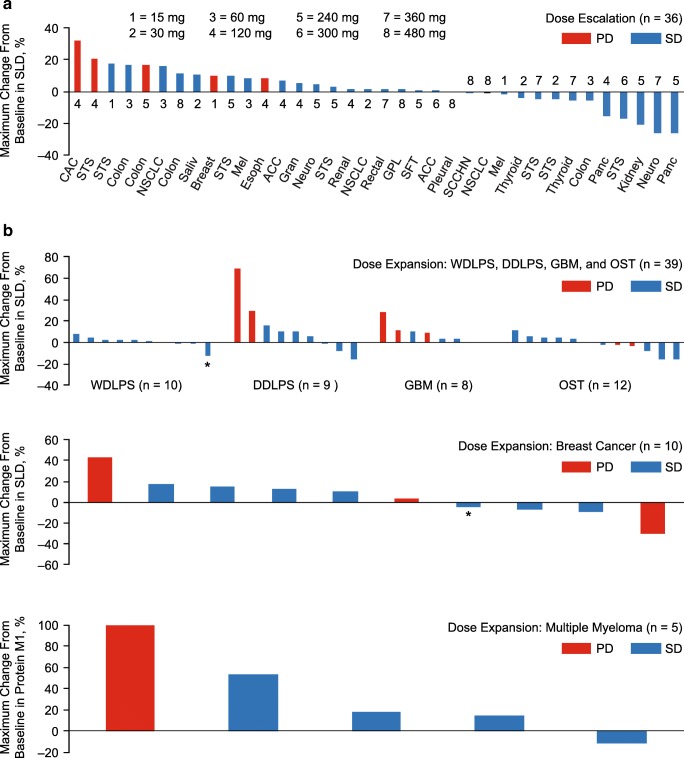
Background This open-label, first-in-human, phase 1 study evaluated AMG 232, an oral selective MDM2 inhibitor in patients with TP53 wild-type (P53WT), advanced solid tumors or multiple myeloma (MM). Methods In the dose escalation (n = 39), patients with P53WT refractory solid tumors enrolled to receive once-daily AMG 232 (15, 30, 60, 120, 240, 480, and 960 mg) for seven days every 3 weeks (Q3W). In the dose expansion (n = 68), patients with MDM2-amplified (well-differentiated and de-differentiated liposarcomas [WDLPS and DDLPS], glioblastoma multiforme [GBM], or other solid tumors [OST]), MDM2-overexpressing ER+ breast cancer (BC), or MM received AMG 232 at the maximum tolerated dose (MTD). Safety, pharmacokinetics, pharmacodynamics, and efficacy were assessed. Results AMG 232 had acceptable safety up to up to 240 mg. Three patients had dose-limiting toxicities of thrombocytopenia (n = 2) and neutropenia (n = 1). Due to these and other delayed cytopenias, AMG 232 240 mg Q3W was determined as the highest tolerable dose assessed in the dose expansion. Adverse events were typically mild/moderate and included diarrhea, nausea, vomiting, fatigue, decreased appetite, and anemia. AMG 232 plasma concentrations increased dose proportionally. Increases in serum macrophage inhibitor cytokine-1 from baseline were generally dose dependent, indicating p53 pathway activation. Per local review, there were no responses. Stable disease (durability in months) was observed in patients with WDLPS (3.9), OST (3.3), DDLPS (2.0), GBM (1.8), and BC (1.4-2.0). Conclusions In patients with P53WT advanced solid tumors or MM, AMG 232 showed acceptable safety and dose-proportional pharmacokinetics, and stable disease was observed.
这项开放标签、首次人体、1 期研究评估了 AMG 232,一种口服选择性 MDM2 抑制剂,用于 TP53 野生型(P53WT)、晚期实体瘤或多发性骨髓瘤(MM)患者。
在剂量递增(n=39)中,P53WT 难治性实体瘤患者入组接受每日一次 AMG 232(15、30、60、120、240、480 和 960mg),每 3 周(Q3W)用药 7 天。在剂量扩展(n=68)中,MDM2 扩增(高分化和去分化脂肪肉瘤[WDLPS 和 DDLPS]、胶质母细胞瘤[GBM]或其他实体瘤[OST])、MDM2 过表达 ER+乳腺癌(BC)或 MM 患者接受 AMG 232 的最大耐受剂量(MTD)。评估安全性、药代动力学、药效学和疗效。
AMG 232 最高达 240mg 时安全性可接受。3 例患者出现血小板减少症(2 例)和中性粒细胞减少症(1 例)的剂量限制性毒性。由于这些和其他延迟性细胞减少症,AMG 232 240mg Q3W 被确定为在剂量扩展中评估的最高耐受剂量。不良事件通常为轻度/中度,包括腹泻、恶心、呕吐、疲劳、食欲下降和贫血。AMG 232 血浆浓度呈剂量依赖性增加。与基线相比,血清巨噬细胞抑制细胞因子-1 的增加通常与剂量相关,表明 p53 通路的激活。根据局部评估,没有反应。在 WDLPS(3.9 个月)、OST(3.3 个月)、DDLPS(2.0 个月)、GBM(1.8 个月)和 BC(1.4-2.0 个月)患者中观察到疾病稳定(持续时间以月计)。
在 P53WT 晚期实体瘤或 MM 患者中,AMG 232 表现出可接受的安全性和与剂量成比例的药代动力学特征,观察到疾病稳定。