From the, Department of Pharmaceutical Outcomes and Policy, University of Florida College of Pharmacy, Gainesville, FL, USA.
Division of Gastroenterology and Hepatology, Stanford University Medical Center, Palo Alto, CA, USA.
J Intern Med. 2019 Dec;286(6):711-722. doi: 10.1111/joim.12964. Epub 2019 Aug 23.
As the prevalence of nonalcoholic fatty liver disease (NAFLD) escalates, understanding its potential impact on the development of chronic kidney disease (CKD) is needed.
To determine the longitudinal association of NAFLD with the development of advanced CKD in the United States.
A retrospective cohort analysis of the Truven Health MarketScan Database (2006-2015) was conducted. We used Cox proportional hazards models to compare the risk of developing CKD stages 3-5 in patients with NAFLD versus non-NAFLD, identified by ICD-9 codes, after 1:3 propensity score (PS) matching.
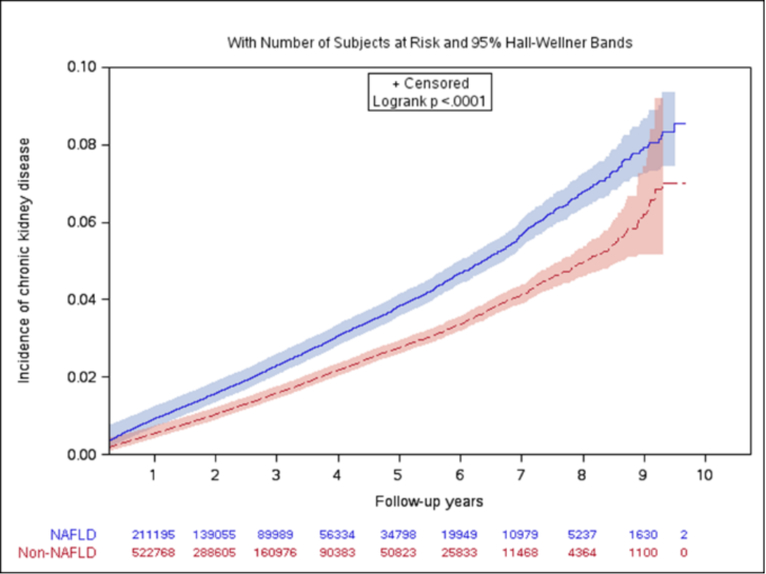
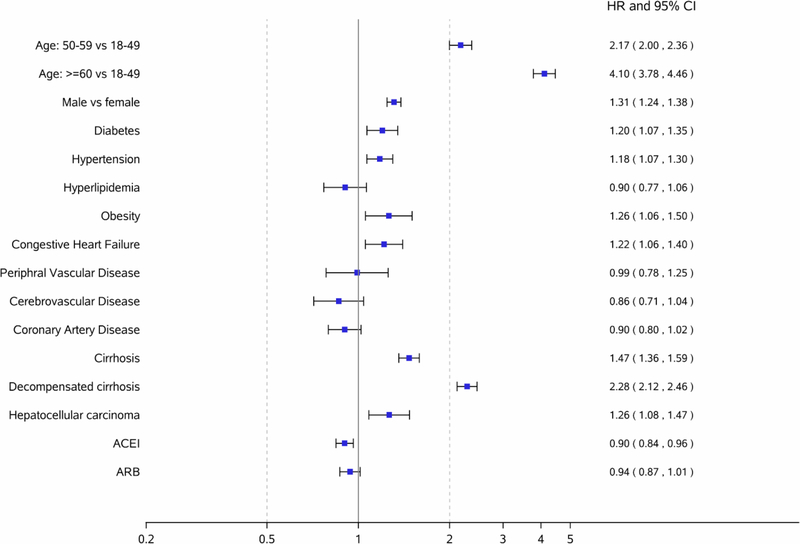
In a cohort of 262 619 newly diagnosed patients with NAFLD and 769 878 PS (1:3)-matched non-NAFLD patients, we identified 5766 and 8655 new advanced (stage 3-5) CKD cases, respectively. The crude CKD incidence rate was 8.2 and 5.5 per 1000 person-years in NAFLD and non-NAFLD groups, respectively. In multivariable Cox model, patients with NAFLD had a 41% increased risk of developing advanced CKD compared with non-NAFLD patients [adjusted hazard ratio (aHR), 1.41; 95% confidence interval (CI), 1.36-1.46]. In the sensitivity analysis adjusting for time-varying covariates after NAFLD diagnosis, NAFLD persisted as a significant CKD risk factor (aHR, 1.58; 95% CI, 1.52-1.66) and the association remained significant when stratified by age, gender and pre-existing comorbidities. The risk of CKD increased in NAFLD with compensated cirrhosis (aHR, 1.47; 95% CI, 1.36-1.59) and decompensated cirrhosis (aHR, 2.28; 95% CI, 2.12-2.46).
Nonalcoholic fatty liver disease was independently associated with an increased risk of advanced CKD development suggesting renal function screening and regular monitoring are needed in this population.
随着非酒精性脂肪性肝病(NAFLD)的患病率不断上升,了解其对慢性肾脏病(CKD)发展的潜在影响是必要的。
在美国,确定 NAFLD 与进展性 CKD 发展之间的纵向关联。
对 Truven Health MarketScan 数据库(2006-2015 年)进行回顾性队列分析。我们使用 Cox 比例风险模型比较了通过 ICD-9 代码识别的 NAFLD 患者与非 NAFLD 患者在 1:3 倾向评分(PS)匹配后,发生 CKD 3-5 期的风险。
在 262619 例新诊断的 NAFLD 患者和 769878 例 PS(1:3)匹配的非 NAFLD 患者的队列中,我们分别确定了 5766 例和 8655 例新的晚期(3-5 期)CKD 病例。NAFLD 组和非 NAFLD 组的粗 CKD 发生率分别为 8.2 和 5.5/1000 人年。在多变量 Cox 模型中,与非 NAFLD 患者相比,NAFLD 患者发生晚期 CKD 的风险增加了 41%[校正风险比(aHR),1.41;95%置信区间(CI),1.36-1.46]。在 NAFLD 诊断后调整时变协变量的敏感性分析中,NAFLD 仍然是 CKD 的一个重要危险因素(aHR,1.58;95%CI,1.52-1.66),并且当按年龄、性别和预先存在的合并症分层时,这种关联仍然显著。在代偿性肝硬化(aHR,1.47;95%CI,1.36-1.59)和失代偿性肝硬化(aHR,2.28;95%CI,2.12-2.46)中,CKD 的风险随着 NAFLD 的增加而增加。
非酒精性脂肪性肝病与晚期 CKD 发展风险增加独立相关,提示该人群需要进行肾功能筛查和定期监测。