Huang Hongyan, Yang Xinglong, Liu Ling, Xu Yanming
Department of Neurology, West China Hospital, Sichuan University, Sichuan Province, PR China.
Department of Geriatric Neurology, The First Affiliated Hospital of Kunming Medical University, Kunming, Yunnan, PR China.
Ann Indian Acad Neurol. 2019 Jul-Sep;22(3):325-327. doi: 10.4103/aian.AIAN_34_18.
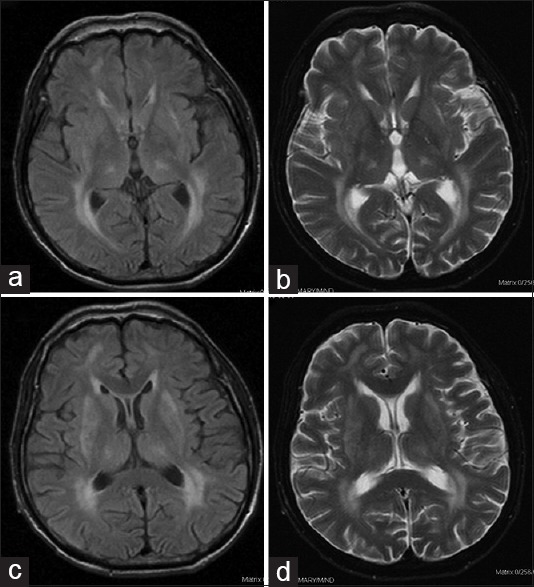
Mitochondrial neurogastrointestinal encephalomyopathy (MNGIE) syndrome, caused by mutations in the thymidine phosphorylase gene, manifests as a multisystemic disorder characterized by severe gastrointestinal dysmotility, cachexia, ptosis and ophthalmoparesis, peripheral neuropathy, and leukoencephalopathy. These clinical manifestations, with the exception of leukoencephalopathy, are mimicked by MNGIE-like syndrome, linked to polymerase-gamma () gene. Here, we report a 49-year-old Chinese man with MNGIE-like syndrome involved leukoencephalopathy and was associated with novel mutations. This case expands the clinical spectrum of MNGIE-like syndrome.
线粒体神经胃肠性脑肌病(MNGIE)综合征由胸苷磷酸化酶基因突变引起,表现为一种多系统疾病,其特征为严重的胃肠动力障碍、恶病质、上睑下垂和眼肌麻痹、周围神经病变以及白质脑病。除白质脑病外,这些临床表现与聚合酶γ()基因突变相关的MNGIE样综合征相似。在此,我们报告一名49岁的中国男性,患有伴有白质脑病的MNGIE样综合征,并与新的突变相关。该病例扩展了MNGIE样综合征的临床谱。