Bencivenga F, Mincigrucci R, Capotondi F, Foglia L, Naumenko D, Maznev A A, Pedersoli E, Simoncig A, Caporaletti F, Chiloyan V, Cucini R, Dallari F, Duncan R A, Frazer T D, Gaio G, Gessini A, Giannessi L, Huberman S, Kapteyn H, Knobloch J, Kurdi G, Mahne N, Manfredda M, Martinelli A, Murnane M, Principi E, Raimondi L, Spampinati S, Spezzani C, Trovò M, Zangrando M, Chen G, Monaco G, Nelson K A, Masciovecchio C
Elettra Sincrotrone Trieste S.C.p.A., Strada Statale 14, km 163.5, 34149 Basovizza (TS), Italy.
Massachusetts Institute of Technology, 77 Massachusetts Avenue, Cambridge, MA 02139, USA.
Sci Adv. 2019 Jul 26;5(7):eaaw5805. doi: 10.1126/sciadv.aaw5805. eCollection 2019 Jul.
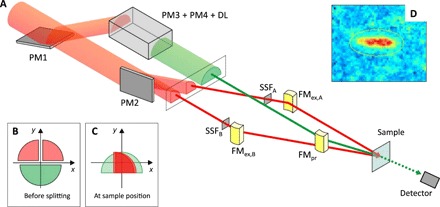
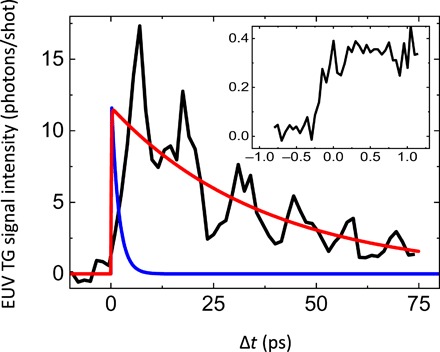
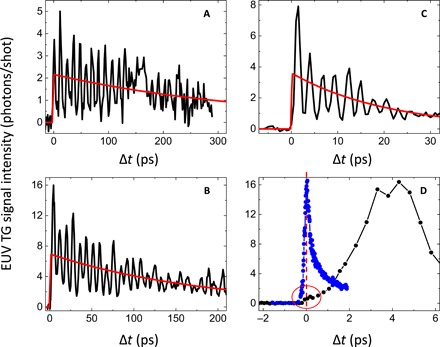
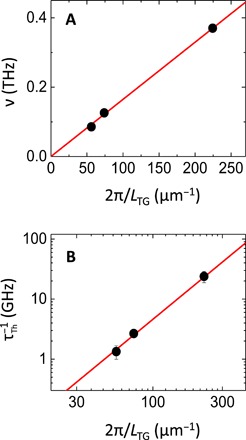
Advances in developing ultrafast coherent sources operating at extreme ultraviolet (EUV) and x-ray wavelengths allow the extension of nonlinear optical techniques to shorter wavelengths. Here, we describe EUV transient grating spectroscopy, in which two crossed femtosecond EUV pulses produce spatially periodic nanoscale excitations in the sample and their dynamics is probed via diffraction of a third time-delayed EUV pulse. The use of radiation with wavelengths down to 13.3 nm allowed us to produce transient gratings with periods as short as 28 nm and observe thermal and coherent phonon dynamics in crystalline silicon and amorphous silicon nitride. This approach allows measurements of thermal transport on the ~10-nm scale, where the two samples show different heat transport regimes, and can be applied to study other phenomena showing nontrivial behaviors at the nanoscale, such as structural relaxations in complex liquids and ultrafast magnetic dynamics.
在开发工作于极紫外(EUV)和X射线波长的超快相干光源方面取得的进展,使得非线性光学技术能够拓展到更短的波长。在此,我们描述了EUV瞬态光栅光谱学,其中两个交叉的飞秒EUV脉冲在样品中产生空间周期性的纳米级激发,并且通过第三个延迟的EUV脉冲的衍射来探测其动力学。使用波长低至13.3 nm的辐射使我们能够产生周期短至28 nm的瞬态光栅,并观察晶体硅和非晶硅氮化物中的热声子和相干声子动力学。这种方法能够在约10纳米尺度上测量热传输,在该尺度下两个样品表现出不同的热传输机制,并且可应用于研究其他在纳米尺度上表现出非平凡行为的现象,例如复杂液体中的结构弛豫和超快磁动力学。