Holmes Jordan A, Zagar Timothy M, Chen Ronald C
Department of Radiation Oncology, University of North Carolina at Chapel Hill, Chapel Hill, NC (JAH, TMZ, RCC); University of North Carolina-Lineberger Comprehensive Cancer Center, Chapel Hill, NC (RCC); Sheps Center for Health Services Research, University of North Carolina at Chapel Hill, Chapel Hill, NC (RCC).
JNCI Cancer Spectr. 2017 Oct 12;1(1):pkx003. doi: 10.1093/jncics/pkx003. eCollection 2017 Sep.
Stereotactic body radiotherapy (SBRT) is a treatment option for stage I non-small cell lung cancer (NSCLC), providing a potentially curative therapy for patients who are nonsurgical candidates. This study describes the adoption of SBRT vs other treatment options across the United States, as well as commonly used dose-fractionation regimens.
We analyzed patients in the National Cancer Data Base. A total of 107 233 stage IA NSCLC patients diagnosed from 2008 to 2013 were included. We described the proportions of patients who received different surgical and radiation treatment options by year. A multivariable model was constructed to assess factors associated with patients receiving SBRT. In patients who received SBRT, we described the proportion of patients who received common dose/fractionation regimens.
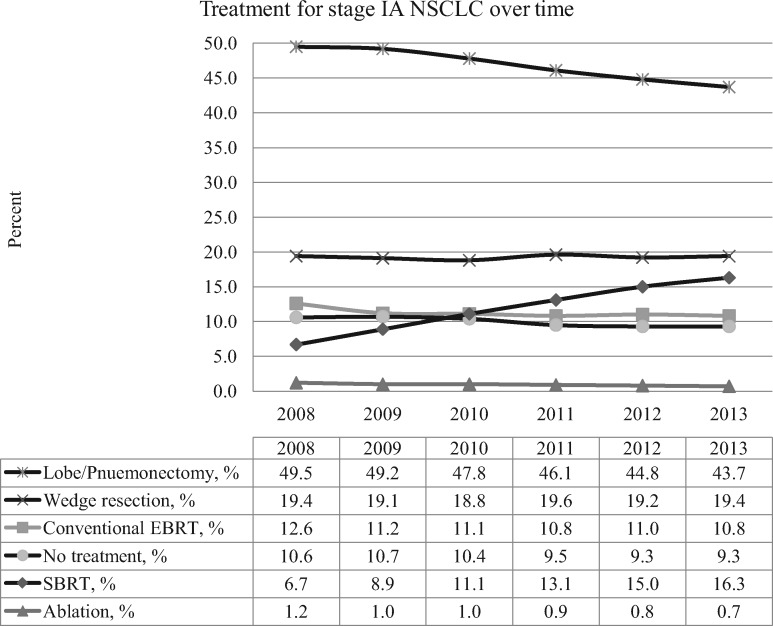
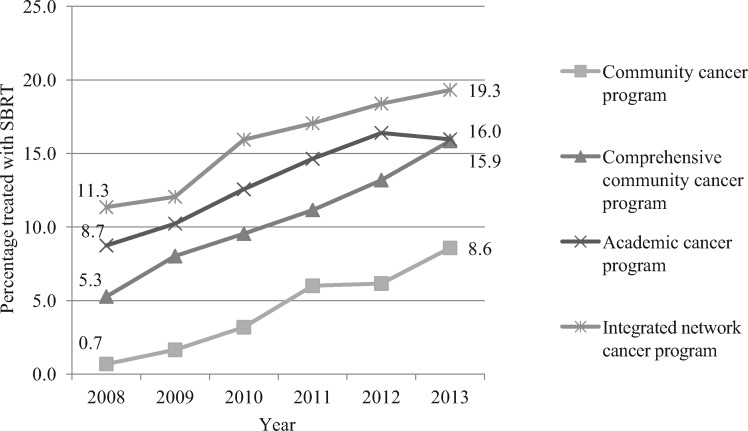
Use of SBRT increased from 6.7% to 16.3% from 2008 to 2013, with a corresponding decrease in lobectomy/pneumonectomy (49.5% to 43.7%). The rates of wedge resection, conventional radiotherapy, and no treatment remained relatively constant. Adoption of SBRT was lowest in small community centers (8.6% of patients by 2013). On multivariable analysis, older age and treatment at larger centers were associated with higher SBRT receipt, and black race and higher comorbidity were associated with lower SBRT receipt. There was statistically significant geographic variation. Common SBRT schemes were 10 Gy × 5 (19%), 18-20 Gy × 3 (31%), and 12 Gy × 4 (16%).
SBRT adoption has been modest over time and has not substantially replaced less curative treatments. Lack of access to this technology in smaller cancer centers may have partly contributed to the slow adoption.
立体定向体部放疗(SBRT)是I期非小细胞肺癌(NSCLC)的一种治疗选择,为不适合手术的患者提供了一种潜在的治愈性疗法。本研究描述了SBRT在美国与其他治疗选择相比的采用情况,以及常用的剂量分割方案。
我们分析了国家癌症数据库中的患者。纳入了2008年至2013年诊断的107233例IA期NSCLC患者。我们按年份描述了接受不同手术和放射治疗选择的患者比例。构建了一个多变量模型来评估与接受SBRT的患者相关的因素。在接受SBRT的患者中,我们描述了接受常见剂量/分割方案的患者比例。
2008年至2013年,SBRT的使用从6.7%增加到16.3%,相应地肺叶切除术/全肺切除术的比例从49.5%下降到43.7%。楔形切除术、传统放疗和未治疗的比例保持相对稳定。小型社区中心采用SBRT的比例最低(到2013年为患者的8.6%)。多变量分析显示,年龄较大和在较大中心接受治疗与接受SBRT的比例较高相关,黑人种族和较高的合并症与接受SBRT的比例较低相关。存在统计学上显著的地理差异。常见的SBRT方案为10 Gy×5(19%)、18 - 20 Gy×3(31%)和12 Gy×4(16%)。
随着时间的推移,SBRT的采用情况一般,并未大量取代疗效较差的治疗方法。较小的癌症中心无法获得该技术可能部分导致了采用缓慢。