Division of Renal Medicine, Department of Clinical Science, Intervention and Technology, Karolinska Institutet, Stockholm, Sweden.
Department of Medical Epidemiology and Biostatistics, Karolinska Institutet, Stockholm, Sweden.
Nephrol Dial Transplant. 2020 Nov 1;35(11):1908-1915. doi: 10.1093/ndt/gfz142.
People undergoing maintenance dialysis are at high risk for fractures, but less is known about fracture incidence and associated outcomes in earlier stages of chronic kidney disease (CKD).
We conducted an observational analysis from the Stockholm Creatinine Measurement project, a Swedish health care utilization cohort during 2006-11. We identified all adults with confirmed CKD Stages 3-5 and no documented history of fractures and extracted information on comorbid history, ongoing medication, cardiovascular events and death. We studied incidence rates of fractures (overall and by location), with the estimated glomerular filtration rate (eGFR) as time-dependent exposure. We then studied hazard ratios [HRs and 95% confidence intervals (CIs)] for the events of death and major adverse cardiac events (MACE) using Cox regression with fracture as time-varying exposure.
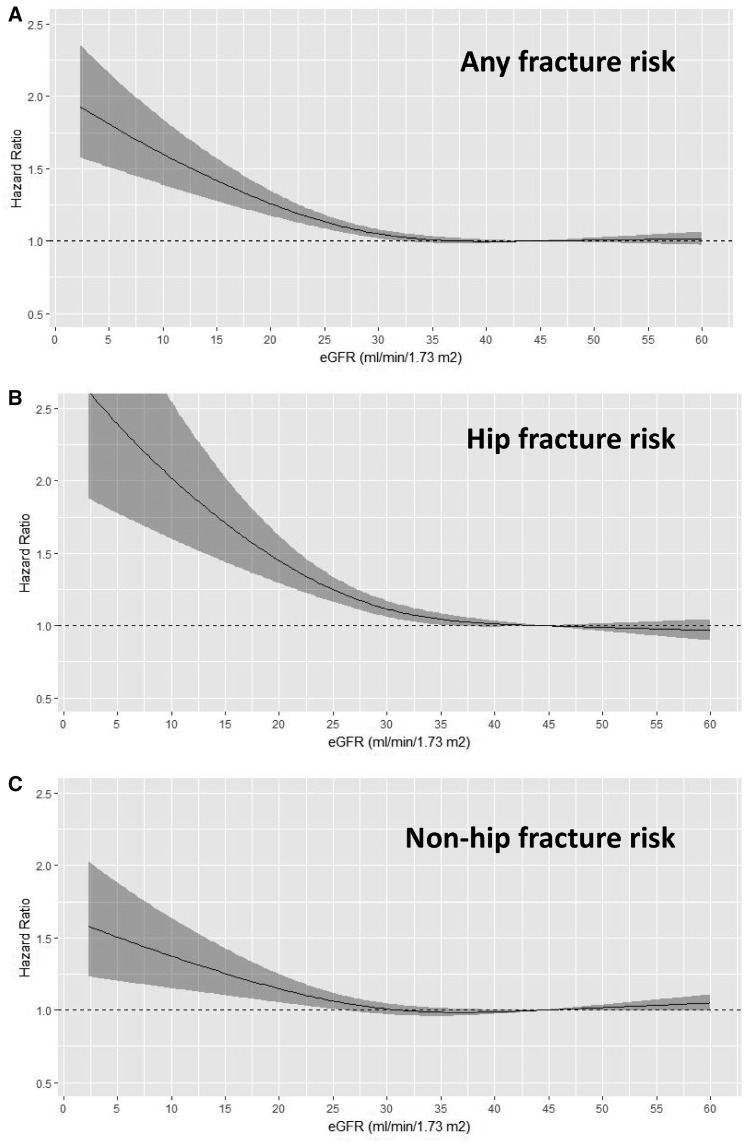
We identified 68 764 individuals with confirmed CKD (mean age 79 years, 56% women). During a median follow-up of 2.7 years, 9219 fractures occurred, of which 3105 were hip fractures. A more severe CKD stage was associated with a higher risk of fractures, particularly hip fractures: compared with CKD Stage 3a, the adjusted HR was 1.10 (95% CI 1.02-1.19), 1.32 (1.17-1.49) and 2.47 (1.94-3.15) for CKD Stage 3b, 4 and 5, respectively. Spline curves suggested a linear association with fracture risk with an eGFR <30 mL/min/1.73 m2. Compared with non-fracture periods, incident fracture was associated with a 4-fold increased mortality within 90 days [HR 4.21 (95% CI 3.95-4.49)]. The risk remained elevated beyond 90 days [HR 1.47 (95% CI 1.40-1.54)] and was stronger after hip fractures. Post-fracture MACE risk was also highest in the first 90 days [HR 4.02 (95% CI 3.73-4.33)], particularly after hip fractures, and persisted beyond 90 days [HR 1.20 (95% CI 1.10-1.30)].
Our findings highlight the commonness of fractures and the increased risk for subsequent adverse outcomes in CKD patients. These results may inform clinical decisions regarding post-fracture clinical surveillance and fracture prevention strategies.
接受维持性透析的患者骨折风险较高,但对于慢性肾脏病(CKD)早期阶段的骨折发生率和相关结局知之甚少。
我们对 2006 年至 2011 年期间瑞典医疗保健利用队列中的斯德哥尔摩肌酐测量项目进行了一项观察性分析。我们确定了所有患有确诊的 CKD 3-5 期且无骨折病史的成年人,并提取了合并症病史、正在使用的药物、心血管事件和死亡的信息。我们研究了骨折的发生率(总体和按部位),以估计肾小球滤过率(eGFR)作为时间依赖性暴露。然后,我们使用骨折作为时变暴露的 Cox 回归研究了死亡和主要不良心脏事件(MACE)的风险比(HR 和 95%置信区间[CI])。
我们确定了 68764 名患有确诊 CKD 的个体(平均年龄 79 岁,56%为女性)。在中位随访 2.7 年后,发生了 9219 例骨折,其中 3105 例为髋部骨折。更严重的 CKD 阶段与更高的骨折风险相关,特别是髋部骨折:与 CKD 3a 期相比,调整后的 HR 分别为 1.10(95%CI 1.02-1.19)、1.32(1.17-1.49)和 2.47(1.94-3.15),CKD 3b、4 和 5 期分别为 1.32(1.17-1.49)和 2.47(1.94-3.15)。样条曲线表明与骨折风险呈线性关联,eGFR<30mL/min/1.73m2。与非骨折期相比,骨折发生后 90 天内的死亡率增加了 4 倍[HR 4.21(95%CI 3.95-4.49)]。90 天后风险仍然升高[HR 1.47(95%CI 1.40-1.54)],髋部骨折后风险更高。骨折后 90 天内的 MACE 风险也最高[HR 4.02(95%CI 3.73-4.33)],特别是髋部骨折后,并且在 90 天后仍然持续[HR 1.20(95%CI 1.10-1.30)]。
我们的研究结果突出了 CKD 患者骨折的常见性和随后发生不良结局的风险增加。这些结果可能为骨折后的临床监测和骨折预防策略提供临床决策依据。