Pontifícia Universidade Católica do Paraná (PUC-PR), Escola de Medicina, Curitiba, PR, Brazil.
Hospital Pequeno Príncipe, Centro de Gastroenterologia Pediátrica, Curitiba, PR, Brazil.
J Pediatr (Rio J). 2020 Sep-Oct;96(5):638-643. doi: 10.1016/j.jped.2019.05.005. Epub 2019 Jul 27.
To compare endoscopic and histologic features of pediatric patients with eosinophilic esophagitis (EoE) responding to proton pump inhibitor (PPI) to those not responding to PPI.
Endoscopic reports and photographs of patients with symptoms of esophageal dysfunction and ≥15 eosinophils per high-powered field (eos/hpf) in esophageal biopsies prior to PPI trial were reviewed. Patients were classified as responsive to PPI (PPIREoE) or non-responsive to PPI (PPINREoE) according to response totreatment (<15 eos/hpf) at second endoscopy after 8 weeks.
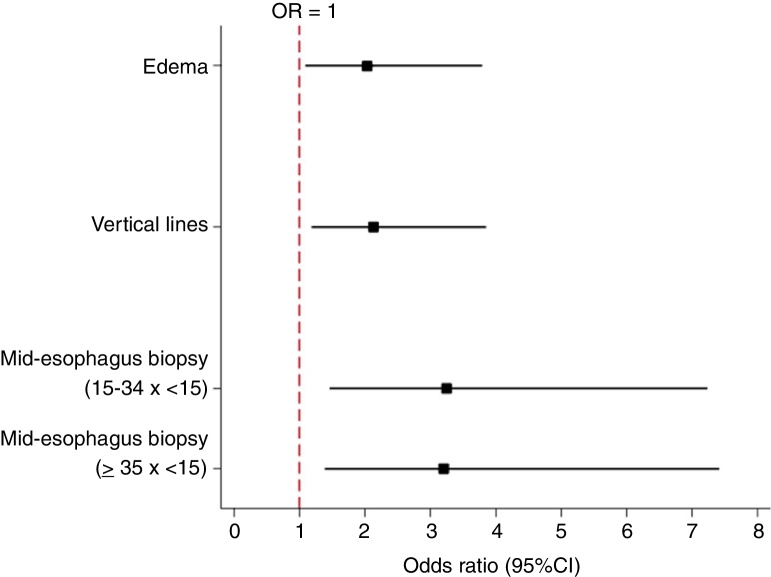
Of the 231 patients (72.3% male), 64 (27.7%) were responsive to the proton pump inhibitors. Edema (77.3% vs. 62.5%, p=0.031) and vertical lines (69.5% vs. 51.6%, p=0.014) were more frequent in PPINREoE patients. An eosinophil count in the mid-esophagus ≥ 35 eos/HPF (25.1% vs. 12.5%) was more frequent in these patients (p=0.001). Those with eosinophil count < 15 eos/HPF in the mid-esophagus at the first endoscopy were more likely to respond to treatment with proton pump inhibitors compared to patients with 15-34 eos/HPF (p=0.004, OR: 3.26, 95% CI: 1.46-7.24) and to patients with ≥ 35 eos/HPF (p=0.006, OR: 3.20, 95% CI: 1.39-7.41).
Edema and vertical lines at the endoscopy and a higher eosinophil count in the mid-esophagus were more frequent in patients who were non-responsive to proton pump inhibitors. As there were no significant differences in the other findings between the groups, it cannot be affirmed that these characteristics are sufficient to differentiate between PPINREoE and PPIREoE patients.
比较质子泵抑制剂(PPI)治疗反应良好和反应不佳的儿童嗜酸性食管炎(EoE)患者的内镜和组织学特征。
回顾了食管功能障碍症状和 PPI 试验前食管活检中每高倍镜视野(hpf)≥15 个嗜酸性粒细胞(eos/hpf)的患者的内镜报告和照片。根据第二次内镜检查后 8 周的治疗反应(<15 eos/hpf),将患者分为 PPI 治疗反应良好(PPIREoE)或反应不佳(PPINREoE)。
在 231 名患者(72.3%为男性)中,64 名(27.7%)对质子泵抑制剂有反应。PPINREoE 患者的食管水肿(77.3%比 62.5%,p=0.031)和垂直条纹(69.5%比 51.6%,p=0.014)更为常见。食管中段嗜酸性粒细胞计数≥35 eos/HPF(25.1%比 12.5%)的患者更为常见(p=0.001)。第一次内镜检查时食管中段嗜酸性粒细胞计数<15 eos/HPF 的患者与 15-34 eos/HPF 的患者(p=0.004,OR:3.26,95%CI:1.46-7.24)和≥35 eos/HPF 的患者(p=0.006,OR:3.20,95%CI:1.39-7.41)相比,更有可能对质子泵抑制剂治疗有反应。
对质子泵抑制剂反应不佳的患者内镜下表现为食管水肿和垂直条纹,食管中段嗜酸性粒细胞计数较高。由于两组之间在其他发现方面没有显著差异,因此不能肯定这些特征足以区分 PPINREoE 和 PPIREoE 患者。