Department of Molecular Endocrinology and Neurochemistry, I.M. Sechenov Institute of Evolutionary Physiology and Biochemistry of the Russian Academy of Sciences, Thorez avenue, 44, Saint-Petersburg 194223, Russia.
Int J Mol Sci. 2019 Jul 29;20(15):3702. doi: 10.3390/ijms20153702.
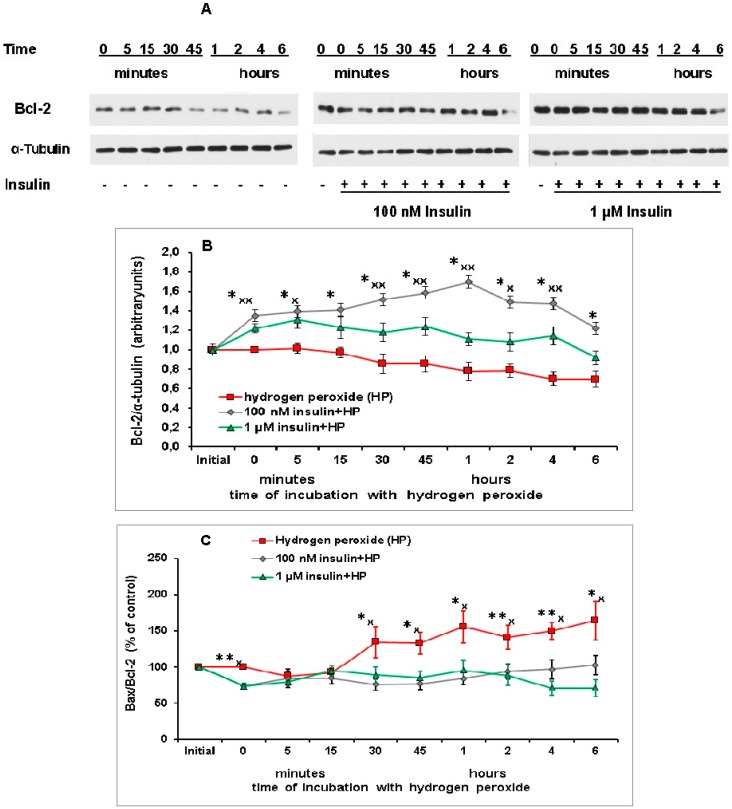
Insulin is a promising drug for the treatment of diseases associated with brain damage. However, the mechanism of its neuroprotective action is far from being understood. Our aim was to study the insulin-induced protection of cortical neurons in oxidative stress and its mechanism. Immunoblotting, flow cytometry, colorimetric, and fluorometric techniques were used. The insulin neuroprotection was shown to depend on insulin concentration in the nanomolar range. Insulin decreased the reactive oxygen species formation in neurons. The insulin-induced modulation of various protein kinase activities was studied at eight time-points after neuronal exposure to prooxidant (hydrogen peroxide). In prooxidant-exposed neurons, insulin increased the phosphorylation of GSK-3beta at Ser (thus inactivating it), which resulted from Akt activation. Insulin activated ERK1/2 in neurons 5-30 min after cell exposure to prooxidant. Hydrogen peroxide markedly activated AMPK, while it was for the first time shown that insulin inhibited it in neurons at periods of the most pronounced activation by prooxidant. Insulin normalized Bax/Bcl-2 ratio and mitochondrial membrane potential in neurons in oxidative stress. The inhibitors of the PI3K/Akt and MEK1/2/ERK1/2 signaling pathways and the AMPK activator reduced the neuroprotective effect of insulin. Thus, the protective action of insulin on cortical neurons in oxidative stress appear to be realized to a large extent through activation of Akt and ERK1/2, GSK-3beta inactivation, and inhibition of AMPK activity increased by neuronal exposure to prooxidant.
胰岛素是一种有前途的治疗与脑损伤相关疾病的药物。然而,其神经保护作用的机制还远未被理解。我们的目的是研究胰岛素在氧化应激下对皮质神经元的保护作用及其机制。我们使用了免疫印迹、流式细胞术、比色法和荧光法技术。研究表明,胰岛素的神经保护作用依赖于纳摩尔范围内的胰岛素浓度。胰岛素可减少神经元中活性氧的形成。在神经元暴露于促氧化剂(过氧化氢)后 8 个时间点研究了胰岛素对各种蛋白激酶活性的诱导调节作用。在促氧化剂暴露的神经元中,胰岛素增加了 GSK-3β 在丝氨酸(从而使其失活)的磷酸化,这是由 Akt 的激活引起的。胰岛素在神经元暴露于促氧化剂后 5-30 分钟内激活了 ERK1/2。过氧化氢显著激活了 AMPK,而首次表明在促氧化剂最明显激活的时期,胰岛素抑制了神经元中的 AMPK。胰岛素可使氧化应激中的神经元 Bax/Bcl-2 比值和线粒体膜电位正常化。PI3K/Akt 和 MEK1/2/ERK1/2 信号通路的抑制剂和 AMPK 激活剂降低了胰岛素的神经保护作用。因此,胰岛素对氧化应激中皮质神经元的保护作用在很大程度上是通过激活 Akt 和 ERK1/2、GSK-3β失活以及抑制神经元暴露于促氧化剂后 AMPK 活性增加来实现的。