Craft Suzanne, Claxton Amy, Baker Laura D, Hanson Angela J, Cholerton Brenna, Trittschuh Emily H, Dahl Deborah, Caulder Erin, Neth Bryan, Montine Thomas J, Jung Youngkyoo, Maldjian Joseph, Whitlow Christopher, Friedman Seth
Department of Internal Medicine, Wake Forest School of Medicine, Winston-Salem, NC, USA.
Alkermes, Inc., Waltham, MA, USA.
J Alzheimers Dis. 2017;57(4):1325-1334. doi: 10.3233/JAD-161256.
Long acting insulin detemir administered intranasally for three weeks enhanced memory for adults with Alzheimer's disease dementia (AD) or amnestic mild cognitive impairment (MCI). The investigation of longer-term administration is necessary to determine whether benefits persist, whether they are similar to benefits provided by regular insulin, and whether either form of insulin therapy affects AD biomarkers.
The present study aimed to determine whether four months of treatment with intranasal insulin detemir or regular insulin improves cognition, daily functioning, and AD biomarkers for adults with MCI or AD.
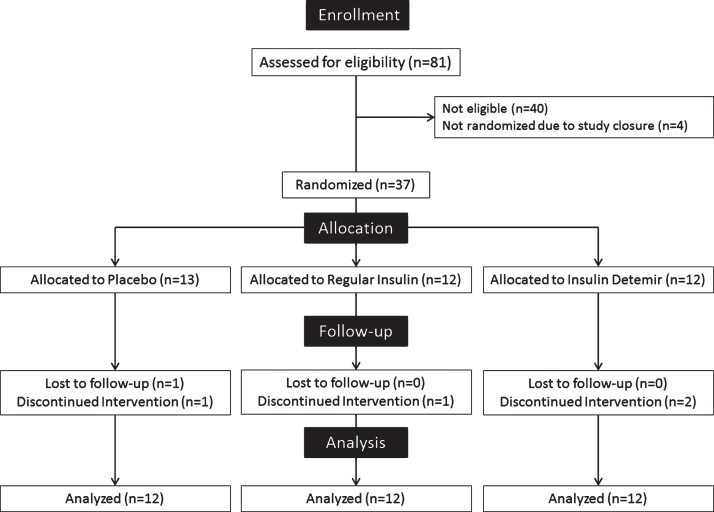
This randomized, double-blind, placebo-controlled trial included an intent-to-treat sample consisting of 36 adults diagnosed with MCI or mild to moderate AD. Participants received placebo (n = 12), 40 IU of insulin detemir (n = 12), or 40 IU of regular insulin (n = 12) daily for four months, administered with a nasal delivery device. A cognitive battery was administered at baseline and after two and four months of treatment. MRI was administered for all participants and lumbar puncture for a subset (n = 20) at baseline and four months. The primary outcome was change from baseline to four months on a memory composite (sum of Z scores for delayed list and story recall). Secondary outcomes included: global cognition (Alzheimer's Disease Assessment Scale-Cognition), daily functioning (Dementia Severity Rating Scale), MRI volume changes in AD-related regions of interest, and cerebrospinal fluid AD markers.
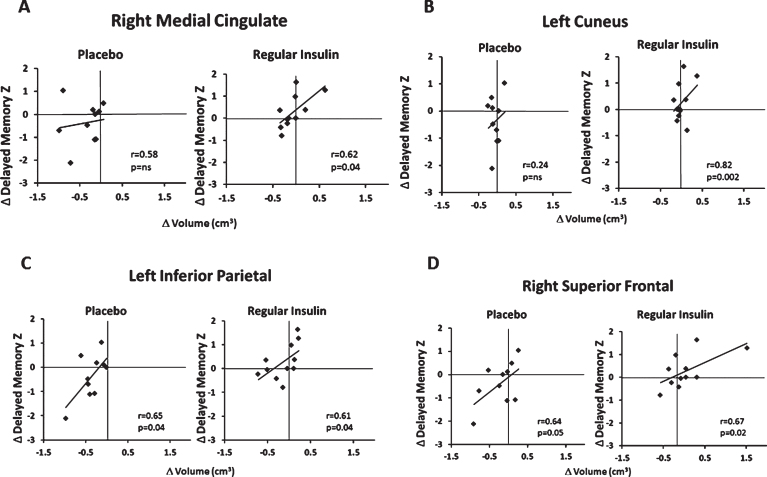
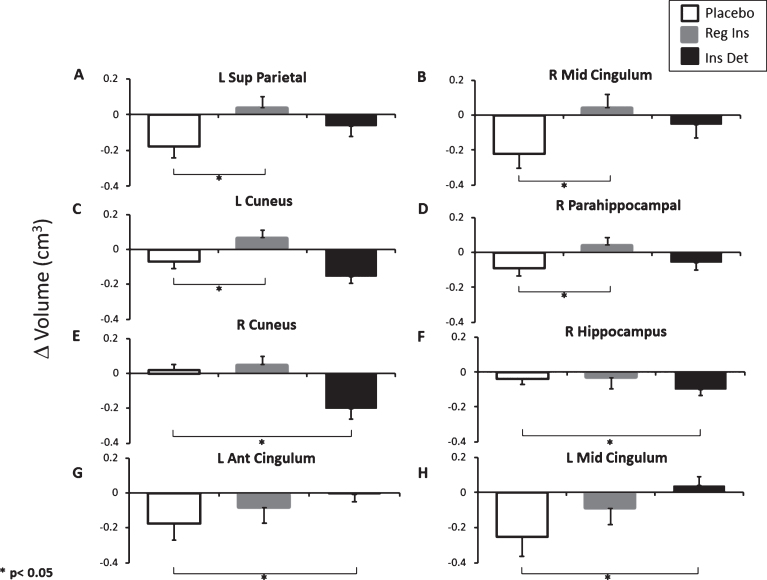
The regular insulin treated group had better memory after two and four months compared with placebo (p < 0.03). No significant effects were observed for the detemir-assigned group compared with the placebo group, or for daily functioning for either group. Regular insulin treatment was associated with preserved volume on MRI. Regular insulin treatment was also associated with reduction in the tau-P181/Aβ42 ratio.
Future research is warranted to examine the mechanistic basis of treatment differences, and to further assess the efficacy and safety of intranasal insulin.
对于患有阿尔茨海默病痴呆(AD)或遗忘型轻度认知障碍(MCI)的成年人,鼻内注射长效胰岛素地特胰岛素三周可增强记忆力。有必要进行长期给药研究,以确定益处是否持续存在、是否与常规胰岛素提供的益处相似,以及两种胰岛素治疗形式是否会影响AD生物标志物。
本研究旨在确定鼻内注射胰岛素地特胰岛素或常规胰岛素四个月是否能改善患有MCI或AD的成年人的认知、日常功能及AD生物标志物。
这项随机、双盲、安慰剂对照试验纳入了36名被诊断为MCI或轻度至中度AD的成年人作为意向性治疗样本。参与者每天接受安慰剂(n = 12)、40 IU胰岛素地特胰岛素(n = 12)或40 IU常规胰岛素(n = 12)治疗,为期四个月,通过鼻内给药装置给药。在基线以及治疗两个月和四个月后进行认知测试。所有参与者在基线和四个月时均接受了MRI检查,部分参与者(n = 20)在基线和四个月时进行了腰椎穿刺。主要结局是记忆综合评分(延迟列表和故事回忆的Z评分总和)从基线到四个月的变化。次要结局包括:整体认知(阿尔茨海默病评估量表 - 认知部分)、日常功能(痴呆严重程度评定量表)、AD相关感兴趣区域的MRI体积变化以及脑脊液AD标志物。
与安慰剂相比,常规胰岛素治疗组在两个月和四个月后的记忆力更好(p < 0.03)。与安慰剂组相比,地特胰岛素组未观察到显著效果,两组在日常功能方面也无显著差异。常规胰岛素治疗与MRI上的体积保留有关。常规胰岛素治疗还与tau - P181/Aβ42比值降低有关。
有必要进行进一步研究以探讨治疗差异的机制基础,并进一步评估鼻内胰岛素的疗效和安全性。