Department of Pediatrics, Osaka University Graduate School of Medicine, Suita, Japan.
The Japan Environment and Children's Study, Osaka Unit Center, Suita, Japan.
Osteoporos Int. 2019 Nov;30(11):2333-2342. doi: 10.1007/s00198-019-05076-6. Epub 2019 Jul 29.
To elucidate mutation spectrum and genotype-phenotype correlations in Japanese patients with OI, we conducted comprehensive genetic analyses using NGS, as this had not been analyzed comprehensively in this patient population. Most mutations were located on COL1A1 and COL1A2. Glycine substitutions in COL1A1 resulted in the severe phenotype.
Most cases of osteogenesis imperfecta (OI) are caused by mutations in COL1A1 or COL1A2, which encode α chains of type I collagen. However, mutations in at least 16 other genes also cause OI. The mutation spectrum in Japanese patients with OI has not been comprehensively analyzed, as it is difficult to identify using classical Sanger sequencing. In this study, we aimed to reveal the mutation spectrum and genotype-phenotype correlations in Japanese patients with OI using next-generation sequencing (NGS).
We designed a capture panel for sequencing 15 candidate OI genes and 19 candidate genes that are associated with bone fragility or Wnt signaling. Using NGS, we examined 53 Japanese patients with OI from unrelated families.
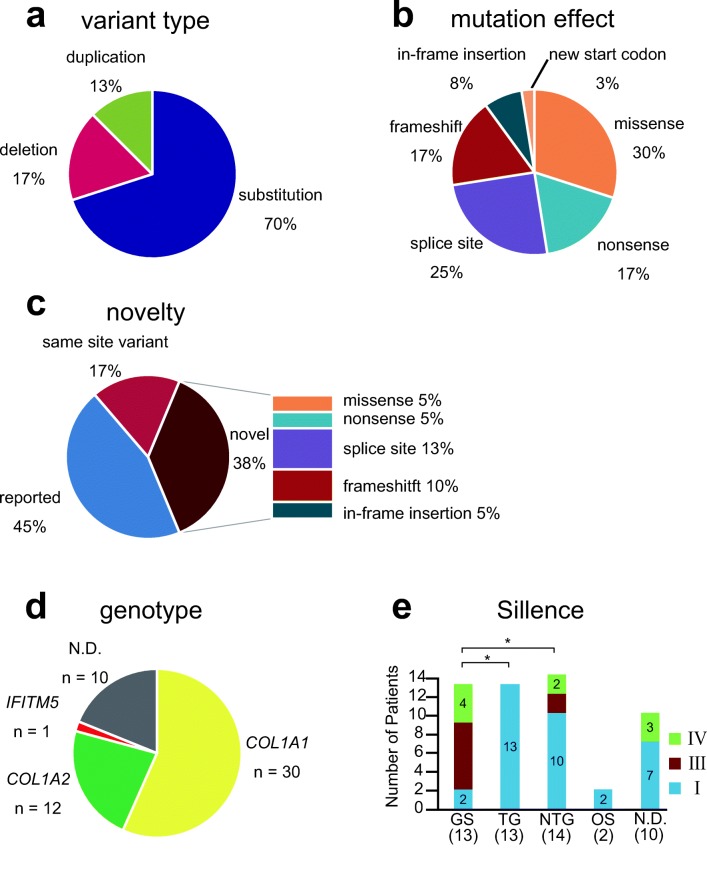
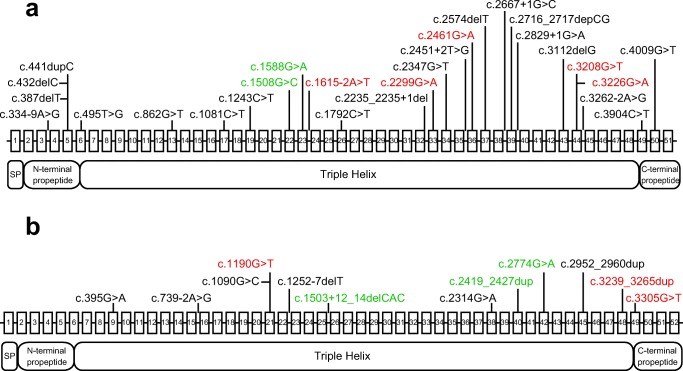
Pathogenic mutations were detected in 43 out of 53 individuals. All mutations were heterozygous. Among the 43 individuals, 40 variants were identified including 15 novel mutations. We found these mutations in COL1A1 (n = 30, 69.8%), COL1A2 (n = 12, 27.9%), and IFITM5 (n = 1, 2.3%). Patients with glycine substitution on COL1A1 had a higher frequency of fractures and were more severely short-statured. Although no significant genotype-phenotype correlation was observed for bone mineral density, the trabecular bone score was significantly lower in patients with glycine substitutions.
We identified pathogenic mutations in 81% of our Japanese patients with OI. Most mutations were located on COL1A1 and COL1A2. This study revealed that glycine substitutions on COL1A1 resulted in the severe phenotype among Japanese patients with OI.
阐明日本成骨不全症(OI)患者的突变谱和基因型-表型相关性,我们使用 NGS 进行了全面的遗传分析,因为这在该患者群体中尚未进行全面分析。大多数突变位于 COL1A1 和 COL1A2 上。COL1A1 中的甘氨酸取代导致严重表型。
大多数成骨不全症(OI)病例是由 COL1A1 或 COL1A2 基因突变引起的,这两个基因编码 I 型胶原的α链。然而,至少 16 个其他基因的突变也会导致 OI。日本 OI 患者的突变谱尚未进行全面分析,因为使用经典的 Sanger 测序很难识别。在这项研究中,我们旨在使用下一代测序(NGS)揭示日本 OI 患者的突变谱和基因型-表型相关性。
我们设计了一个用于测序 15 个候选 OI 基因和 19 个与骨脆性或 Wnt 信号相关的候选基因的捕获面板。我们使用 NGS 检查了 53 名来自无关家庭的日本 OI 患者。
在 53 名个体中的 43 名个体中检测到致病性突变。所有突变均为杂合子。在 43 名个体中,确定了 40 种变体,包括 15 种新突变。我们在 COL1A1(n = 30,69.8%)、COL1A2(n = 12,27.9%)和 IFITM5(n = 1,2.3%)中发现了这些突变。在 COL1A1 上具有甘氨酸取代的患者骨折频率更高,身材更矮小。尽管骨密度没有观察到明显的基因型-表型相关性,但在具有甘氨酸取代的患者中,小梁骨评分明显较低。
我们在 81%的日本 OI 患者中确定了致病性突变。大多数突变位于 COL1A1 和 COL1A2 上。这项研究表明,COL1A1 上的甘氨酸取代导致日本 OI 患者的严重表型。