The George Institute for Global Health at Peking University Health Science Center, Beijing, China.
Faculty of Medicine, University of New South Wales, Sydney, Australia.
JMIR Mhealth Uhealth. 2019 Jul 30;7(7):e13261. doi: 10.2196/13261.
There are an increasing number of mobile apps that provide dietary guidance to support a healthy lifestyle and disease management. However, the characteristics of these nutrition-related apps are not well analyzed.
This study aimed to evaluate the functionality and quality of nutrition-related apps in China.
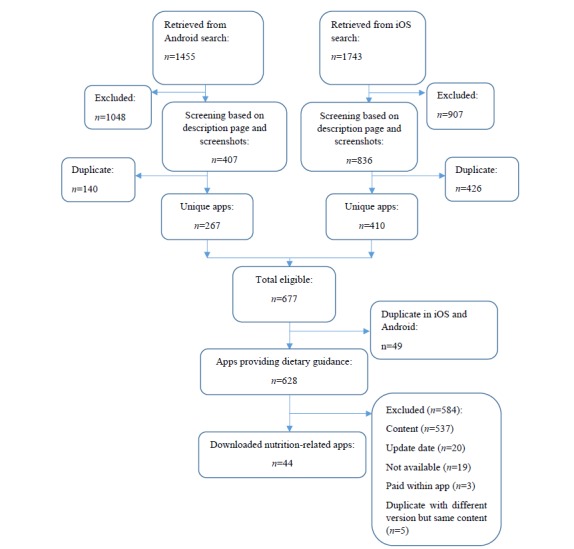
Mobile apps providing dietary guidance were screened in the Chinese iOS and Android app stores in November 2017, using stepwise searching criteria. The first screening consisted of extracting information from the app descriptions. Apps that (1) were free, (2) contain information on diet and nutrition, and (3) were last updated after January 1, 2016, were downloaded for further analysis. Nutritional functionalities were determined according to the Chinese Dietary Guidelines framework. Market-related functionalities were developed from previous studies and tailored to downloaded apps. The quality of apps was assessed with the user version of the Mobile App Rating Scale (uMARS).
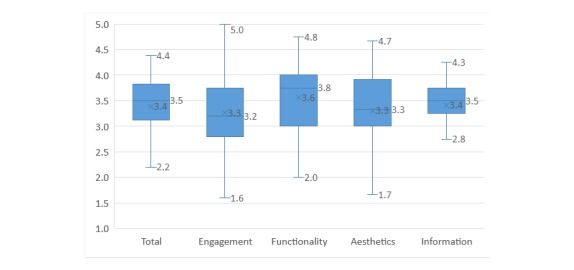
Out of 628 dietary guidance apps screened, 44 were nutrition-related. Of these, guidance was provided on diet exclusively (11/44, 25%), fitness (17/44, 39%), disease management (11/44, 25%), or maternal health (5/44, 11%). Nutritional functionalities included nutritional information inquiry (40/44, 91%), nutrition education (35/44, 80%), food record (34/44, 77%), diet analysis (34/44, 77%), and personalized recipes (21/44, 48%). Dietary analysis and suggestions mainly focused on energy intake (33/44, 75%) and less on other factors such as dietary structure (10/44, 23%). Social communication functionalities were available in 42 apps (96%), user incentives were supported in 26 apps (59%), and intelligent recognition technology was available in 8 apps (18%). The median score for the quality of the 44 apps, as determined on a 5-point uMARS scale, was 3.6 (interquartile range 0.7).
Most nutrition-related apps are developed for health management rather than for dietary guidance exclusively. Although basic principles of energy balance are used, their nutritional functionality was relatively limited and not individualized. More efforts should be made to develop nutrition-related apps with evidence-based nutritional knowledge, comprehensive and personalized dietary guidance, and innovative technology.
越来越多的移动应用程序提供饮食指导,以支持健康的生活方式和疾病管理。然而,这些营养相关应用程序的特点尚未得到很好的分析。
本研究旨在评估中国营养相关应用程序的功能和质量。
2017 年 11 月,我们采用逐步搜索标准,在中国的 iOS 和 Android 应用商店中筛选提供饮食指导的移动应用程序。初次筛选包括从应用描述中提取信息。筛选出以下应用程序进行进一步分析:(1)免费;(2)包含饮食和营养信息;(3)更新日期在 2016 年 1 月 1 日之后。根据中国膳食指南框架确定营养功能。市场相关功能是根据以前的研究开发的,并针对下载的应用程序进行了定制。应用程序的质量使用移动应用程序评级量表(uMARS)的用户版本进行评估。
在筛选出的 628 个饮食指导应用程序中,有 44 个是营养相关的。其中,仅提供饮食指导的应用程序有 11 个(25%),提供健身指导的有 17 个(39%),提供疾病管理指导的有 11 个(25%),提供孕产妇健康指导的有 5 个(11%)。营养功能包括营养信息查询(40/44,91%)、营养教育(35/44,80%)、食物记录(34/44,77%)、饮食分析(34/44,77%)和个性化食谱(21/44,48%)。饮食分析和建议主要集中在能量摄入方面(33/44,75%),而其他因素如饮食结构方面(10/44,23%)则关注较少。42 个应用程序(96%)提供社交沟通功能,26 个应用程序(59%)支持用户激励,8 个应用程序(18%)提供智能识别技术。在 5 分制的 uMARS 量表上,44 个应用程序的质量中位数评分为 3.6(四分位距 0.7)。
大多数营养相关应用程序是为健康管理而开发的,而不仅仅是为饮食指导而开发的。尽管应用了能量平衡的基本原理,但它们的营养功能相对有限且不具有个性化。应努力开发具有基于证据的营养知识、全面个性化饮食指导和创新技术的营养相关应用程序。