• 文献检索
  • 文档翻译
  • 深度研究
  • 学术资讯
  • Suppr Zotero 插件Zotero 插件
  • 邀请有礼
  • 套餐&价格
  • 历史记录
应用&插件
Suppr Zotero 插件Zotero 插件浏览器插件Mac 客户端Windows 客户端微信小程序
定价
高级版会员购买积分包购买API积分包
服务
文献检索文档翻译深度研究API 文档MCP 服务
关于我们
关于 Suppr公司介绍联系我们用户协议隐私条款
关注我们

Suppr 超能文献

核心技术专利:CN118964589B侵权必究
粤ICP备2023148730 号-1Suppr @ 2026

文献检索

告别复杂PubMed语法,用中文像聊天一样搜索,搜遍4000万医学文献。AI智能推荐,让科研检索更轻松。

立即免费搜索

文件翻译

保留排版,准确专业,支持PDF/Word/PPT等文件格式,支持 12+语言互译。

免费翻译文档

深度研究

AI帮你快速写综述,25分钟生成高质量综述,智能提取关键信息,辅助科研写作。

立即免费体验

寻找基于网络的原始DNA解读服务的消费者:利用社交媒体针对难以触及的人群

The Search for Consumers of Web-Based Raw DNA Interpretation Services: Using Social Media to Target Hard-to-Reach Populations.

作者信息

Cahill Tiernan J, Wertz Blake, Zhong Qiankun, Parlato Andrew, Donegan John, Forman Rebecca, Manot Supriya, Wu Tianyi, Xu Yazhu, Cummings James J, Norkunas Cunningham Tricia, Wang Catharine

机构信息

Divison of Emerging Media, Boston University College of Communication, Boston, MA, United States.

Department of Community Health Sciences, Boston University School of Public Health, Boston, MA, United States.

出版信息

J Med Internet Res. 2019 Jul 30;21(7):e12980. doi: 10.2196/12980.

DOI:10.2196/12980
PMID:31364607
原文链接:https://pmc.ncbi.nlm.nih.gov/articles/PMC6691676/
Abstract

BACKGROUND

In recent years, there has been a proliferation of third-party Web-based services available to consumers to interpret raw DNA from direct-to-consumer genetic testing companies. Little is known about who uses these services and the downstream health implications. Identifying this hard-to-reach population of consumers for research raised questions about the most effective recruitment methods to undertake. Past studies have found that Web-based social media survey distribution can be cost-effective for targeting hard-to-reach populations, yet comparative efficacy information across platforms is limited.

OBJECTIVE

The aim of this study was to identify the most effective Web-based strategies to identify and recruit the target population of direct-to-consumer genetic testing users who also made use of third-party interpretation services to analyze their raw genetic data. Web-based survey recruitment methods varying by social media platform and advertising method were compared in terms of cost-effectiveness and demographics of survey respondents.

METHODS

A total of 5 Web-based survey distribution conditions were examined: 4 paid advertising services and 1 unpaid service. For the paid services, a 2x2 quasi-experimental design compared social media platforms (Facebook vs Twitter) and advertising tracking metrics (by click vs by conversion). The fifth unpaid comparison method consisted of study postings on the social media platform, Reddit, without any paid advertising. Links to identical Web-based versions of the study questionnaire were posted for 10 to 14 days for each of the distribution conditions, which allowed tracking the number of respondents that entered and completed the questionnaire by distribution condition.

RESULTS

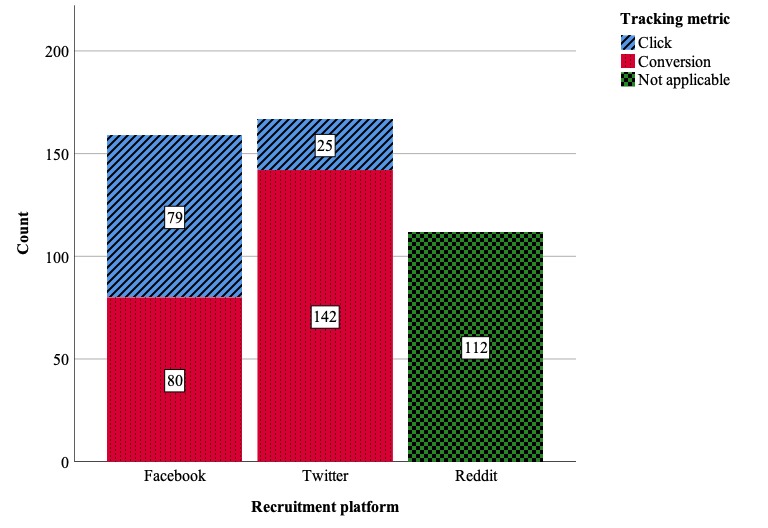
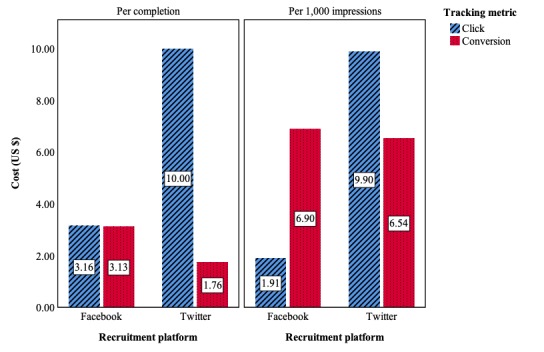
In total, 438 individuals were recruited to the study through all conditions. A nearly equivalent number of participants were recruited from paid campaigns on Facebook (n=159) and Twitter (n=167), with a smaller sample recruited on Reddit (n=112). Significantly more participants were recruited through conversion-tracking (n=222) than through click-tracking campaigns (n=104; Z=6.5, P<.001). Response rates were found to be partially driven by organic sharing of recruitment materials among social media users. Conversion tracking was more cost-effective than click tracking across paid social media platforms. Significant differences in terms of gender and age distributions were noted between the platforms and between the tracking metrics.

CONCLUSIONS

Web-based recruitment methods were effective at recruiting participants from a hard-to-reach population in a short time frame. There were significant differences in the effectiveness of various paid advertising techniques. Recruitment through Web-based communities also appeared to perform adequately, yet it may be limited by the number of users accessible in open community groups. Future research should evaluate the impact of organic sharing of recruitment materials because this appeared to play a substantial role in the observed effectiveness of different methods.

摘要

背景

近年来,面向消费者的第三方基于网络的服务激增,可用于解读直接面向消费者的基因检测公司提供的原始DNA数据。对于谁使用这些服务以及其对健康的潜在影响,人们知之甚少。识别这一难以接触到的消费者群体进行研究,引发了关于最有效招募方法的问题。过去的研究发现,基于网络的社交媒体调查分发对于定位难以接触到的人群可能具有成本效益,但跨平台的比较效果信息有限。

目的

本研究的目的是确定最有效的基于网络的策略,以识别和招募直接面向消费者的基因检测用户这一目标群体,这些用户还利用第三方解读服务来分析他们的原始基因数据。比较了基于网络的调查招募方法在成本效益和调查对象人口统计学方面因社交媒体平台和广告方法的不同。

方法

共研究了5种基于网络的调查分发条件:4种付费广告服务和1种免费服务。对于付费服务,采用2×2准实验设计比较社交媒体平台(Facebook与Twitter)和广告跟踪指标(按点击量与按转化率)。第五种免费比较方法包括在社交媒体平台Reddit上发布研究招募信息,不进行任何付费广告。在每种分发条件下,将相同基于网络版本的研究问卷链接发布10至14天,这样可以按分发条件跟踪进入并完成问卷的受访者数量。

结果

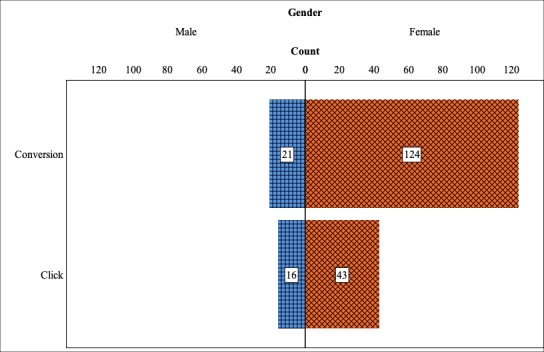
通过所有条件共招募了438人参与研究。从Facebook上的付费活动(n = 159)和Twitter上的付费活动(n = 167)招募的参与者数量几乎相同,在Reddit上招募的样本较小(n = 112)。通过转化率跟踪招募的参与者(n = 222)明显多于通过点击量跟踪活动招募的参与者(n = 104;Z = 6.5,P <.001)。发现回复率部分是由社交媒体用户之间对招募材料的自然分享驱动的。在付费社交媒体平台上,转化率跟踪比点击量跟踪更具成本效益。在平台之间以及跟踪指标之间,在性别和年龄分布方面存在显著差异。

结论

基于网络的招募方法在短时间内有效地从难以接触到的人群中招募了参与者。各种付费广告技术的有效性存在显著差异。通过基于网络的社区进行招募似乎也表现良好,但可能会受到开放社区群组中可接触用户数量的限制。未来的研究应评估招募材料自然分享的影响,因为这似乎在不同方法的观察效果中发挥了重要作用。
https://cdn.ncbi.nlm.nih.gov/pmc/blobs/791c/6691676/185f408ba00a/jmir_v21i7e12980_fig6.jpg
https://cdn.ncbi.nlm.nih.gov/pmc/blobs/791c/6691676/3cd16039ef7a/jmir_v21i7e12980_fig1.jpg
https://cdn.ncbi.nlm.nih.gov/pmc/blobs/791c/6691676/6d6f733a521f/jmir_v21i7e12980_fig2.jpg
https://cdn.ncbi.nlm.nih.gov/pmc/blobs/791c/6691676/8265213e90cd/jmir_v21i7e12980_fig3.jpg
https://cdn.ncbi.nlm.nih.gov/pmc/blobs/791c/6691676/74ccd3fdc53e/jmir_v21i7e12980_fig4.jpg
https://cdn.ncbi.nlm.nih.gov/pmc/blobs/791c/6691676/8ee2965f1494/jmir_v21i7e12980_fig5.jpg
https://cdn.ncbi.nlm.nih.gov/pmc/blobs/791c/6691676/185f408ba00a/jmir_v21i7e12980_fig6.jpg
https://cdn.ncbi.nlm.nih.gov/pmc/blobs/791c/6691676/3cd16039ef7a/jmir_v21i7e12980_fig1.jpg
https://cdn.ncbi.nlm.nih.gov/pmc/blobs/791c/6691676/6d6f733a521f/jmir_v21i7e12980_fig2.jpg
https://cdn.ncbi.nlm.nih.gov/pmc/blobs/791c/6691676/8265213e90cd/jmir_v21i7e12980_fig3.jpg
https://cdn.ncbi.nlm.nih.gov/pmc/blobs/791c/6691676/74ccd3fdc53e/jmir_v21i7e12980_fig4.jpg
https://cdn.ncbi.nlm.nih.gov/pmc/blobs/791c/6691676/8ee2965f1494/jmir_v21i7e12980_fig5.jpg
https://cdn.ncbi.nlm.nih.gov/pmc/blobs/791c/6691676/185f408ba00a/jmir_v21i7e12980_fig6.jpg

相似文献

1
The Search for Consumers of Web-Based Raw DNA Interpretation Services: Using Social Media to Target Hard-to-Reach Populations.寻找基于网络的原始DNA解读服务的消费者:利用社交媒体针对难以触及的人群
J Med Internet Res. 2019 Jul 30;21(7):e12980. doi: 10.2196/12980.
2
The Use of Facebook in Recruiting Participants for Health Research Purposes: A Systematic Review.脸书在招募健康研究参与者中的应用:一项系统综述
J Med Internet Res. 2017 Aug 28;19(8):e290. doi: 10.2196/jmir.7071.
3
Youth Study Recruitment Using Paid Advertising on Instagram, Snapchat, and Facebook: Cross-Sectional Survey Study.利用Instagram、Snapchat和Facebook上的付费广告招募青年研究对象:横断面调查研究
JMIR Public Health Surveill. 2019 Oct 9;5(4):e14080. doi: 10.2196/14080.
4
A practical guide to implementing a successful social media recruitment strategy: lessons from the Eczema Monitoring Online trial.实施成功社交媒体招聘策略的实用指南:来自湿疹监测在线试验的经验教训。
Trials. 2022 Oct 27;23(1):905. doi: 10.1186/s13063-022-06839-z.
5
Using Paid and Free Facebook Methods to Recruit Australian Parents to an Online Survey: An Evaluation.运用付费和免费的脸书方法招募澳大利亚家长参与在线调查:一项评估。
J Med Internet Res. 2019 Mar 6;21(3):e11206. doi: 10.2196/11206.
6
Recruiting Hard-to-Reach Populations for Survey Research: Using Facebook and Instagram Advertisements and In-Person Intercept in LGBT Bars and Nightclubs to Recruit LGBT Young Adults.为调查研究招募难以接触到的人群:利用脸书和照片墙广告以及在 LGBT 酒吧和夜总会进行实地拦截来招募 LGBT 青年成年人。
J Med Internet Res. 2018 Jun 18;20(6):e197. doi: 10.2196/jmir.9461.
7
Exploring the Utility of Web-Based Social Media Advertising to Recruit Adult Heavy-Drinking Smokers for Treatment.探索基于网络的社交媒体广告在招募成年重度饮酒吸烟者接受治疗方面的效用。
J Med Internet Res. 2016 May 18;18(5):e107. doi: 10.2196/jmir.5360.
8
Social Media Recruitment Strategies to Recruit Pregnant Women Into a Longitudinal Observational Cohort Study: Usability Study.社交媒体招聘策略招募孕妇参加纵向观察队列研究:可用性研究。
J Med Internet Res. 2022 Dec 12;24(12):e40298. doi: 10.2196/40298.
9
Using Web-Based Social Media to Recruit Heavy-Drinking Young Adults for Sleep Intervention: Prospective Observational Study.利用基于网络的社交媒体招募重度饮酒的年轻成年人参与睡眠干预:前瞻性观察研究。
J Med Internet Res. 2020 Aug 11;22(8):e17449. doi: 10.2196/17449.
10
Sampling Sexual and Gender Minority Youth With UnACoRN (Understanding Affirming Communities, Relationships, and Networks): Lessons From a Web-Based Survey.使用 UnACoRN(理解肯定社区、关系和网络)对性少数和性别少数青年进行抽样调查:来自网络调查的经验教训。
J Med Internet Res. 2023 Jan 12;25:e44175. doi: 10.2196/44175.

引用本文的文献

1
Autism Traits and Cognitive Performance: Mediating Roles of Sleep Disturbance, Anxiety and Depression.自闭症特质与认知表现:睡眠障碍、焦虑和抑郁的中介作用。
J Autism Dev Disord. 2023 Dec;53(12):4560-4576. doi: 10.1007/s10803-022-05742-5. Epub 2022 Sep 22.
2
Social Media Use for Research Participant Recruitment: Integrative Literature Review.社交媒体在研究参与者招募中的应用:综合文献回顾。
J Med Internet Res. 2022 Aug 4;24(8):e38015. doi: 10.2196/38015.
3
Direct-to-consumer genetic testing: Prospective users' attitudes toward information about ancestry and biological relationships.

本文引用的文献

1
Direct-to-Consumer Genetic Testing: User Motivations, Decision Making, and Perceived Utility of Results.直接面向消费者的基因检测:用户动机、决策过程及对检测结果的感知效用
Public Health Genomics. 2017;20(1):36-45. doi: 10.1159/000455006. Epub 2017 Jan 10.
2
Comparing Twitter and Online Panels for Survey Recruitment of E-Cigarette Users and Smokers.比较通过推特和在线样本库招募电子烟使用者和吸烟者进行调查的情况。
J Med Internet Res. 2016 Nov 15;18(11):e288. doi: 10.2196/jmir.6326.
3
The Use of Social Media in Recruitment for Medical Research Studies: A Scoping Review.
直接面向消费者的基因检测:潜在用户对有关祖先和生物关系信息的态度。
PLoS One. 2021 Nov 29;16(11):e0260340. doi: 10.1371/journal.pone.0260340. eCollection 2021.
4
Cost, reach, and representativeness of recruitment efforts for an online skin cancer risk reduction intervention trial for young adults.招募努力的成本、范围和代表性:一项针对年轻成年人的在线皮肤癌风险降低干预试验
Transl Behav Med. 2021 Oct 23;11(10):1875-1884. doi: 10.1093/tbm/ibab047.
社交媒体在医学研究招募中的应用:一项范围综述
J Med Internet Res. 2016 Nov 7;18(11):e286. doi: 10.2196/jmir.5698.
4
Facebook as a research tool for the social sciences: Opportunities, challenges, ethical considerations, and practical guidelines.脸书作为社会科学的研究工具:机遇、挑战、伦理考量及实用指南。
Am Psychol. 2015 Sep;70(6):543-56. doi: 10.1037/a0039210.
5
Recruiting for addiction research via Facebook.通过脸书招募成瘾研究对象。
Drug Alcohol Rev. 2016 Jul;35(4):494-502. doi: 10.1111/dar.12305. Epub 2015 Jul 14.
6
Using online social media for recruitment of human immunodeficiency virus-positive participants: a cross-sectional survey.利用在线社交媒体招募人类免疫缺陷病毒阳性参与者:一项横断面调查。
J Med Internet Res. 2014 May 1;16(5):e117. doi: 10.2196/jmir.3229.
7
Big data. The parable of Google Flu: traps in big data analysis.大数据。谷歌流感预测的教训:大数据分析中的陷阱。
Science. 2014 Mar 14;343(6176):1203-5. doi: 10.1126/science.1248506.
8
The good, bad, and ugly of online recruitment of parents for health-related focus groups: lessons learned.在线招募家长参与健康相关焦点小组的利弊:经验教训
J Med Internet Res. 2013 Nov 14;15(11):e250. doi: 10.2196/jmir.2829.
9
Purposive facebook recruitment endows cost-effective nutrition education program evaluation.有目的的脸书招募为具有成本效益的营养教育项目评估提供了条件。
JMIR Res Protoc. 2013 Aug 15;2(2):e27. doi: 10.2196/resprot.2713.
10
Can I get a retweet please? Health research recruitment and the Twittersphere.请转发一下好吗?健康研究招募和推特圈。
J Adv Nurs. 2014 Mar;70(3):599-609. doi: 10.1111/jan.12222. Epub 2013 Aug 4.