Lohse Barbara, Wamboldt Patricia
Department of Nutritional Sciences, The Pennsylvania State University, University Park, PA, United States.
JMIR Res Protoc. 2013 Aug 15;2(2):e27. doi: 10.2196/resprot.2713.
Recent legislation established a requirement for nutrition education in federal assistance programs to be evidence-based. Recruitment of low-income persons to participate and evaluate nutrition education activities can be challenging and costly. Facebook has been shown to be a cost-effective strategy to recruit this target audience to a nutrition program.
The purpose of our study was to examine Facebook as a strategy to recruit participants, especially Supplemental Nutrition Assistance Program Education (SNAP-Ed) eligible persons, to view and evaluate an online nutrition education program intended to be offered as having some evidence base for SNAP-Ed programming.
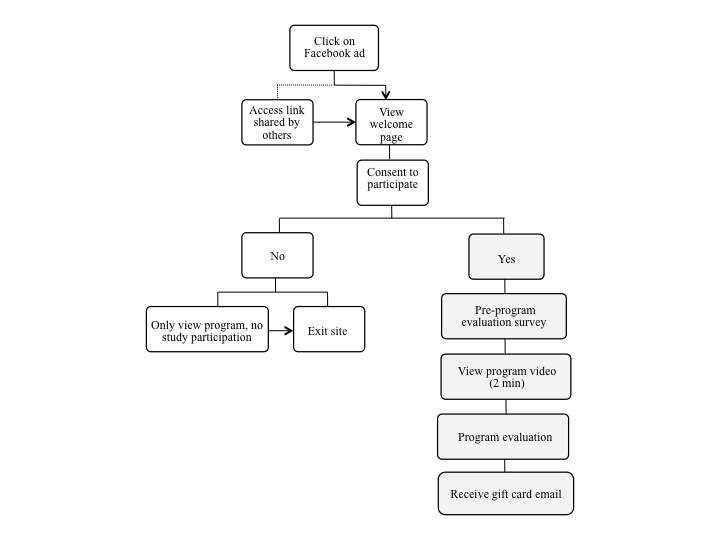
English-speaking, low-income Pennsylvania residents, 18-55 years with key profile words (eg, Supplemental Nutrition Assistance Program, Food bank), responded to a Facebook ad inviting participation in either Eating Together as a Family is Worth It (WI) or Everyone Needs Folic Acid (FA). Participants completed an online survey on food-related behaviors, viewed a nutrition education program, and completed a program evaluation. Facebook set-up functions considered were costing action, daily spending cap, and population reach.
Respondents for both WI and FA evaluations were similar; the majority were white, <40 years, overweight or obese body mass index, and not eating competent. A total of 807 Facebook users clicked on the WI ad with 73 unique site visitors and 47 of them completing the program evaluation (ie, 47/807, 5.8% of clickers and 47/73, 64% of site visitors completed the evaluation). Cost per completed evaluation was US $25.48; cost per low-income completer was US $39.92. Results were similar for the FA evaluation; 795 Facebook users clicked on the ad with 110 unique site visitors, and 73 completing the evaluation (ie, 73/795, 9.2% of ad clickers and 73/110, 66% of site visitors completed the evaluation). Cost per valid completed survey with program evaluation was US $18.88; cost per low-income completer was US $27.53.
With Facebook we successfully recruited low-income Pennsylvanians to online nutrition program evaluations. Benefits using Facebook as a recruitment strategy included real-time recruitment management with lower costs and more efficiency compared to previous data from traditional research recruitment strategies reported in the literature. Limitations prompted by repeated survey attempts need to be addressed to optimize this recruitment strategy.
近期立法规定,联邦援助项目中的营养教育必须以证据为基础。招募低收入人群参与并评估营养教育活动可能具有挑战性且成本高昂。事实证明,脸书是招募这一目标受众参与营养项目的一种经济高效的策略。
我们研究的目的是考察脸书作为一种招募参与者的策略,尤其是那些符合补充营养援助计划教育(SNAP-Ed)资格的人群,以观看和评估一个旨在为SNAP-Ed项目提供一定证据基础的在线营养教育项目。
宾夕法尼亚州18至55岁、说英语的低收入居民,若其个人资料中有关键搜索词(如补充营养援助计划、食品银行),则会收到脸书广告邀请,参与“全家一起用餐很值得”(WI)或“人人都需要叶酸”(FA)项目。参与者完成了一项关于饮食相关行为的在线调查,观看了一个营养教育项目,并完成了项目评估。所考虑的脸书设置功能包括成本行动、每日支出上限和覆盖人群。
WI和FA评估的受访者情况相似;大多数为白人,年龄小于40岁,体重指数超重或肥胖,且饮食能力欠佳。共有807名脸书用户点击了WI广告,其中73人是独立网站访客,47人完成了项目评估(即47/807,占点击者的5.8%;47/73,占网站访客的64%完成了评估)。完成一次评估的成本为25.48美元;低收入完成者的成本为39.92美元。FA评估结果类似;795名脸书用户点击了广告,110人是独立网站访客,73人完成了评估(即73/795,占广告点击者的9.2%;73/110,占网站访客的66%完成了评估)。完成带有项目评估的有效调查的成本为18.88美元;低收入完成者的成本为27.53美元。
通过脸书,我们成功招募了宾夕法尼亚州的低收入居民参与在线营养项目评估。将脸书用作招募策略的好处包括实时招募管理,与文献中报道的传统研究招募策略的先前数据相比,成本更低且效率更高。需要解决因重复调查尝试而产生的局限性,以优化这一招募策略。