Whitaker Christopher, Stevelink Sharon, Fear Nicola
Kings Centre for Military Health Research, Department of Psychological Medicine, Kings College London, London, United Kingdom.
J Med Internet Res. 2017 Aug 28;19(8):e290. doi: 10.2196/jmir.7071.
Social media is a popular online tool that allows users to communicate and exchange information. It allows digital content such as pictures, videos and websites to be shared, discussed, republished and endorsed by its users, their friends and businesses. Adverts can be posted and promoted to specific target audiences by demographics such as region, age or gender. Recruiting for health research is complex with strict requirement criteria imposed on the participants. Traditional research recruitment relies on flyers, newspaper adverts, radio and television broadcasts, letters, emails, website listings, and word of mouth. These methods are potentially poor at recruiting hard to reach demographics, can be slow and expensive. Recruitment via social media, in particular Facebook, may be faster and cheaper.
The aim of this study was to systematically review the literature regarding the current use and success of Facebook to recruit participants for health research purposes.
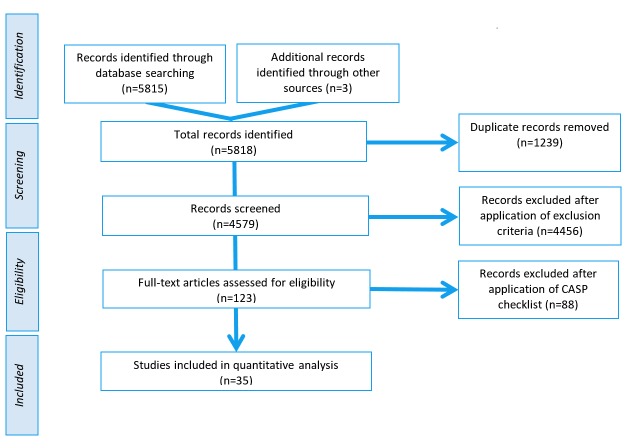
A literature review was completed in March 2017 in the English language using MEDLINE, EMBASE, Web of Science, PubMed, PsycInfo, Google Scholar, and a hand search of article references. Papers from the past 12 years were included and number of participants, recruitment period, number of impressions, cost per click or participant, and conversion rate extracted.
A total of 35 studies were identified from the United States (n=22), Australia (n=9), Canada (n=2), Japan (n=1), and Germany (n=1) and appraised using the Critical Appraisal Skills Programme (CASP) checklist. All focused on the feasibility of recruitment via Facebook, with some (n=10) also testing interventions, such as smoking cessation and depression reduction. Most recruited young age groups (16-24 years), with the remaining targeting specific demographics, for example, military veterans. Information from the 35 studies was analyzed with median values being 264 recruited participants, a 3-month recruitment period, 3.3 million impressions, cost per click of US $0.51, conversion rate of 4% (range 0.06-29.50), eligibility of 61% (range 17-100), and cost per participant of US $14.41. The studies showed success in penetrating hard to reach populations, finding the results representative of their control or comparison demographic, except for an over representation of young white women.
There is growing evidence to suggest that Facebook is a useful recruitment tool and its use, therefore, should be considered when implementing future health research. When compared with traditional recruitment methods (print, radio, television, and email), benefits include reduced costs, shorter recruitment periods, better representation, and improved participant selection in young and hard to reach demographics. It however, remains limited by Internet access and the over representation of young white women. Future studies should recruit across all ages and explore recruitment via other forms of social media.
社交媒体是一种广受欢迎的在线工具,用户可借此进行交流和信息交换。它允许用户、其朋友及企业分享、讨论、重新发布和认可诸如图片、视频及网站等数字内容。广告可依据地区、年龄或性别等人口统计学特征针对特定目标受众进行投放和推广。健康研究的招募工作复杂,对参与者有严格的要求标准。传统的研究招募依靠传单、报纸广告、广播和电视广播、信件、电子邮件、网站列表以及口碑相传。这些方法在招募难以触及的人群方面可能效果不佳,而且可能既缓慢又昂贵。通过社交媒体,尤其是脸书进行招募可能更快且更便宜。
本研究旨在系统回顾关于目前使用脸书招募健康研究参与者的情况及其成效的文献。
2017年3月使用MEDLINE、EMBASE、科学网、PubMed、PsycInfo、谷歌学术完成了一项英文文献综述,并对文章参考文献进行了手工检索。纳入过去12年的论文,并提取参与者数量、招募周期、展示次数、每次点击或每位参与者的成本以及转化率。
共从美国(n = 22)、澳大利亚(n = 9)、加拿大(n = 2)、日本(n = 1)和德国(n = 1)识别出35项研究,并使用批判性评估技能计划(CASP)清单进行评估。所有研究都聚焦于通过脸书进行招募的可行性,其中一些研究(n = 10)还测试了干预措施,如戒烟和减轻抑郁。大多数研究招募的是年轻年龄组(16 - 24岁),其余研究针对特定人群,例如退伍军人。对这35项研究的信息进行了分析,中位数为招募264名参与者、3个月的招募周期、330万次展示、每次点击成本0.51美元、转化率4%(范围0.06 - 29.50)、符合条件率61%(范围17 - 100)以及每位参与者成本14.41美元。研究表明在接触难以触及的人群方面取得了成功,研究结果代表了其对照组或比较人群,但年轻白人女性的比例过高。
越来越多的证据表明脸书是一种有用的招募工具,因此在开展未来的健康研究时应考虑使用。与传统招募方法(印刷品、广播、电视和电子邮件)相比,其优点包括成本降低、招募周期缩短、代表性更好以及在年轻和难以触及的人群中参与者选择有所改善。然而,它仍然受到互联网接入的限制以及年轻白人女性比例过高的问题。未来的研究应涵盖所有年龄段,并探索通过其他形式的社交媒体进行招募。
