Department of Musculoskeletal Oncology and Rehabilitation, National Cancer Center Hospital, Tokyo, Japan.
Rare Cancer Center, National Cancer Center Hospital, Tokyo, Japan.
Jpn J Clin Oncol. 2019 Oct 1;49(10):938-946. doi: 10.1093/jjco/hyz096.
Although eribulin is used to treat soft tissue sarcomas (STSs), treatment data for rare subtypes are limited. We conducted a post-marketing surveillance study to assess safety and efficacy of eribulin in STS patients stratified by subtype.
Japanese patients (n = 256) with advanced or metastatic STS receiving eribulin treatment were monitored for treatment status, adverse events, diagnostic imaging, and clinical outcomes at 3 months and 1 year. Interim analysis was performed. Patients will be monitored up to 2 years.
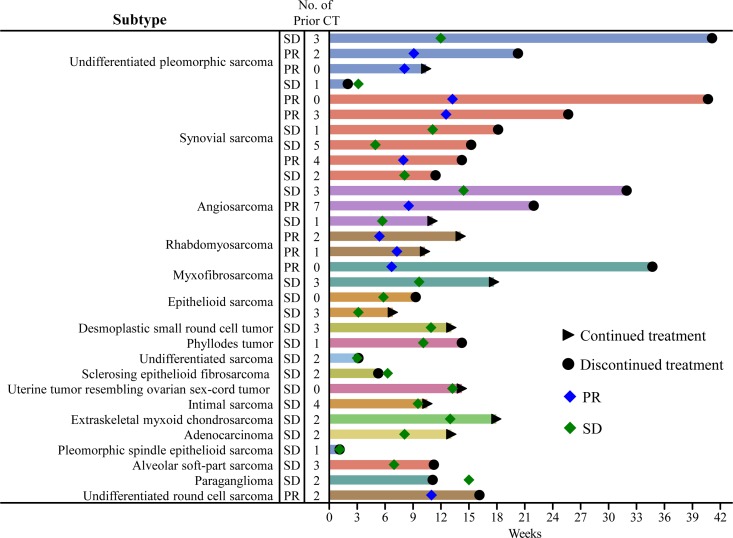
Interim analysis included 3-month (n = 255), imaging (n = 226), and 1-year (n = 105) data. STS subtype distribution was normal. Median number of eribulin cycles was 3.0 (range: 1-17 cycles). Among patients with imaging data, best overall tumor response (12 weeks) was partial response, 7.5% (n = 17); stable disease, 34.5% (n = 78); and stable disease ≥11 weeks, 10.2% (n = 23). Overall response rate (ORR), disease control rate (DCR), and clinical benefit rate (CBR) for all patients were 7.5%, 42.0% and 17.7%, respectively. ORR, DCR, and CBR were 10.3%, 32.0% and 16.5%, respectively, for patients with STS subtypes other than liposarcoma and leiomyosarcoma and included responses from patients with rare STS subtypes. Adverse drug reactions (ADRs) occurred in 211 (82.7%) patients (42 [16.5%] patients had serious ADRs), and none led to death. ADRs leading to drug withdrawal and dose reduction occurred in 27 (10.6%) and 55 (21.6%) patients, respectively.
Eribulin was generally well tolerated and showed antitumor activity against STSs, including rare subtypes that currently have few treatment options.
NCT03058406 (ClinicalTrials.gov).
尽管艾瑞布林被用于治疗软组织肉瘤(STS),但针对罕见亚型的治疗数据有限。我们开展了一项上市后监测研究,按亚型对接受艾瑞布林治疗的 STS 患者的安全性和疗效进行评估。
接受艾瑞布林治疗的日本晚期或转移性 STS 患者(n=256),在治疗期间、出现不良事件时、进行诊断性影像学检查时和治疗 3 个月及 1 年时监测治疗状况、不良事件、诊断性影像学检查和临床结局。进行了中期分析。患者将接受长达 2 年的监测。
中期分析纳入了 3 个月(n=255)、影像学(n=226)和 1 年(n=105)的数据。STS 亚型分布为普通型。艾瑞布林治疗周期中位数为 3.0(范围:1-17 个周期)。在有影像学数据的患者中,最佳总体肿瘤缓解(12 周)为部分缓解,7.5%(n=17);疾病稳定,34.5%(n=78);疾病稳定≥11 周,10.2%(n=23)。所有患者的总缓解率(ORR)、疾病控制率(DCR)和临床获益率(CBR)分别为 7.5%、42.0%和 17.7%。非脂肪肉瘤和 leiomyosarcoma 型 STS 患者的 ORR、DCR 和 CBR 分别为 10.3%、32.0%和 16.5%,包括来自罕见 STS 亚型患者的缓解。211 例(82.7%)患者出现药物不良反应(ADR)(42 例[16.5%]患者发生严重 ADR),均未导致死亡。27 例(10.6%)和 55 例(21.6%)患者分别因 ADR 导致停药和剂量减少。
艾瑞布林总体耐受良好,对 STS 具有抗肿瘤活性,包括目前治疗选择有限的罕见亚型。
NCT03058406(ClinicalTrials.gov)。