Department of Musculoskeletal Oncology and Rehabilitation Medicine, National Cancer Center Hospital, Rare Cancer Center, National Cancer Center Hospital, 5-1-1 Tsukiji, Chuo-ku, Tokyo, 104-0045, Japan.
Rare Cancer Center, National Cancer Center, Tokyo, Japan.
BMC Cancer. 2022 May 11;22(1):528. doi: 10.1186/s12885-022-09527-y.
Soft tissue sarcomas (STSs) are a heterogeneous group of cancers with over 100 described subtypes. While these cancers are infrequent, the prognosis is quite poor, particularly for those with stage IV metastatic disease. Patients for whom curative resection is difficult or those with recurrent metastatic disease are treated with chemotherapy, although the options are very limited. Eribulin is an approved treatment of all STS subtypes in Japan. Efficacy and safety data for the treatment of rare STS subtypes other than liposarcoma and leiomyosarcoma (L-type sarcomas) are limited. This nationwide, multicenter, prospective, post-marketing observational study was conducted to assess the real-world effectiveness and safety of eribulin in Japanese patients with STS.
Patients with all types of STS and who consented to eribulin treatment were eligible to participate. The observation period was 1 year, starting at treatment initiation, and clinical outcomes were followed up for 2 years after initiating treatment. The primary endpoint was overall survival (OS). Additional outcomes included time-to-treatment failure (TTF), objective response rate (ORR), disease control rate (DCR), and safety. ORR and DCR were evaluated using imaging findings. Effectiveness results were analyzed both for all patients and by STS subtype.
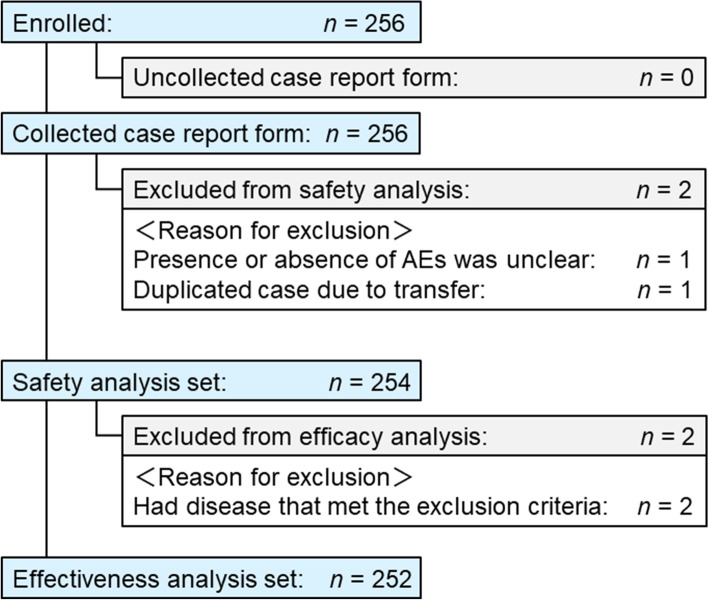
A total of 256 patients were enrolled; 252 and 254 were included in the effectiveness and safety analysis set, respectively. Most patients (83.1%) received an initial eribulin dose of 1.4 mg/m (standard dose). Respective median OS (95% confidence interval [CI]) was 10.8 (8.5-13.1), 13.8 (10.1-22.3) and 6.5 (5.7-11.1) months for all, L-type, and non-L-type subtypes. The respective median TTF (95% CI) was 2.5 (2.1-2.8), 2.8 (2.3-3.7), and 2.2 (1.6-2.6) months. The ORR and DCR were 8.1 and 42.6%, respectively. Adverse drug reactions (ADRs) and serious ADRs were reported for 83.5 and 18.9% of patients, respectively. The main ADRs were associated with myelosuppression. No significant difference was observed in the incidence of ADRs for patients ≥65 versus <65 years old.
Eribulin demonstrated effectiveness and a manageable safety profile for patients with STS, although the effectiveness of eribulin was not demonstrated for some non-L-type subtypes.
NCT03058406 ( ClinicalTrials.gov ).
软组织肉瘤(STS)是一组具有 100 多种描述性亚型的异质性癌症。尽管这些癌症并不常见,但预后却相当差,尤其是对于那些患有 IV 期转移性疾病的患者。对于那些难以进行根治性切除或患有复发性转移性疾病的患者,采用化疗治疗,尽管选择非常有限。在日本,表柔比星是所有 STS 亚型的一种获批治疗药物。对于除脂肪肉瘤和平滑肌肉瘤(L 型肉瘤)以外的罕见 STS 亚型的治疗效果和安全性数据有限。本项全国性、多中心、前瞻性、上市后观察性研究旨在评估在日本 STS 患者中使用表柔比星的真实世界疗效和安全性。
所有类型的 STS 患者,且同意接受表柔比星治疗的患者,有资格参与本研究。观察期为 1 年,从开始治疗时开始,在开始治疗后 2 年内随访临床结局。主要终点为总生存期(OS)。其他结局包括治疗失败时间(TTF)、客观缓解率(ORR)、疾病控制率(DCR)和安全性。使用影像学检查结果评估 ORR 和 DCR。疗效结果同时在所有患者和 STS 亚型中进行分析。
共纳入 256 例患者;有效性分析集和安全性分析集分别纳入 252 例和 254 例患者。大多数患者(83.1%)接受了初始 1.4mg/m 的表柔比星剂量(标准剂量)。所有患者、L 型患者和非 L 型患者的中位 OS(95%CI)分别为 10.8(8.5-13.1)、13.8(10.1-22.3)和 6.5(5.7-11.1)个月。相应的中位 TTF(95%CI)分别为 2.5(2.1-2.8)、2.8(2.3-3.7)和 2.2(1.6-2.6)个月。ORR 和 DCR 分别为 8.1%和 42.6%。分别有 83.5%和 18.9%的患者报告了药物不良反应(ADR)和严重 ADR。主要 ADR 与骨髓抑制相关。≥65 岁和<65 岁患者的 ADR 发生率无显著差异。
表柔比星在 STS 患者中表现出有效性和可管理的安全性特征,尽管对某些非 L 型亚型的疗效尚未得到证实。
NCT03058406(ClinicalTrials.gov)。