Community Health Sciences, University of Calgary, Calgary, Alberta, Canada.
Medicine, University of Calgary, Calgary, Alberta, Canada.
BMJ Open. 2019 Jul 30;9(7):e030333. doi: 10.1136/bmjopen-2019-030333.
Fatigue is a pervasive symptom of end-stage renal disease (ESRD) that is associated with low quality of life, disability and mortality, and has been identified as a top research priority by patients. We developed a personalised, web-supported educational programme (the Personal Energy Planning (PEP) programme) to teach people with ESRD to use energy management to manage fatigue. Preliminary studies have demonstrated positive effects on fatigue and life participation (ie, the ability to participate in valued day-to-day activities), which justifies the need for a randomised controlled trial (RCT) to better understand the efficacy of the programme. The objectives of the pilot RCT are to estimate RCT eligibility, recruitment and attrition rates, to inform the primary outcome measure and sample size for the RCT and to evaluate treatment fidelity among programme administrators.
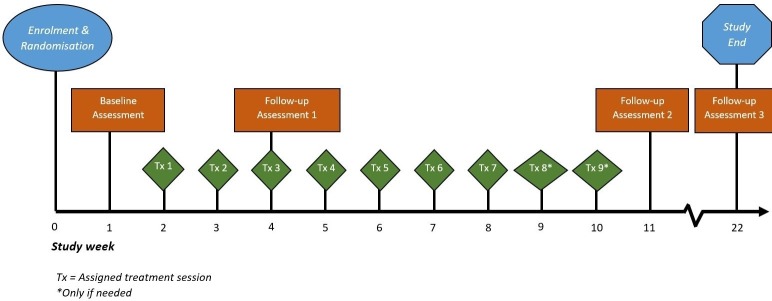
A parallel-arm, 1:1 pilot RCT will be conducted at four in-centre haemodialysis units in Calgary, Alberta, Canada. People on haemodialysis who report moderate or severe fatigue on the Fatigue Severity Scale, and meet other study eligibility criteria, will be invited to participate. Consenting participants will be randomised to undergo the 7-9 week 'PEP' programme or an active control, and followed for 12 weeks after the programme concludes. Information on eligibility, recruitment and attrition rates will be collected, and questionnaires assessing fatigue and life participation will be administered preintervention, midintervention, immediately postintervention and 12 weeks postintervention. Analyses will include calculation of eligibility, recruitment and attrition rates; power considerations for the full-scale RCT and evaluation of treatment fidelity of programme administrators.
Risks associated with this study are minor. Patients may experience emotional discomfort while filling out study questionnaires. They will be advised to skip any questions that make them uncomfortable. Potential benefits of participating include any benefit derived from the study intervention, and contributing to research that may benefit people with kidney disease in the future. Trial results will be disseminated via publication in an academic journal and presentation at academic conferences. The study has been approved by the Conjoint Health Research Ethics Board at the University of Calgary (ID #18-1657).
疲劳是终末期肾病(ESRD)的一种普遍症状,与生活质量差、残疾和死亡率有关,并且已被患者确定为首要研究重点。我们开发了一种个性化的、基于网络的教育计划(个人能量规划(PEP)计划),以教给 ESRD 患者使用能量管理来管理疲劳。初步研究表明该计划对疲劳和生活参与度(即参与有价值的日常活动的能力)有积极影响,这证明有必要进行随机对照试验(RCT)以更好地了解该计划的疗效。该试验的目的是估计 RCT 的合格性、招募率和流失率,为 RCT 的主要结局指标和样本量提供信息,并评估计划管理员的治疗依从性。
一项在加拿大阿尔伯塔省卡尔加里的四个中心血液透析单位进行的平行臂、1:1 试验性 RCT。报告疲劳严重程度量表中度或重度疲劳且符合其他研究合格标准的血液透析患者将被邀请参加。同意参加的参与者将被随机分配接受为期 7-9 周的“PEP”计划或积极对照治疗,并在计划结束后 12 周进行随访。将收集有关合格性、招募率和流失率的信息,并在干预前、干预中期、干预结束后立即和干预结束后 12 周进行评估疲劳和生活参与度的问卷。分析将包括计算合格性、招募率和流失率;为全面 RCT 提供动力考虑因素,并评估计划管理员的治疗依从性。
这项研究的风险很小。患者在填写研究问卷时可能会感到情绪不适。他们将被建议跳过任何让他们感到不舒服的问题。参与的潜在好处包括从研究干预中获得的任何好处,并为未来可能有益于肾病患者的研究做出贡献。试验结果将通过在学术期刊上发表和在学术会议上发表来传播。该研究已获得卡尔加里大学联合健康研究伦理委员会的批准(ID #18-1657)。