Division of Cancer Services, Princess Alexandra Hospital, Brisbane, Queensland, Australia.
Centre for Healthcare Transformation, Queensland University of Technology, Brisbane, Queensland, Australia.
BMJ Open. 2022 May 16;12(5):e059952. doi: 10.1136/bmjopen-2021-059952.
Cancer-related fatigue (CRF) is one of the most common and debilitating adverse effects of cancer and its treatment reported by cancer survivors. Physical activity, psychological interventions and management of concurrent symptoms have been shown to be effective in alleviating CRF. This pilot randomised controlled trial (RCT) will determine the feasibility of a telehealth CRF clinic intervention (T-CRF) to implement evidence-based strategies and assess the impact of the intervention on CRF and other clinical factors in comparison to usual care.
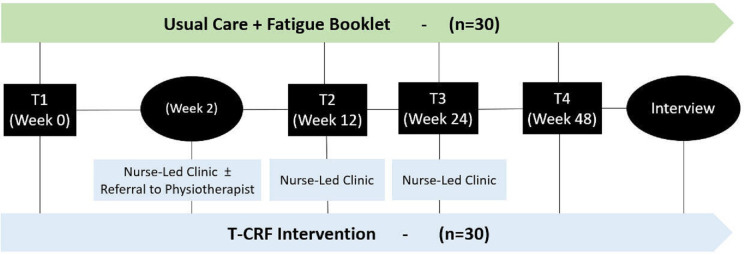
A parallel-arm (intervention vs usual care) pilot RCT will be conducted at the Princess Alexandra Hospital in Queensland, Australia. Sixty cancer survivors aged 18 years and over, who report moderate or severe fatigue on the Brief Fatigue Inventory and meet other study criteria will be recruited. Participants will be randomised (1:1) to receive the T-CRF intervention or usual care (ie, specialist-led care, with a fatigue information booklet). The intervention is a 24-week programme of three telehealth nurse-led consultations and a personalised CRF management plan. The primary objective of this pilot RCT is to determine intervention feasibility, with a secondary objective to determine preliminary clinical efficacy. Feasibility outcomes include the identification of recruitment methods; recruitment rate and uptake; attrition; adherence; fidelity; apathy; and intervention functionality, acceptability and satisfaction. Clinical and resource use outcomes include cancer survivor fatigue, symptom burden, level of physical activity, productivity loss, hospital resource utilisation and carer's fatigue and productivity loss. Descriptive statistics will be used to report on feasibility and process-related elements additional to clinical and resource outcomes.
This trial is prospectively registered (ACTRN12620001334998). The study protocol has been approved by the Metro South Health and Hospital Services Human Research Ethics Committee (MSHHS HREC/2020/QMS/63495). Findings will be disseminated through peer-reviewed publications, national and international conferences and seminars or workshops.
Australian New Zealand Clinical Trials Registry ID: ACTRN12620001334998; Pre-results. Trial Version: Version 1.1. Last updated 10 December 2020.
癌症相关性疲劳(CRF)是癌症幸存者报告的最常见和最具致残性的癌症相关不良反应之一。已证实,身体活动、心理干预和同时治疗症状可有效缓解 CRF。本先导随机对照试验(RCT)将确定远程医疗 CRF 诊所干预(T-CRF)的可行性,以实施基于证据的策略,并评估该干预对 CRF 和其他临床因素的影响,与常规护理相比。
将在澳大利亚昆士兰州的亚历山德拉公主医院进行一项平行臂(干预与常规护理)先导 RCT。将招募 60 名年龄在 18 岁及以上、在简要疲劳量表上报告中度或重度疲劳且符合其他研究标准的癌症幸存者。参与者将以 1:1 的比例随机分配到接受 T-CRF 干预或常规护理(即,专家主导的护理,同时提供疲劳信息手册)。干预是一项为期 24 周的三次远程医疗护士主导的咨询和个性化 CRF 管理计划。该先导 RCT 的主要目的是确定干预的可行性,次要目的是确定初步临床疗效。可行性结果包括确定招募方法、招募率和参与率、失访率、依从性、保真度、冷漠、以及干预的功能、可接受性和满意度。临床和资源使用结果包括癌症幸存者的疲劳、症状负担、身体活动水平、生产力损失、医院资源利用以及照顾者的疲劳和生产力损失。将使用描述性统计来报告可行性和与过程相关的元素,除了临床和资源结果之外。
本试验已前瞻性注册(ACTRN12620001334998)。研究方案已获得 Metro South 卫生和医院服务人体研究伦理委员会(MSHHS HREC/2020/QMS/63495)的批准。研究结果将通过同行评议的出版物、国家和国际会议以及研讨会或讲习班进行传播。
澳大利亚新西兰临床试验注册中心 ID:ACTRN12620001334998;预结果。试验版本:版本 1.1。最后更新于 2020 年 12 月 10 日。