Laboratoire des Sciences du Climat et de l'Environnement, CEA-CNRS-UVSQ/IPSL, Université Paris Saclay, 91191, Gif sur Yvette, France.
International Institute for Applied Systems Analysis, A-2361, Laxenburg, Austria.
Nat Commun. 2019 Jul 31;10(1):3420. doi: 10.1038/s41467-019-11066-3.
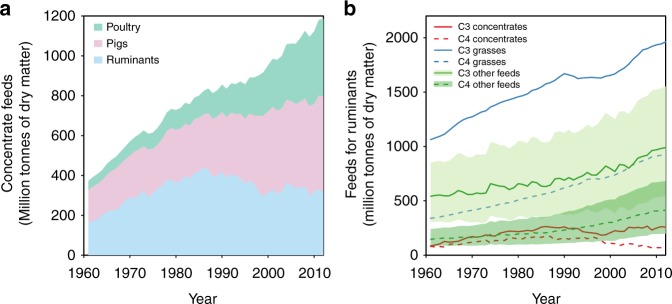
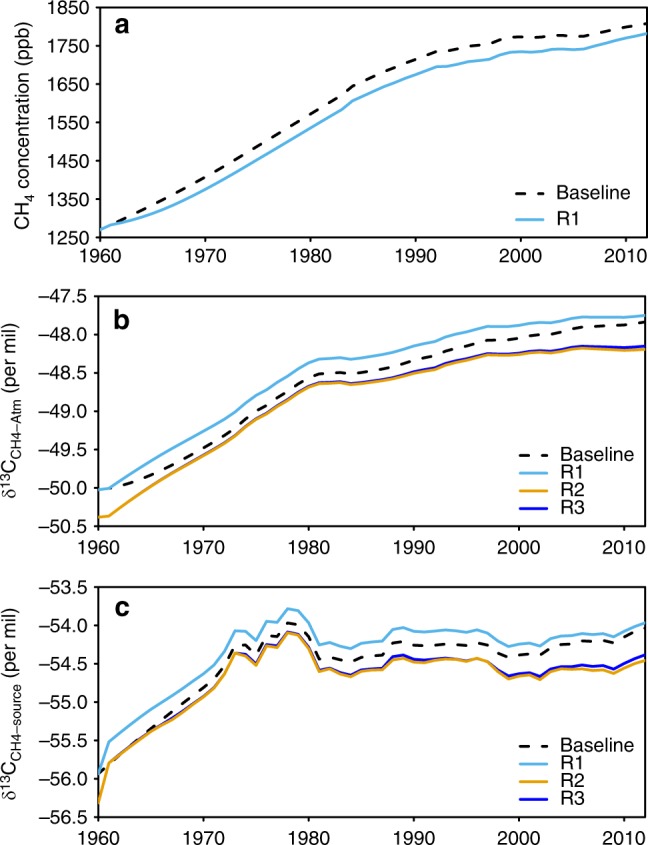
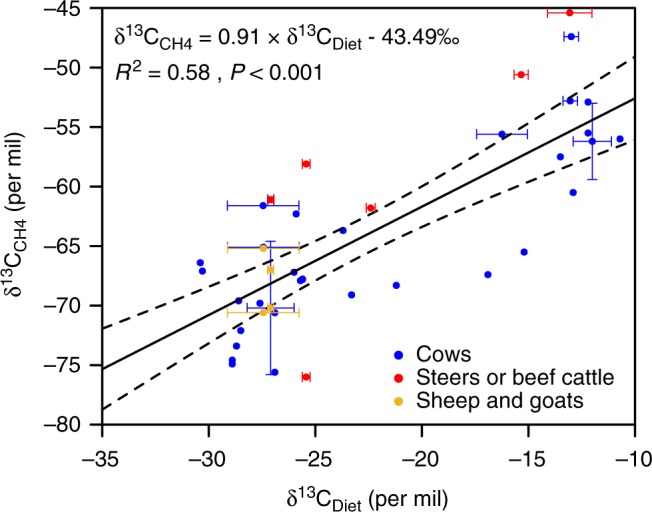
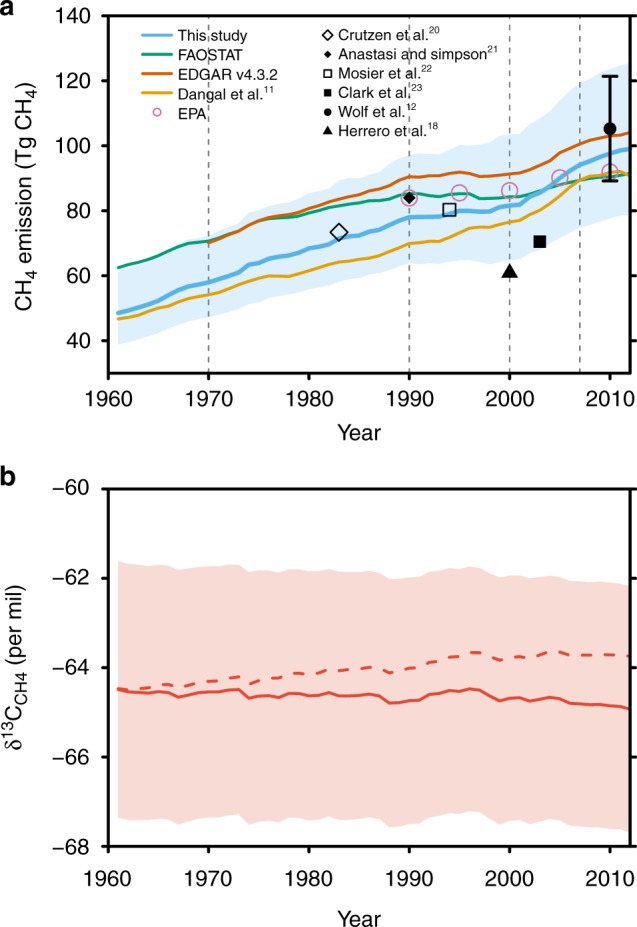
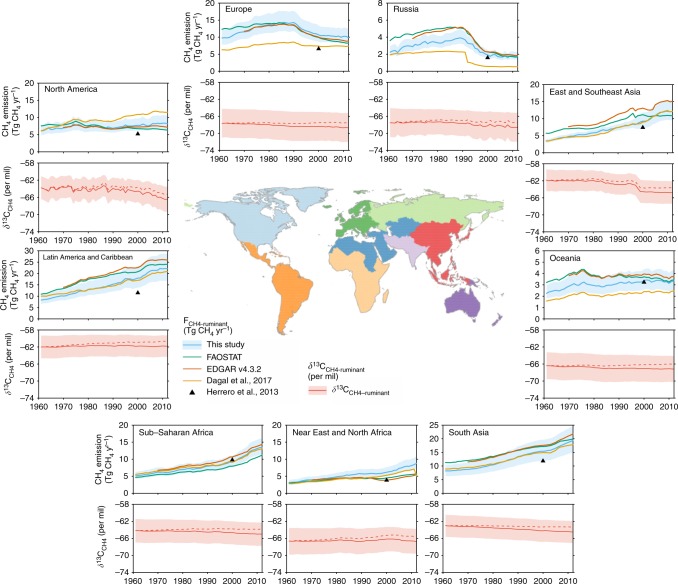
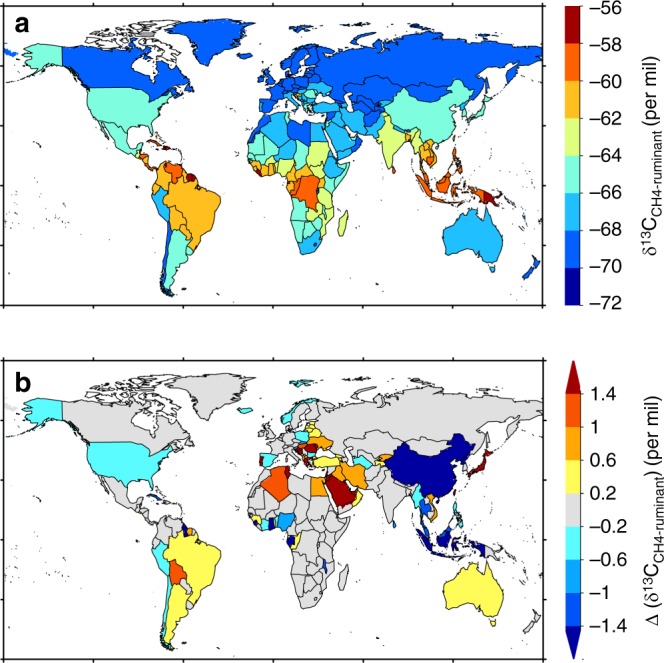
Accurate knowledge of C isotopic signature (δC) of methane from each source is crucial for separating biogenic, fossil fuel and pyrogenic emissions in bottom-up and top-down methane budget. Livestock production is the largest anthropogenic source in the global methane budget, mostly from enteric fermentation of domestic ruminants. However, the global average, geographical distribution and temporal variations of the δC of enteric emissions are not well understood yet. Here, we provide a new estimation of C3-C4 diet composition of domestic ruminants (cattle, buffaloes, goats and sheep), a revised estimation of yearly enteric CH emissions, and a new estimation for the evolution of its δC during the period 1961-2012. Compared to previous estimates, our results suggest a larger contribution of ruminants' enteric emissions to the increasing trend in global methane emissions between 2000 and 2012, and also a larger contribution to the observed decrease in the δC of atmospheric methane.
准确了解甲烷的碳同位素特征(δC)对于在自下而上和自上而下的甲烷预算中区分生物成因、化石燃料和热成因排放至关重要。畜牧业生产是全球甲烷预算中最大的人为源,主要来自反刍动物的瘤胃发酵。然而,肠道排放的 δC 的全球平均值、地理分布和时间变化尚不清楚。在这里,我们提供了对反刍动物(牛、水牛、山羊和绵羊)的 C3-C4 饮食组成的新估计,对每年肠道 CH 排放的修订估计,以及对 1961-2012 年期间其 δC 演变的新估计。与以前的估计相比,我们的结果表明,反刍动物肠道排放对 2000 年至 2012 年期间全球甲烷排放增加趋势的贡献更大,对大气甲烷 δC 观测下降的贡献也更大。