Faculty of Life Science and Technology, Central South University of Forestry and Technology, Changsha, 410004, Hunan, China.
National Engineering Laboratory for Applied Technology of Forestry and Ecology in South China, Central South University of Forestry and Technology, Changsha, 410004, Hunan, China.
Sci Rep. 2019 Jul 31;9(1):11116. doi: 10.1038/s41598-019-46983-2.
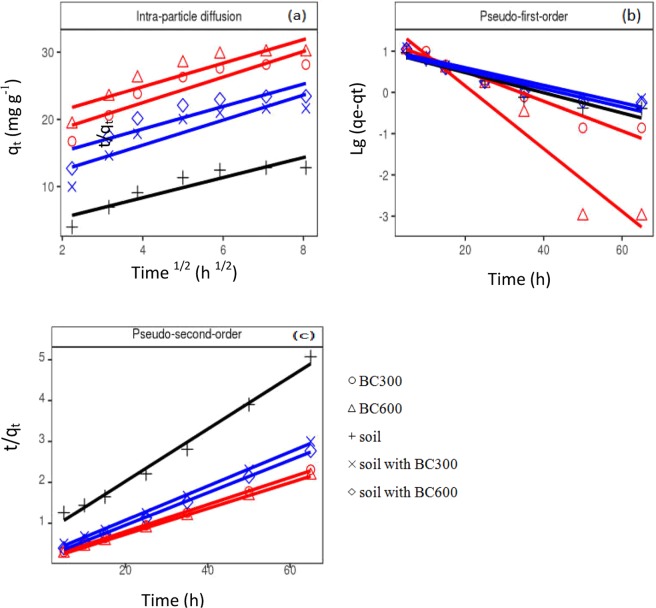
Biochar as a promising adsorbent to remove heavy metals has attracted much attention globally. One of the potential adsorbents is biochar derived from punica granatum peels, a growing but often wasted resource in tropical countries. However, the immobilization capacity of punica granatum peel biochar is not known. This study investigated the physicochemical properties of punica granatum peel boichars pyrolyzed at 300 °C and 600 °C (referred as BC300 and BC600), and the efficiency and mechanisms of Cu(II) adsorption of five types of material treatments: BC300, BC600, soil only, and soils with biochar amendment BC300 and BC600, respectively, at the rate of 1% of the soil by weight. The results show that BC300 had higher yield, volatile matter content and organic carbon content, and larger pore diameter, but less ash content, surface area, pH, and cation exchange capacity than BC600. The Cu(II) adsorption capacity onto biochars and soils with biochar were greatly influenced by initial ion concentration and contact time. The Cu(II) adsorption capacity of biochar, independent of pyrolysis temperature, was around 52 mg g. The adsorption capacity of the soil amended with biochar nearly doubled (29.85 mg g) compared to that of the original soil (14.99 mg g), indicating superb synergetic adsorption capacity of the biochar-amended soils. The adsorption isotherms showed monolayer adsorption of Cu(II) on biochar, and co-existence of monolayer and multilayer adsorption in soils with or without biochar amendment. Results also suggest that the adsorption process is spontaneous and endothermic, and the rate-limiting phase of the sorption process is primarily chemical. This study demonstrates punica granatum peel biochar has a great potential as an adsorbent for Cu(II) removal in soil.
生物炭作为一种很有前途的吸附剂,可以去除重金属,在全球范围内引起了广泛关注。其中一种潜在的吸附剂是由石榴皮制成的生物炭,石榴在热带国家是一种不断增长但经常被浪费的资源。然而,石榴皮生物炭的固定容量尚不清楚。本研究调查了在 300°C 和 600°C 下热解得到的石榴皮生物炭(分别称为 BC300 和 BC600)的物理化学性质,以及五种材料处理方式(BC300、BC600、仅土壤、以及分别添加 1%(按重量计)生物炭的土壤)对 Cu(II)吸附的效率和机制。结果表明,BC300 的产率、挥发分含量和有机碳含量较高,孔径较大,但灰分含量、表面积、pH 值和阳离子交换容量较低。生物炭和添加生物炭的土壤对 Cu(II)的吸附能力受初始离子浓度和接触时间的影响很大。独立于热解温度,生物炭对 Cu(II)的吸附容量约为 52mg g。与原始土壤(14.99mg g)相比,添加生物炭的土壤的吸附容量几乎增加了一倍(29.85mg g),表明添加生物炭的土壤具有极好的协同吸附能力。吸附等温线表明,Cu(II)在生物炭上的吸附是单层吸附,而在添加或不添加生物炭的土壤中,同时存在单层和多层吸附。结果还表明,吸附过程是自发和吸热的,吸附过程的限速阶段主要是化学的。本研究表明,石榴皮生物炭作为土壤中去除 Cu(II)的吸附剂具有很大的潜力。