Ntavatzikos Anastasios, Spathis Aris, Patapis Paul, Machairas Nikolaos, Vourli Georgia, Peros George, Papadopoulos Iordanis, Panayiotides Ioannis, Koumarianou Anna
Hematology-Oncology Unit, 4th Department of Internal Medicine, Medical School, National and Kapodistrian University of Athens, "ATTIKON" University Hospital, Athens 12462, Greece.
Department of Cytopathology, National and Kapodistrian University of Athens, Medical School, "ATTIKON" University Hospital, Athens 12462, Greece.
World J Gastrointest Oncol. 2019 Jul 15;11(7):551-566. doi: 10.4251/wjgo.v11.i7.551.
Patients with stage II-III colorectal cancer (CRC) treated with adjuvant chemotherapy, gain a 25% survival benefit. In the context of personalized medicine, there is a need to identify patients with CRC who may benefit from adjuvant chemotherapy. Molecular profiling could guide treatment decisions in these patients. Thymidylate synthase () gene polymorphisms, and could be included in the molecular profile under consideration.
To investigate the association of gene polymorphisms, and mutations with survival of CRC patients treated with chemotherapy.
A retrospective study studied formalin-fixed paraffin-embedded tissues (FFPEs) of consecutive patients treated with adjuvant chemotherapy during January/2005-January/2007. FFPEs were analysed with PCR for the detection of polymorphisms, mutated (m) and BRAF (m). Patients were classified into three groups (high, medium and low risk) according to 5'UTR polymorphisms Similarly, based on 3'UTR polymorphism ins/loss of heterozygosity (LOH) patients were allocated into two groups (high and low risk of relapse, respectively). Cox regression models examined the associated 5-year survival outcomes.
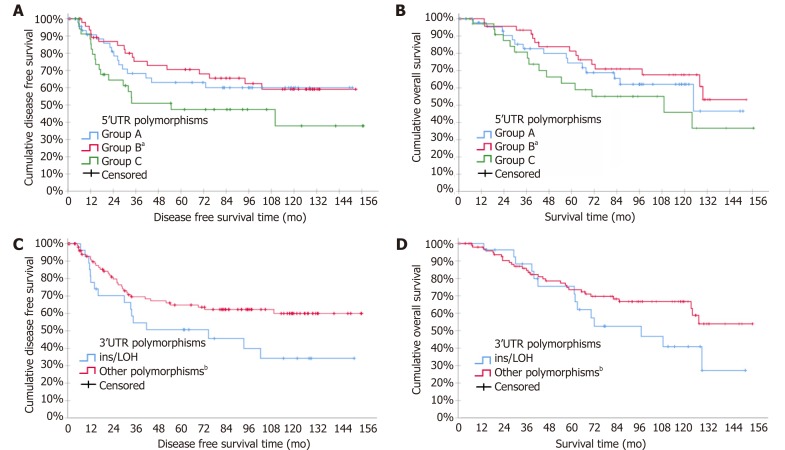
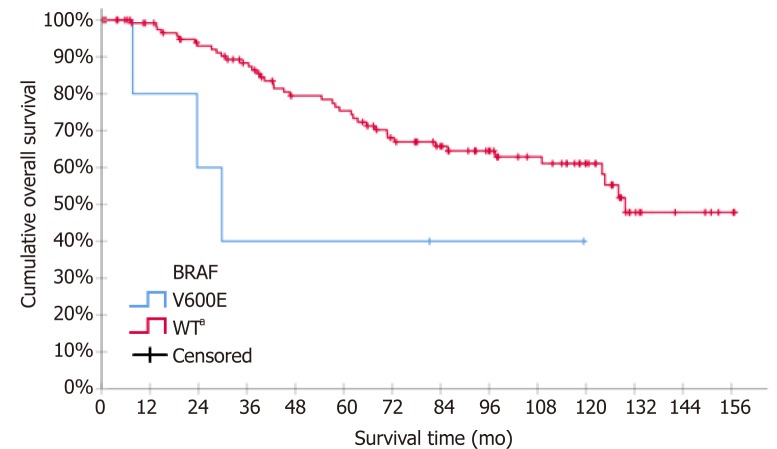
One hundred and thirty patients with early stage CRC (stage I-II: 55 patients; stage III 75 patients; colon: 70 patients; rectal: 60 patients) were treated with surgery and chemotherapy. The 5-year disease free survival and overall survival rate was 61.6% and 73.9% respectively. 5'UTR polymorphisms of intermediate polymorphisms (2RG/3RG, 2RG/LOH, 3RC/LOH) were associated with lower risk for relapse [hazard ratio (HR) 0.320, = 0.02 and HR 0.343, = 0.013 respectively] and death (HR 0.368, = 0.031 and HR 0.394, = 0.029 respectively). The 3'UTR polymorphism ins/LOH was independently associated with increased risk for disease recurrence ( = 0.001) and death ( = 0.005). m (3.8% of patients) was associated with increased risk of death (HR 4.500, = 0.022) whereas m (39% of patients) not.
Prospective validating studies are required to confirm whether 2RG/3RG, 2RG/LOH, 3RC/LOH, absence of ins/LOH and wild type may indicate patients at lower risk of relapse following adjuvant chemotherapy.
接受辅助化疗的II - III期结直肠癌(CRC)患者的生存率可提高25%。在个性化医疗的背景下,有必要识别可能从辅助化疗中获益的CRC患者。分子谱分析可为这些患者的治疗决策提供指导。胸苷酸合成酶()基因多态性、和可纳入正在考虑的分子谱中。
研究基因多态性、突变与接受化疗的CRC患者生存率之间的关联。
一项回顾性研究对2005年1月至2007年1月期间接受辅助化疗的连续患者的福尔马林固定石蜡包埋组织(FFPE)进行了研究。采用聚合酶链反应(PCR)分析FFPE,以检测多态性、突变型(m)和BRAF(m)。根据5'非翻译区(UTR)多态性将患者分为三组(高、中、低风险)。同样,基于3'UTR多态性插入/杂合性缺失(LOH)将患者分为两组(分别为高复发风险和低复发风险)。Cox回归模型检验了相关的5年生存结果。
130例早期CRC患者(I - II期:55例;III期:75例;结肠癌:70例;直肠癌:60例)接受了手术和化疗。5年无病生存率和总生存率分别为61.6%和73.9%。中间多态性(2RG/3RG、2RG/LOH、3RC/LOH)的5'UTR多态性与较低的复发风险[风险比(HR)分别为0.320, = 0.02和HR 0.343, = 0.013]和死亡风险(HR分别为0.368, = 0.031和HR 0.394, = 0.029)相关。3'UTR多态性插入/LOH与疾病复发风险增加( = 0.001)和死亡风险增加( = 0.005)独立相关。m(占患者的3.8%)与死亡风险增加相关(HR 4.500, = 0.022),而m(占患者的39%)则不然。
需要进行前瞻性验证研究,以确认2RG/3RG、2RG/LOH、3RC/LOH、无插入/LOH和野生型是否可表明辅助化疗后复发风险较低的患者。