Motedayen Morteza, Sarokhani Diana, Ghiasi Bahareh, Khatony Alireza, Hasanpour Dehkordi Ali
Department of Cardiology, Faculty of Medicine, Zanjan University of Medical Sciences, Zanjan, Iran.
Psychosocial Injuries Research Center, Ilam University of Medical Sciences, Ilam, Iran.
Int J Prev Med. 2019 Jul 5;10:124. doi: 10.4103/ijpvm.IJPVM_522_18. eCollection 2019.
Hypertension is a risk factor for renal disease. Therefore, this study was aimed at estimating the prevalence of hypertension in renal patients in Iran through meta-analysis.
The search was carried out using authentic Persian and English keywords in national and international databases including IranMedex, SID, Magiran, IranDoc, Medlib, ScienceDirect, Pubmed, Scopus, Cochrane, Embase, Web of Science, Medline, and Google Scholar search engine without any time limitation until 2017. Heterogeneity of studies was assessed using the index. Data were analyzed using STATA ver 11.
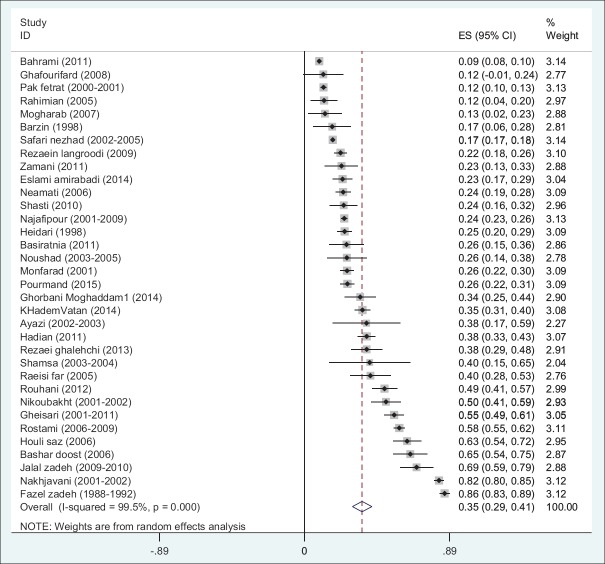
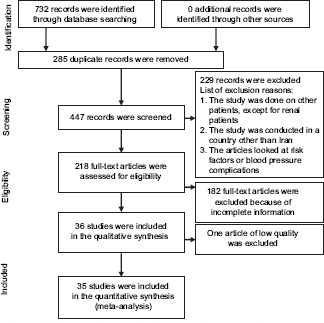
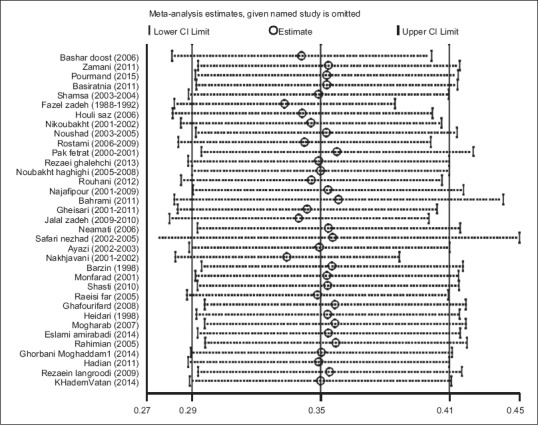
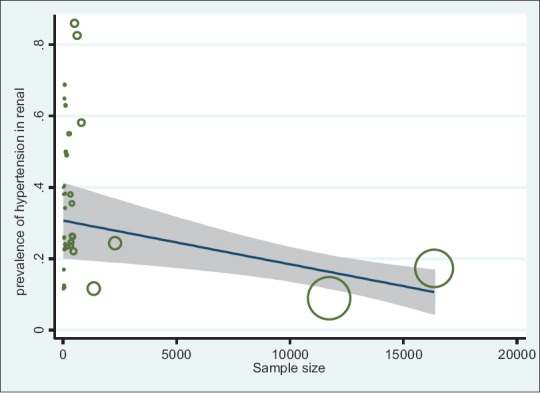
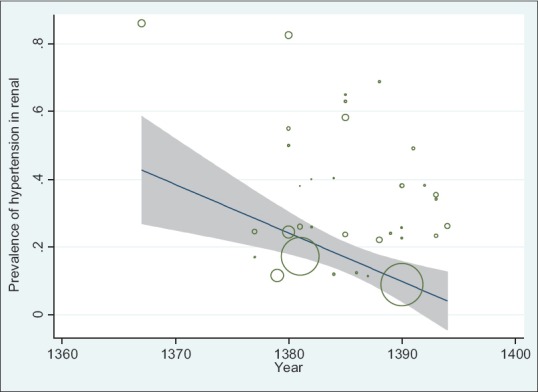
In 35 reviewed studies with a sample of 39,621 subjects, the prevalence of hypertension in renal patients was 35% (95% CI: 29%-41%) (25% in women and 18% in men). The prevalence of systolic hypertension in renal patients was 5%, diastolic hypertension 26%, and diabetes 23%. The prevalence of hypertension in hemodialysis patients was 34%, 27% in peritoneal dialysis, 43% in kidney transplantation, and 26% in chronic renal failure. In addition, meta-regression showed that the prevalence of hypertension in renal patients did not significantly decrease during the years 1988-2017.
More than a third of kidney patients in Iran suffer from high blood pressure. The diastolic blood pressure of these patients is about five times higher than their systolic blood pressure. Moreover, the age group under 30 is a high-risk group. The prevalence of hypertension in women with kidney disease is higher than in men. In addition, patients who have kidney transplants are more likely to have high blood pressure than other kidney patients.
高血压是肾脏疾病的一个危险因素。因此,本研究旨在通过荟萃分析评估伊朗肾病患者中高血压的患病率。
使用波斯语和英语的真实关键词在包括伊朗医学数据库(IranMedex)、科学信息数据库(SID)、马吉兰数据库(Magiran)、伊朗文档数据库(IranDoc)、医学图书馆数据库(Medlib)、科学Direct、PubMed、Scopus、Cochrane、Embase、科学网、医学在线和谷歌学术搜索引擎在内的国内外数据库中进行检索,检索时间无限制,截至2017年。使用 指数评估研究的异质性。数据使用STATA 11版进行分析。
在35项纳入研究中,样本量为39621名受试者,肾病患者中高血压的患病率为35%(95%置信区间:29%-41%)(女性为25%,男性为18%)。肾病患者中收缩期高血压的患病率为5%,舒张期高血压为26%,糖尿病为23%。血液透析患者中高血压的患病率为34%,腹膜透析患者为27%,肾移植患者为43%,慢性肾衰竭患者为26%。此外,荟萃回归显示,1988年至2017年期间,肾病患者中高血压的患病率没有显著下降。
伊朗超过三分之一的肾病患者患有高血压。这些患者的舒张压比收缩压高约五倍。此外,30岁以下年龄组是高危人群。肾病女性中高血压的患病率高于男性。此外,肾移植患者比其他肾病患者更易患高血压。