Department of Internal Medicine, Chung-Ang University College of Medicine, Seoul, Korea.
Department of Internal Medicine, Dongguk University College of Medicine Gyeongju Hospital, Gyeongju, Korea.
Helicobacter. 2019 Oct;24(5):e12646. doi: 10.1111/hel.12646. Epub 2019 Aug 1.
The Helicobacter pylori eradication rate has decreased with increasing antibiotic resistance. We conducted a prospective, nationwide, multicenter registry study to monitor the real status of H. pylori eradication therapy and to investigate the association between eradication success and antibiotic use density in Korea.
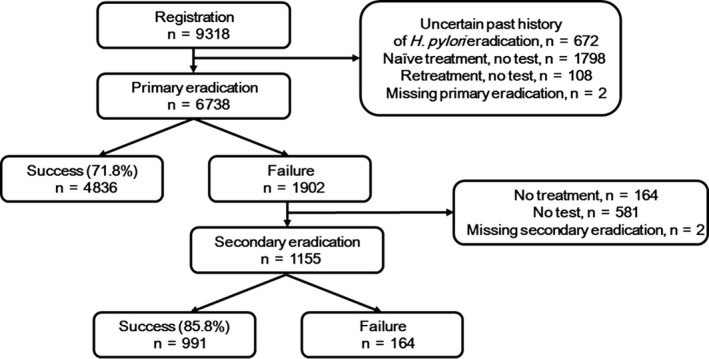
We enrolled 9318 patients undergoing H. pylori eradication therapy from 37 hospitals through "on-line database registry" from October 2010 to July 2015. Demographic data, detection methods, treatment indications, regimens, durations, compliance, adverse events, and eradication results were collected. The use of all commercially available eradication antibiotics was analyzed through the Korean National Health Insurance data of the Health Insurance Review and Assessment Service. The defined daily dose of antibiotics was used to standardize drug use comparisons.
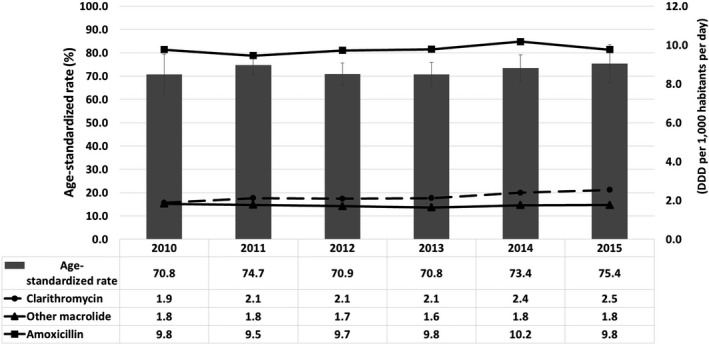
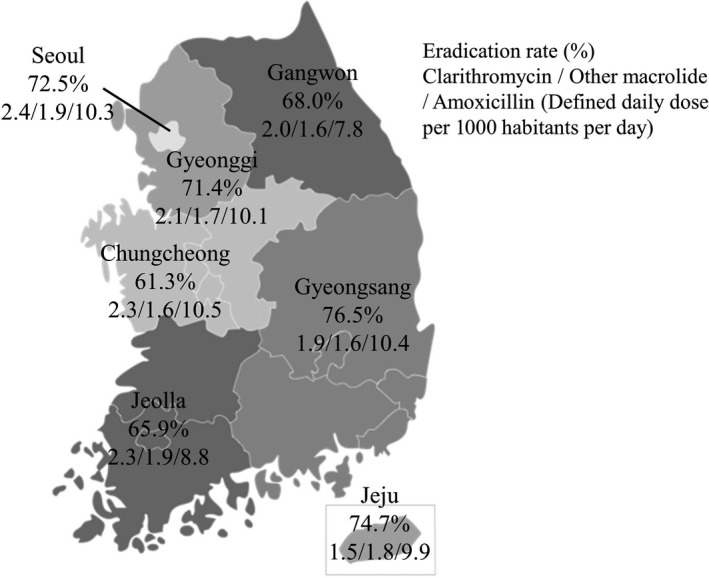
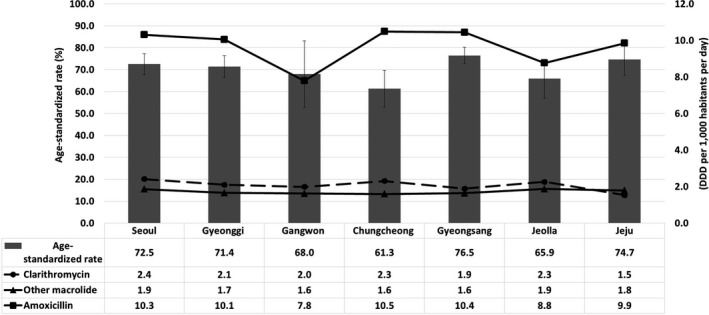
Finally, 6738 patients were analyzed. The overall eradication rate of first-line therapy was 71.8%. The eradication success rates were 71.7%, 86.9%, and 74.0% for standard triple therapy for 7 days, quadruple therapy, and concomitant therapy, respectively. The eradication success rate in naive patients was higher than that in those who previously underwent H. pylori eradication. Eradication success was significantly associated with younger age, female sex, and high compliance. Regional differences in eradication rates were observed. The yearly use density of clarithromycin increased statistically in seven regions across the country from 2010 to 2015. The yearly use density of amoxicillin in the Gyeongsang and Chungcheong areas was significantly increased (P < .01), whereas that of other macrolides was significantly lower in the Gyeonggi area than in other areas (P = .01). The overall use of eradication antibiotics has increased while the eradication rate steadily decreased for 5 years. However, there was no significant correlation between antibiotic use density and eradication.
There was no relationship between the eradication rate and antibiotic use density in Korea.
随着抗生素耐药性的增加,幽门螺杆菌的根除率有所下降。我们进行了一项前瞻性、全国性、多中心登记研究,以监测幽门螺杆菌根除治疗的真实状况,并调查韩国根除成功率与抗生素使用密度之间的关系。
我们通过“在线数据库登记”从 2010 年 10 月至 2015 年 7 月从 37 家医院招募了 9318 名接受幽门螺杆菌根除治疗的患者。收集了人口统计学数据、检测方法、治疗指征、方案、持续时间、依从性、不良反应和根除结果。通过健康保险审查和评估服务的韩国国家健康保险数据分析了所有市售的根除抗生素的使用情况。抗生素的定义日剂量用于标准化药物使用比较。
最终分析了 6738 例患者。一线治疗的总体根除率为 71.8%。标准 7 天三联疗法、四联疗法和同时疗法的根除成功率分别为 71.7%、86.9%和 74.0%。初治患者的根除成功率高于既往根除过幽门螺杆菌的患者。根除成功率与年龄较小、女性和高依从性显著相关。观察到根除率存在地区差异。2010 年至 2015 年,全国 7 个地区克拉霉素的年使用密度呈统计学增加。庆尚和忠清地区阿莫西林的年使用密度显著增加(P<.01),而京畿地区大环内酯类药物的年使用密度明显低于其他地区(P=.01)。总的来说,尽管根除率在 5 年内稳步下降,但 5 年来根除抗生素的使用量却有所增加。然而,抗生素使用密度与根除率之间没有显著相关性。
韩国的根除率与抗生素使用密度之间没有关系。