CHU Pellegrin, Clinique du Sommeil, F-33076, Bordeaux, France.
Université de Bordeaux, Sommeil, Addiction et Neuropsychiatrie, USR 3413, F-33000, Bordeaux, France.
BMC Psychiatry. 2019 Aug 1;19(1):237. doi: 10.1186/s12888-019-2218-0.
Neurofeedback (NF) has gained increasing interest among non-pharmacological treatments for Attention Deficit Hyperactivity Disorder (ADHD). NF training aims to enhance self-regulation of brain activities. The goal of the NEWROFEED study is to assess the efficacy of a new personalized NF training device, using two different protocols according to each child's electroencephalographic pattern, and designed for use at home. This study is a non-inferiority trial comparing NF to methylphenidate.
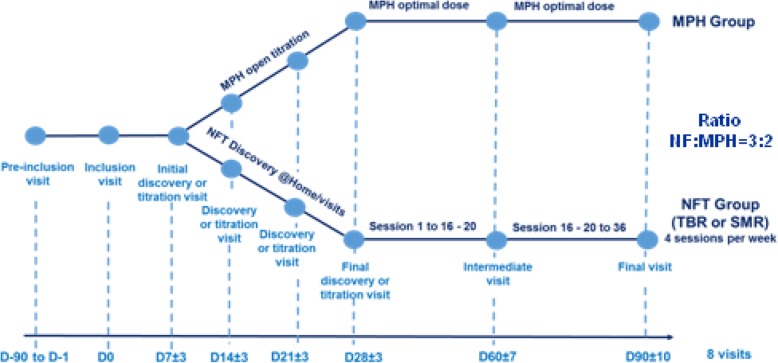
The study is a prospective, multicentre, randomized, reference drug-controlled trial. One hundred seventy-nine children with ADHD, aged 7 to 13 years will be recruited in 13 clinical centres from 5 European countries. Subjects will be randomized to two groups: NF group (Neurofeedback Training Group) and MPH group (Methylphenidate group). Outcome measures include clinicians, parents and teachers' assessments, attention measures and quantitative EEG (qEEG). Patients undergo eight visits over a three-month period: pre-inclusion visit, inclusion visit, 4 "discovery" (NF group) or titration visits (MPH group), an intermediate and a final visit. Patients will be randomized to either the MPH or NF group. Children in the NF group will undergo either an SMR or a Theta/Beta training protocol according to their baselineTheta/Beta Ratio obtained from the qEEG.
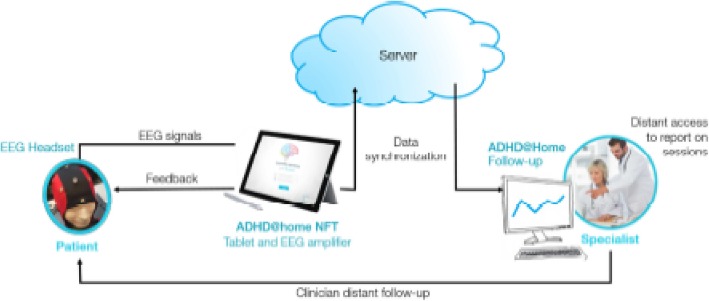
This is the first non-inferiority study between a personalized NF device and pharmacological treatment. Innovative aspects of Mensia Koala™ include the personalization of the training protocol according to initial qEEG characteristics (SMR or Theta/Beta training protocols) and an improved accessibility of NF due to the opportunity to train at home with monitoring by the clinician through a dedicated web portal.
NCT02778360 . Date registration (retrospectively registered): 5-12-2016. Registered May 19, 2016.
神经反馈(NF)作为非药物治疗注意缺陷多动障碍(ADHD)的方法,越来越受到关注。NF 训练旨在增强大脑活动的自我调节能力。NEWROFEED 研究的目的是评估一种新的个性化 NF 训练设备的疗效,该设备根据每个孩子的脑电图模式使用两种不同的方案设计,并用于家庭使用。这项研究是一项非劣效性试验,将 NF 与哌甲酯进行比较。
该研究是一项前瞻性、多中心、随机、对照药物对照试验。将从 5 个欧洲国家的 13 个临床中心招募 179 名年龄在 7 至 13 岁的 ADHD 儿童。受试者将随机分为两组:NF 组(神经反馈训练组)和 MPH 组(哌甲酯组)。主要观察指标包括临床医生、家长和教师的评估、注意力测量和定量脑电图(qEEG)。患者在三个月的时间内接受 8 次就诊:入组前就诊、入组就诊、4 次“发现”(NF 组)或滴定就诊(MPH 组)、中期和最后就诊。患者将随机分配到 MPH 或 NF 组。NF 组的儿童将根据基线 qEEG 获得的θ/β 比值,进行 SMR 或θ/β 训练方案。
这是第一个个性化 NF 设备与药物治疗之间的非劣效性研究。MENSIA Koala™ 的创新之处在于根据初始 qEEG 特征(SMR 或θ/β 训练方案)个性化训练方案,以及通过专用网络门户由临床医生进行监测,使 NF 更容易获得。
NCT02778360。注册日期(回溯性注册):2016 年 12 月 5 日。2016 年 5 月 19 日注册。