Merritt Kate, Perez-Iglesias Rocio, Sendt Kyra-Verena, Goozee Rhianna, Jauhar Sameer, Pepper Fiona, Barker Gareth J, Glenthøj Birte, Arango Celso, Lewis Shôn, Kahn René, Stone James, Howes Oliver, Dazzan Paola, McGuire Philip, Egerton Alice
Department of Psychosis Studies, Institute of Psychiatry, Psychology & Neuroscience, De Crespigny Park, London, SE5 8AF, UK.
CIBERSAM: Centro Investigación Biomédica en Red Salud Mental, Santander, Spain.
NPJ Schizophr. 2019 Aug 1;5(1):12. doi: 10.1038/s41537-019-0080-1.
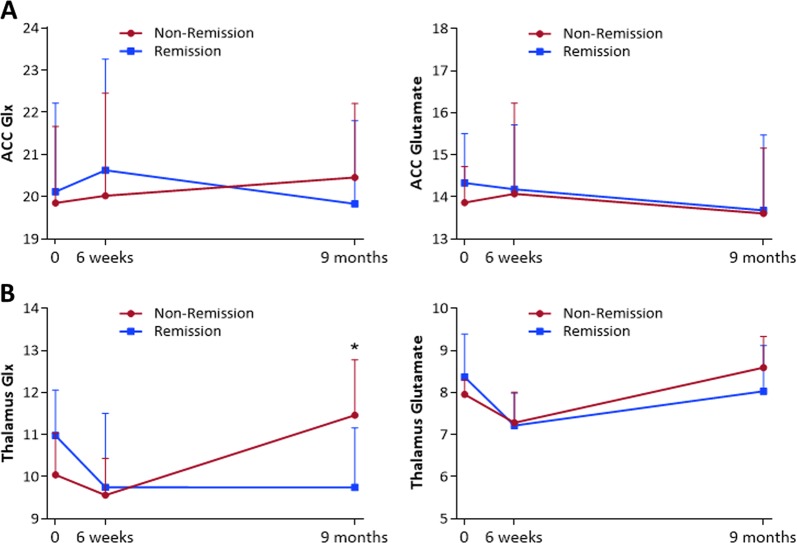
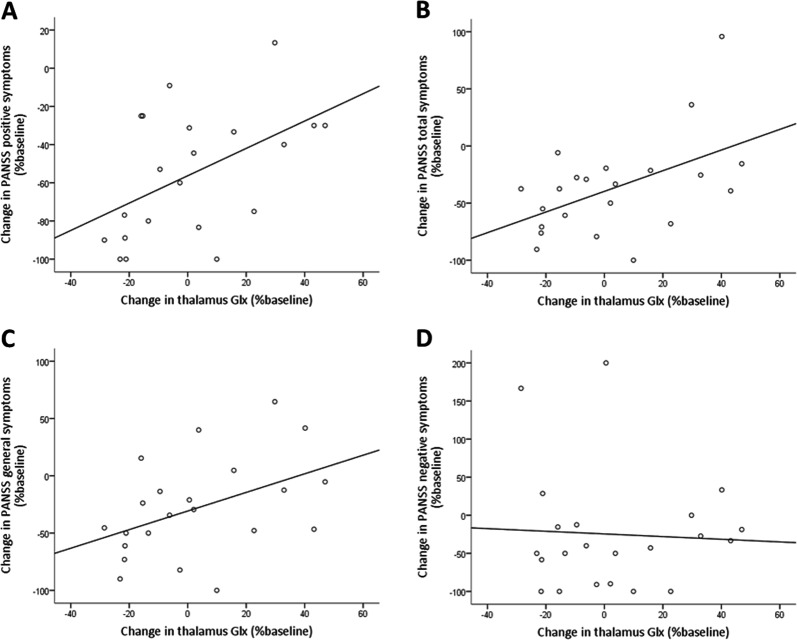
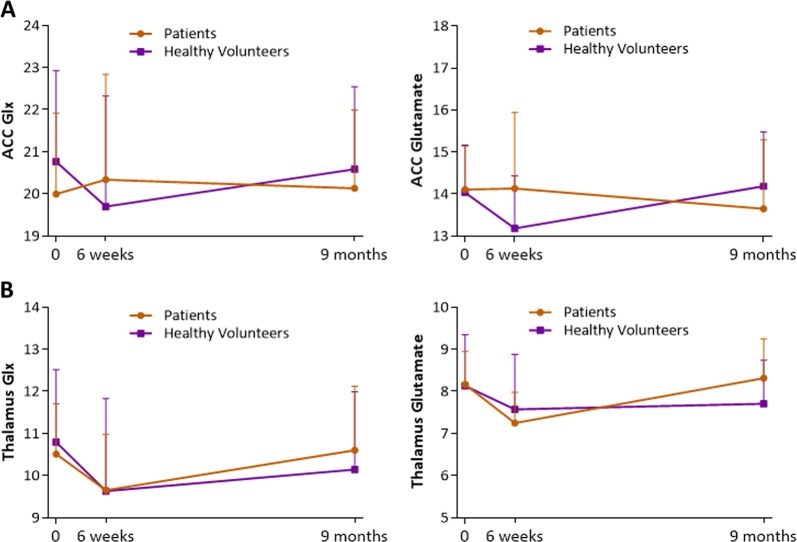
Neuroimaging studies in schizophrenia have linked elevated glutamate metabolite levels to non-remission following antipsychotic treatment, and also indicate that antipsychotics can reduce glutamate metabolite levels. However, the relationship between symptomatic reduction and change in glutamate during initial antipsychotic treatment is unclear. Here we report proton magnetic resonance spectroscopy (1H-MRS) measurements of Glx and glutamate in the anterior cingulate cortex (ACC) and thalamus in patients with first episode psychosis (n = 23) at clinical presentation, and after 6 weeks and 9 months of treatment with antipsychotic medication. At 9 months, patients were classified into Remission (n = 12) and Non-Remission (n = 11) subgroups. Healthy volunteers (n = 15) were scanned at the same three time-points. In the thalamus, Glx varied over time according to remission status (P = 0.020). This reflected an increase in Glx between 6 weeks and 9 months in the Non-Remission subgroup that was not evident in the Remission subgroup (P = 0.031). In addition, the change in Glx in the thalamus over the 9 months of treatment was positively correlated with the change in the severity of Positive and Negative Syndrome Scale (PANSS) positive, total and general symptoms (P<0.05). There were no significant effects of group or time on glutamate metabolites in the ACC, and no differences between either patient subgroup and healthy volunteers. These data suggest that the nature of the response to antipsychotic medication may be related to the pattern of changes in glutamatergic metabolite levels over the course of treatment. Specifically, longitudinal reductions in thalamic Glx levels following antipsychotic treatment are associated with symptomatic improvement.
精神分裂症的神经影像学研究表明,谷氨酸代谢物水平升高与抗精神病药物治疗后未缓解有关,同时也表明抗精神病药物可降低谷氨酸代谢物水平。然而,在初始抗精神病药物治疗期间,症状减轻与谷氨酸变化之间的关系尚不清楚。在此,我们报告了首次发作精神病患者(n = 23)在临床表现时、接受抗精神病药物治疗6周和9个月后,前扣带回皮质(ACC)和丘脑的Glx和谷氨酸的质子磁共振波谱(1H-MRS)测量结果。在9个月时,患者被分为缓解组(n = 12)和未缓解组(n = 11)。健康志愿者(n = 15)在相同的三个时间点进行扫描。在丘脑中,Glx根据缓解状态随时间变化(P = 0.020)。这反映了未缓解亚组在6周和9个月之间Glx增加,而在缓解亚组中不明显(P = 0.031)。此外,治疗9个月期间丘脑中Glx的变化与阳性和阴性症状量表(PANSS)阳性、总分和一般症状的严重程度变化呈正相关(P<0.05)。ACC中谷氨酸代谢物的组间或时间效应均不显著,患者亚组与健康志愿者之间也无差异。这些数据表明,对抗精神病药物治疗的反应性质可能与治疗过程中谷氨酸能代谢物水平的变化模式有关。具体而言,抗精神病药物治疗后丘脑Glx水平的纵向降低与症状改善相关。