Chen Cai-Ping, Sang Yi, Liu Lijuan, Feng Zhi-Qi, Liang Zibin, Pei Xiaofeng
Jiangsu Key Laboratory of Drug Discovery for Metabolic Disease, and State Key Laboratory of Natural Medicines, China Pharmaceutical University, Nanjing 210009, People's Republic of China.
Department of Center Laboratory, Jiangxi Key Laboratory of Cancer Metastasis and Precision Treatment, The Third Affiliated Hospital of Nanchang University, Nanchang, Jiangxi 330008, People's Republic of China.
Onco Targets Ther. 2019 Jul 12;12:5651-5660. doi: 10.2147/OTT.S208908. eCollection 2019.
Lung adenocarcinoma (LUAD) is one of the most common cancers worldwide. The THanatos-Associated Proteins (THAP) family plays an essential role in multiple cancers. However, the role of THAP7 in cancers has remained elusive.
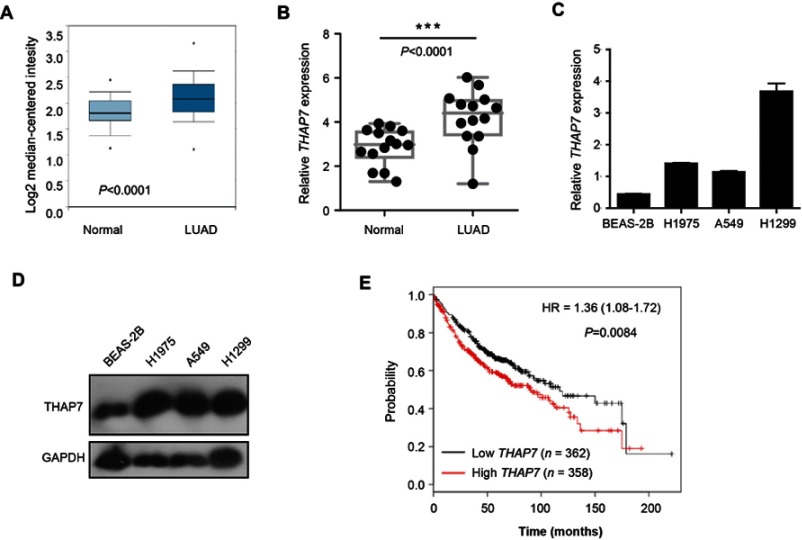
THAP7 expression status in LUAD tissues was analysed by using the Oncomine database and qRT-PCR, and its expression level in LUAD cell lines was detected by qRT-PCR and Western blotting. The role of THAP7 in LUAD cells was determined by proliferation, colony formation, and cell cycle analyses. In vivo role of THAP7 was studied on xenograft models. Luciferase reporter assays and chromatin immunoprecipitation (ChIP) were used to determine the activity and acetylation of the p21 promoter.
THAP7 expression was increased in LUAD tissues and cell lines. Moreover, the high expression of THAP7 was correlated with poor prognosis. The overexpression of THAP7 accelerated the G1/S phase transition and promoted tumour growth both in vitro and in vivo. A mechanistic study revealed that THAP7 reduced the acetylation of histone H3 on the p21 promoter to suppress p21 transcription.
For the first time, we demonstrated the function of THAP7 in LUAD, and our findings suggested that THAP7 may be a potential molecular therapy target in LUAD.
肺腺癌(LUAD)是全球最常见的癌症之一。与死亡相关蛋白(THAP)家族在多种癌症中发挥着重要作用。然而,THAP7在癌症中的作用仍不清楚。
利用Oncomine数据库和qRT-PCR分析LUAD组织中THAP7的表达状态,并通过qRT-PCR和蛋白质免疫印迹法检测其在LUAD细胞系中的表达水平。通过增殖、集落形成和细胞周期分析确定THAP7在LUAD细胞中的作用。在异种移植模型上研究THAP7的体内作用。采用荧光素酶报告基因检测和染色质免疫沉淀(ChIP)法测定p21启动子的活性和乙酰化水平。
THAP7在LUAD组织和细胞系中表达增加。此外,THAP7的高表达与预后不良相关。THAP7的过表达加速了G1/S期转变,促进了体外和体内肿瘤的生长。机制研究表明,THAP7降低了p21启动子上组蛋白H3的乙酰化水平,从而抑制p21转录。
我们首次证明了THAP7在LUAD中的功能,我们的研究结果表明THAP7可能是LUAD潜在的分子治疗靶点。