Han Dunxin, Wang Mingming, Yu Zhongkai, Yin Long, Liu Changli, Wang Jianmin, Liu Yongjun, Jiang Shengyang, Ren Zhongwu, Yin Jun
Department of Spine Surgery, 970 Hospital of the PLA Joint Logistic Support Force, Yantai, Shandong, People's Republic of China.
Department of Clinical Laboratory, Qingdao Women and Children's Hospital, Qingdao, People's Republic of China.
Cancer Manag Res. 2019 Jul 10;11:6457-6466. doi: 10.2147/CMAR.S200234. eCollection 2019.
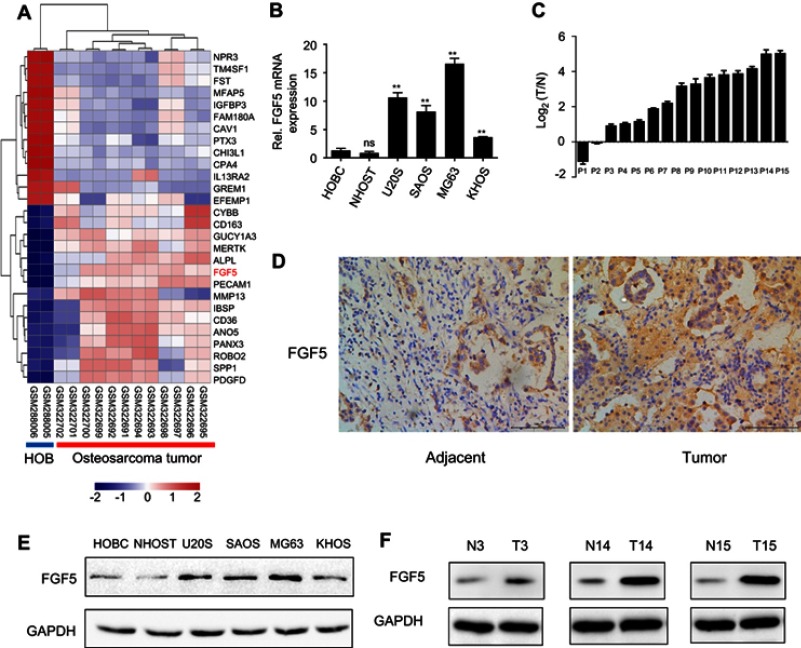
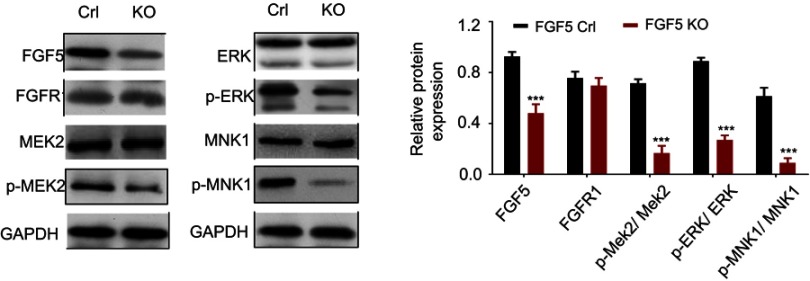
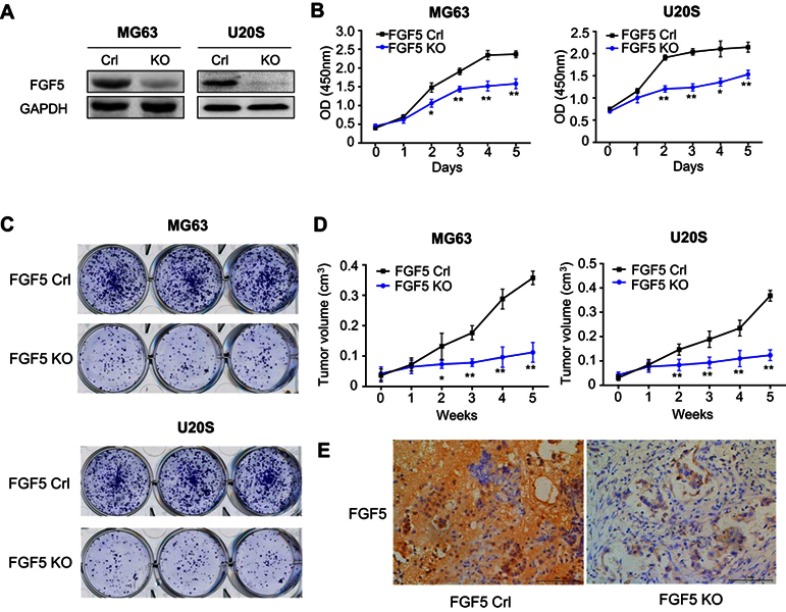
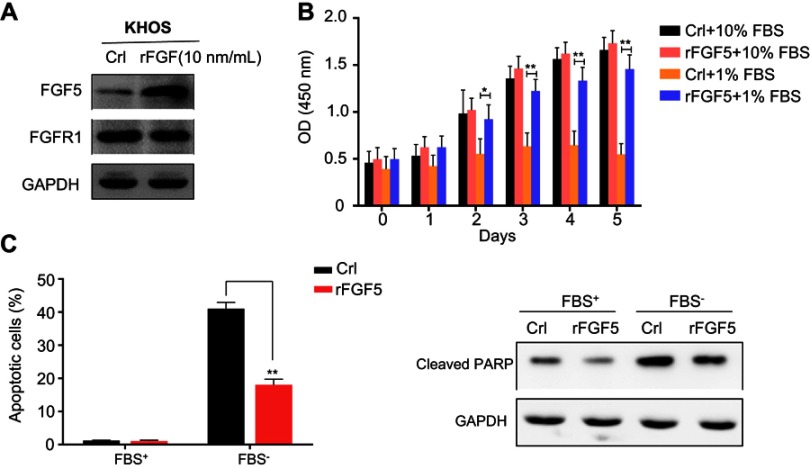
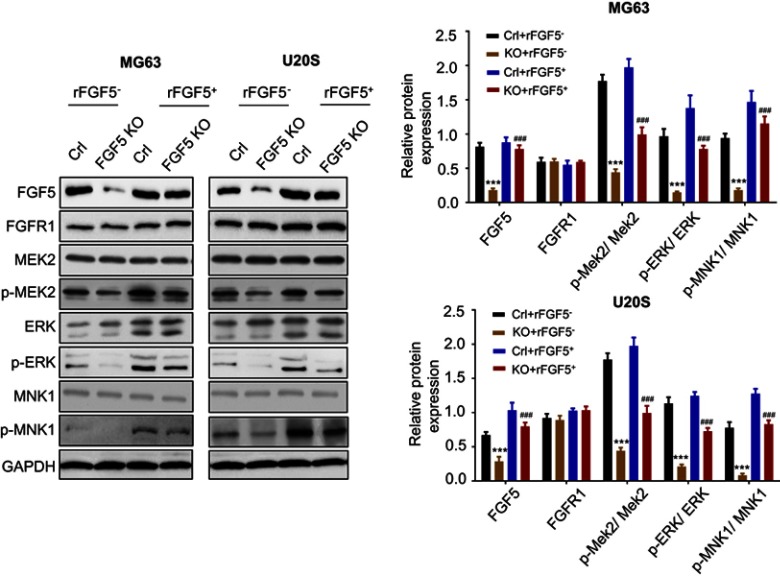
This study aimed to investigate the role of fibroblast growth factor-5 (FGF5) in osteosarcoma (OS) and explore the potential mechanisms. OS gene expression data was downloaded from the Gene Expression Omnibus (GEO; GSE12865) and analyzed by R software. OS tissues and cell lines were collected. The expression level of FGF5 in tumor tissues and cell lines was detected using qRT-PCR. Knockout of FGF5 was performed using CRISPR/Cas9 system. The effects of FGF5 knockout on OS cell proliferation and tumor growth were determined through cell counting kit-8 assay and xenograft nude mice, respectively. Additionally, recombinant FGF5 (rFGF5) was added into OS cell and the effects of rFGF5 on the proliferation and apoptosis of OS cell lines were assayed. Furthermore, the protein expression levels of mitogen-activated protein kinase (MAPK) signaling pathway were detected through Western blot. FGF5 was significantly upregulated in OS tissues and cells, and closely associated with poor differentiation, larger tumor size, lymph node metastasis, and advanced TNM stage. FGF5 knockout could inhibit proliferation of OS cells and tumor growth in nude mouse model. Addition of exogenous rFGF5 promoted OS cell proliferation while inhibited OS cell apoptosis. The expression levels of MAPK signaling pathway proteins in FGF5 knockout group were significantly lower than that in control when there was no rFGF5. Additionally, their expression level in rFGF5 addition group was higher than that in without rFGF5 group. We demonstrated for the first time that FGF5 was overexpressed in OS cell lines and clinical tissue samples and promotes OS cell proliferation by activating MAPK signaling pathway, which indicated that FGF5 was a potential therapeutic target for OS.
本研究旨在探讨成纤维细胞生长因子5(FGF5)在骨肉瘤(OS)中的作用并探索其潜在机制。从基因表达综合数据库(GEO;GSE12865)下载OS基因表达数据并用R软件进行分析。收集OS组织和细胞系。使用qRT-PCR检测肿瘤组织和细胞系中FGF5的表达水平。利用CRISPR/Cas9系统敲除FGF5。分别通过细胞计数试剂盒-8检测法和裸鼠异种移植实验确定FGF5敲除对OS细胞增殖和肿瘤生长的影响。此外,将重组FGF5(rFGF5)加入OS细胞中,检测rFGF5对OS细胞系增殖和凋亡的影响。此外,通过蛋白质免疫印迹法检测丝裂原活化蛋白激酶(MAPK)信号通路的蛋白质表达水平。FGF5在OS组织和细胞中显著上调,且与低分化、肿瘤体积较大、淋巴结转移及TNM分期较晚密切相关。FGF5敲除可抑制OS细胞增殖及裸鼠模型中的肿瘤生长。添加外源性rFGF5可促进OS细胞增殖,同时抑制OS细胞凋亡。在无rFGF5时,FGF5敲除组中MAPK信号通路蛋白的表达水平显著低于对照组。此外,rFGF5添加组中的表达水平高于无rFGF5组。我们首次证明FGF5在OS细胞系和临床组织样本中过表达,并通过激活MAPK信号通路促进OS细胞增殖,这表明FGF5是OS的一个潜在治疗靶点。