Max Planck Institute for Neurological Research, Klaus-Joachim-Zülch Laboratories of the Max Planck Society and the Medical Faculty of the University of Cologne, 50931 Cologne, Germany.
Sci Transl Med. 2010 Dec 15;2(62):62ra93. doi: 10.1126/scitranslmed.3001451.
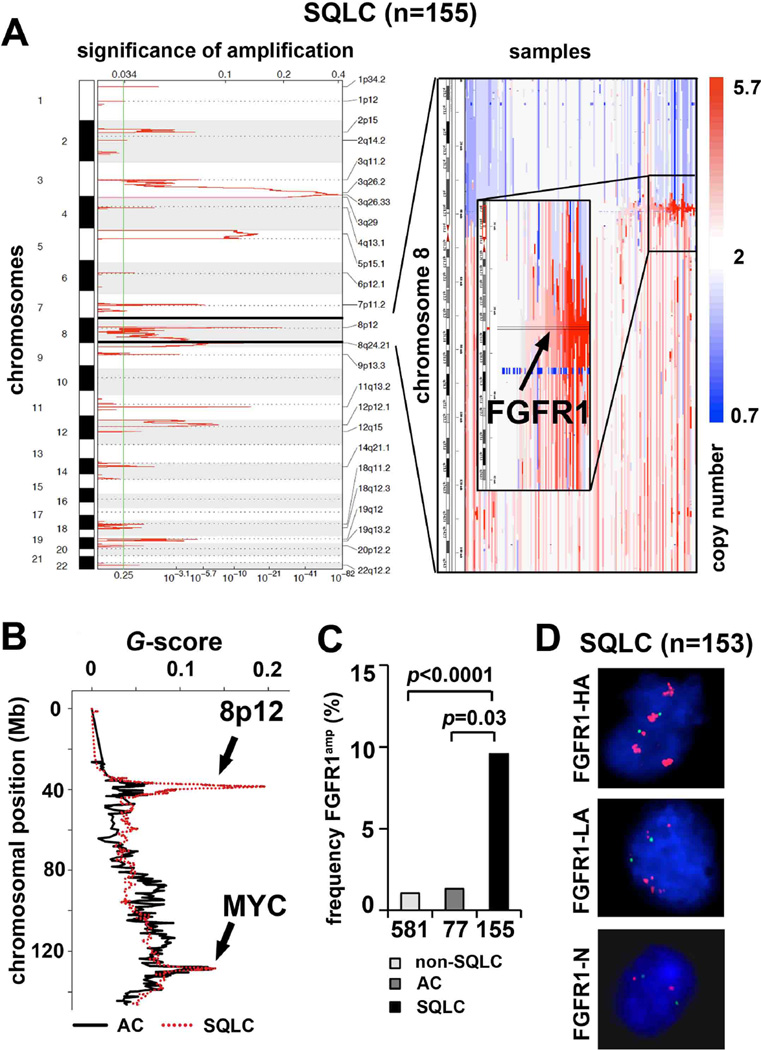
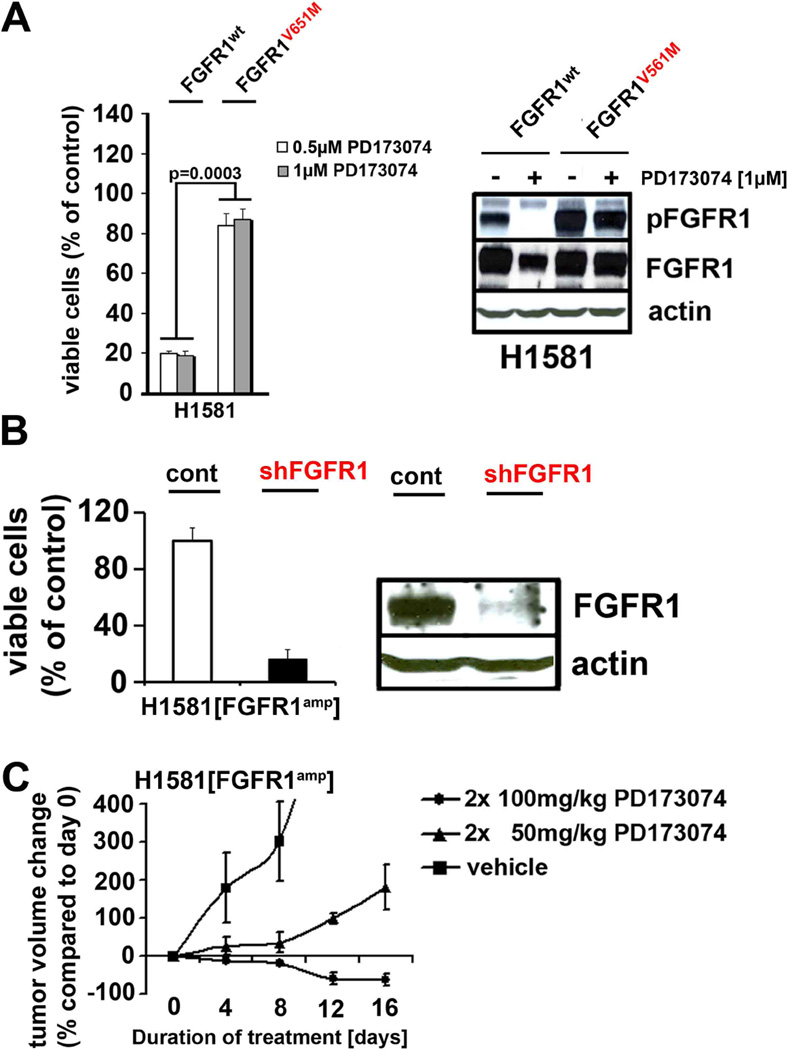
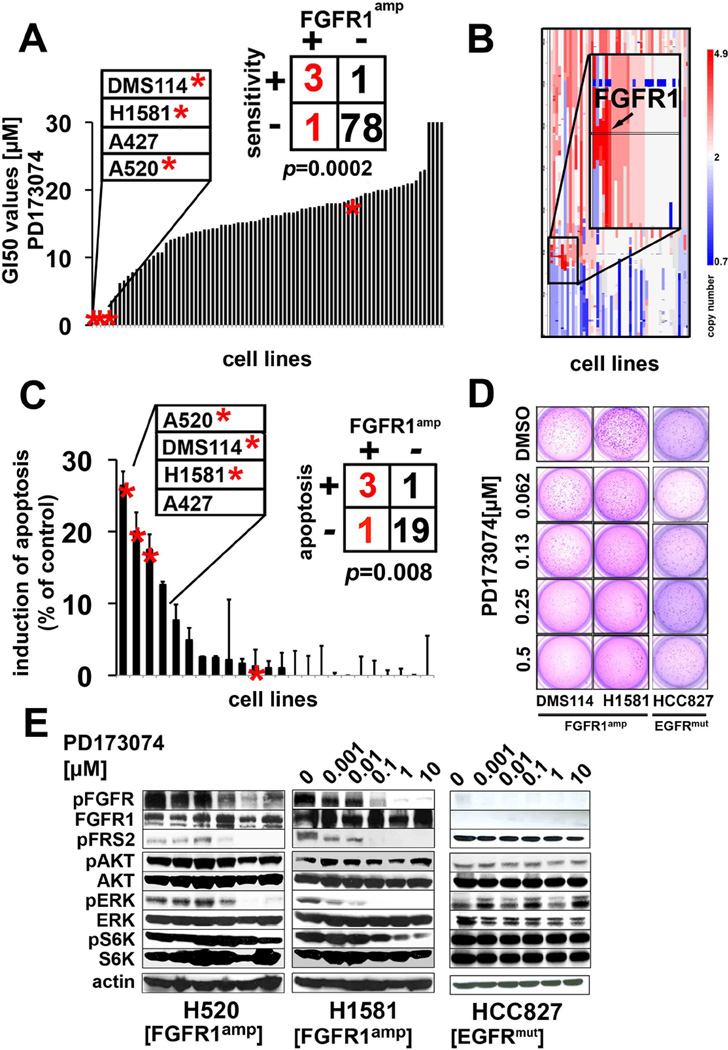
Lung cancer remains one of the leading causes of cancer-related death in developed countries. Although lung adenocarcinomas with EGFR mutations or EML4-ALK fusions respond to treatment by epidermal growth factor receptor (EGFR) and anaplastic lymphoma kinase (ALK) inhibition, respectively, squamous cell lung cancer currently lacks therapeutically exploitable genetic alterations. We conducted a systematic search in a set of 232 lung cancer specimens for genetic alterations that were therapeutically amenable and then performed high-resolution gene copy number analyses. We identified frequent and focal fibroblast growth factor receptor 1 (FGFR1) amplification in squamous cell lung cancer (n = 155), but not in other lung cancer subtypes, and, by fluorescence in situ hybridization, confirmed the presence of FGFR1 amplifications in an independent cohort of squamous cell lung cancer samples (22% of cases). Using cell-based screening with the FGFR inhibitor PD173074 in a large (n = 83) panel of lung cancer cell lines, we demonstrated that this compound inhibited growth and induced apoptosis specifically in those lung cancer cells carrying amplified FGFR1. We validated the FGFR1 dependence of FGFR1-amplified cell lines by FGFR1 knockdown and by ectopic expression of an FGFR1-resistant allele (FGFR1(V561M)), which rescued FGFR1-amplified cells from PD173074-mediated cytotoxicity. Finally, we showed that inhibition of FGFR1 with a small molecule led to significant tumor shrinkage in vivo. Thus, focal FGFR1 amplification is common in squamous cell lung cancer and associated with tumor growth and survival, suggesting that FGFR inhibitors may be a viable therapeutic option in this cohort of patients.
肺癌仍然是发达国家癌症相关死亡的主要原因之一。尽管具有 EGFR 突变或 EML4-ALK 融合的肺腺癌分别对表皮生长因子受体 (EGFR) 和间变性淋巴瘤激酶 (ALK) 抑制治疗有反应,但鳞状细胞肺癌目前缺乏可治疗的遗传改变。我们在一组 232 个肺癌标本中进行了系统搜索,寻找可治疗的遗传改变,然后进行了高分辨率基因拷贝数分析。我们发现鳞状细胞肺癌中频繁且局灶性的成纤维细胞生长因子受体 1 (FGFR1) 扩增(n = 155),但在其他肺癌亚型中没有,并且通过荧光原位杂交在独立的鳞状细胞肺癌样本队列中证实了 FGFR1 扩增的存在(22%的病例)。使用 FGFR 抑制剂 PD173074 在大型(n = 83)肺癌细胞系面板中进行基于细胞的筛选,我们证明该化合物特异性抑制携带扩增 FGFR1 的肺癌细胞的生长并诱导其凋亡。我们通过 FGFR1 敲低和过表达 FGFR1 抗性等位基因 (FGFR1[V561M]) 验证了 FGFR1 扩增细胞系对 FGFR1 的依赖性,这挽救了 PD173074 介导的细胞毒性作用下的 FGFR1 扩增细胞。最后,我们表明,用小分子抑制 FGFR1 可导致体内肿瘤明显缩小。因此,局灶性 FGFR1 扩增在鳞状细胞肺癌中很常见,与肿瘤生长和存活相关,这表明 FGFR 抑制剂可能是该患者群体的可行治疗选择。