Fox Jonathan, Klüsener Sebastian, Myrskylä Mikko
1John F. Kennedy Institute for North American Studies, Freie Universität Berlin, Lansstr. 7-9, 14195 Berlin, Germany.
2Max Planck Institute for Demographic Research, Konrad-Zuse-Str. 1, 18057 Rostock, Germany.
Eur J Popul. 2018 May 8;35(3):487-518. doi: 10.1007/s10680-018-9485-1. eCollection 2019 Jul.
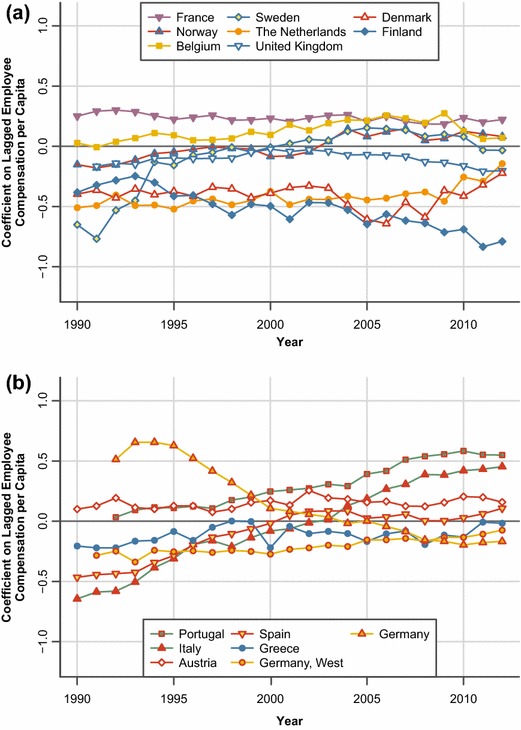
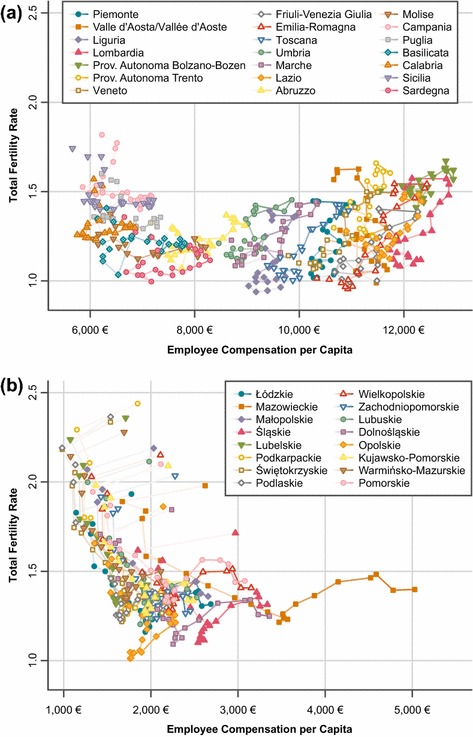
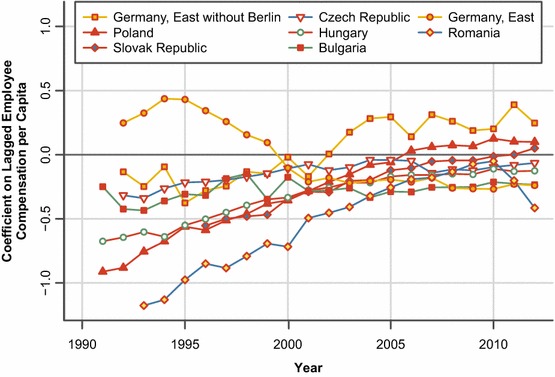
Evidence for nation-states suggests that the long-standing negative relationship between fertility and economic development might turn positive at high levels of development. The robustness of the reversal continues to be debated. We add to this discussion from a novel angle by considering whether such a reversal could also occur at the sub-national level within highly developed countries. Our contributions are both theoretical and empirical. We first discuss important trends which might foster the emergence of a positive fertility-development relationship across regions of highly developed countries. These include shifts in family policies, changes in the spatial organisation of the economic sphere, and selective international and internal migration processes. In order to explore whether we observe tendencies towards a reversal, we investigate data covering 20 European countries subdivided in 256 regions between 1990 and 2012. We document a weakening of the negative relationship between fertility and economic development within many countries, and among some countries the emergence of a positive relationship. These findings do not seem to be driven by postponement effects alone. However, there is substantial variation in the fertility and the economic development levels at which such tendencies towards a reversal are observed.
民族国家的相关证据表明,生育率与经济发展之间长期存在的负相关关系在高度发达水平时可能会转为正相关。这种逆转的稳健性仍在争论之中。我们从一个新的角度加入这场讨论,即考虑这种逆转是否也会在高度发达国家的次国家层面发生。我们的贡献既有理论方面的,也有实证方面的。我们首先讨论一些重要趋势,这些趋势可能会促使高度发达国家各地区出现生育率与发展之间的正相关关系。这些趋势包括家庭政策的转变、经济领域空间组织的变化以及有选择性的国际和国内移民过程。为了探究我们是否观察到了逆转趋势,我们研究了1990年至2012年间涵盖20个欧洲国家、细分为256个地区的数据。我们记录了许多国家内生育率与经济发展之间负相关关系的减弱,以及一些国家中出现的正相关关系。这些发现似乎并非仅由推迟效应驱动。然而,观察到这种逆转趋势的生育率和经济发展水平存在很大差异。