Kesikburun Bilge, Eksioglu Emel, Turan Aynur, Adiguzel Emre, Kesikburun Serdar, Cakci Aytul
Bilge Kesikburun, MD, University of Health Sciences, Dışkapı Yıldırım Beyazıt Training and Research Hospital, Department of Physical Medicine and Rehabilitation, Ankara, Turkey.
Emel Eksioglu, MD, Associate Professor, University of Health Sciences, Dışkapı Yıldırım Beyazıt Training and Research Hospital, Department of Physical Medicine and Rehabilitation, Ankara, Turkey.
Pak J Med Sci. 2019 Jul-Aug;35(4):974-980. doi: 10.12669/pjms.35.4.346.
To evaluate the natural history of lumbar extruded disc with conservative treatment on MRI and to assess relation between the radiologic changes and clinical outcome.
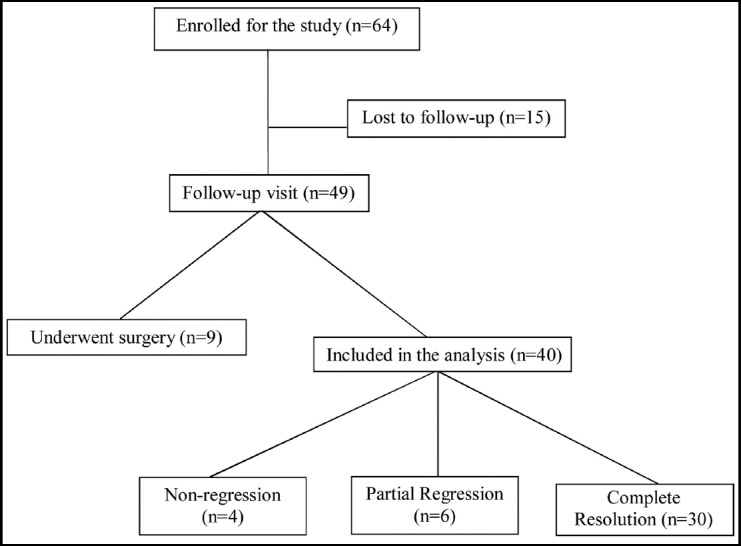
This prospective observational study was conducted at University of Health Sciences, Diskapi Yildirim Beyazit Training and Research Hospital between May 2015-June 2018. It included consecutive patients who were diagnosed as having lumbar symptomatic extruded disc as shown in MRI. After an average period of 17.0±7.2 months, repeat MRI was taken in 40 patients who received only conservative care during follow-up. Changes in the volume of herniated disc was measured. The patients were assigned into 3 groups as follow: (1) non-regression, (2) partial-regression, and (3) complete resolution. Numeric Rating Scale (NRS) pain score, the Oswestry Low Back Pain Disability Index (ODI) and muscle weakness were evaluated.
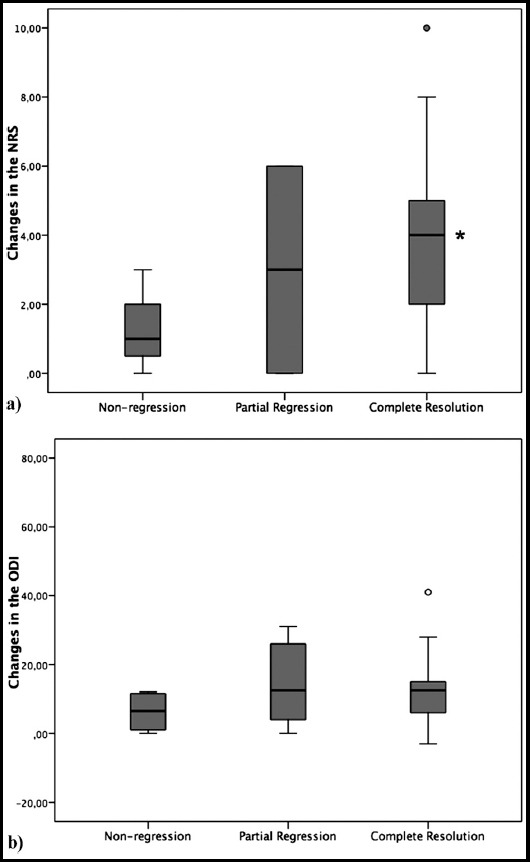
Based on disc volume of the T2-weighted MR images; four patients (10%) did not show any regression, six patients (15%) had a partial regression, and 30 patients (75%) had a complete resolution. Patients with complete resolution showed a significant improvement in the NRS pain score and the ODI score (p<0,001) over time. In patients with partial regression, only the ODI score improved significantly (p=0,043). Non-regression group did not show any improvement in any clinical outcome measure (p>0,05). Changes in the NRS scores over time were significantly higher in complete resolution group compared to non-regression group (p=0.016).
The majority of the patients with extruded lumbar disc herniation might have reduction in size of herniated disc in the long run along with improvement in symptoms and function with conservative care.
通过磁共振成像(MRI)评估经保守治疗的腰椎间盘突出症的自然病程,并评估影像学改变与临床结局之间的关系。
这项前瞻性观察性研究于2015年5月至2018年6月在健康科学大学迪斯卡皮·耶尔德勒姆·贝亚齐特培训与研究医院进行。研究纳入了MRI显示为腰椎症状性椎间盘突出的连续患者。在平均17.0±7.2个月的随访期后,对40例在随访期间仅接受保守治疗的患者进行了重复MRI检查。测量了突出椎间盘的体积变化。患者被分为以下3组:(1)无退缩组,(2)部分退缩组,(3)完全消退组。评估了数字评分量表(NRS)疼痛评分、奥斯威斯腰痛残疾指数(ODI)和肌肉无力情况。
根据T2加权MR图像上的椎间盘体积;4例患者(10%)未显示任何退缩,6例患者(15%)有部分退缩,30例患者(75%)完全消退。完全消退的患者随着时间推移,NRS疼痛评分和ODI评分有显著改善(p<0.001)。在部分退缩的患者中,只有ODI评分有显著改善(p=0.043)。无退缩组在任何临床结局指标上均未显示出改善(p>0.05)。完全消退组随时间变化的NRS评分显著高于无退缩组(p=0.016)。
从长远来看,大多数腰椎间盘突出症患者经保守治疗后,突出椎间盘的大小可能会减小,同时症状和功能也会改善。