Shah Pratik, Kendall Francis, Khozin Sean, Goosen Ryan, Hu Jianying, Laramie Jason, Ringel Michael, Schork Nicholas
1Massachusetts Institute of Technology, Media Laboratory, Cambridge, MA USA.
F. Hoffmann-La Roche AG, Strategic Innovation, San Francisco, CA USA.
NPJ Digit Med. 2019 Jul 26;2:69. doi: 10.1038/s41746-019-0148-3. eCollection 2019.
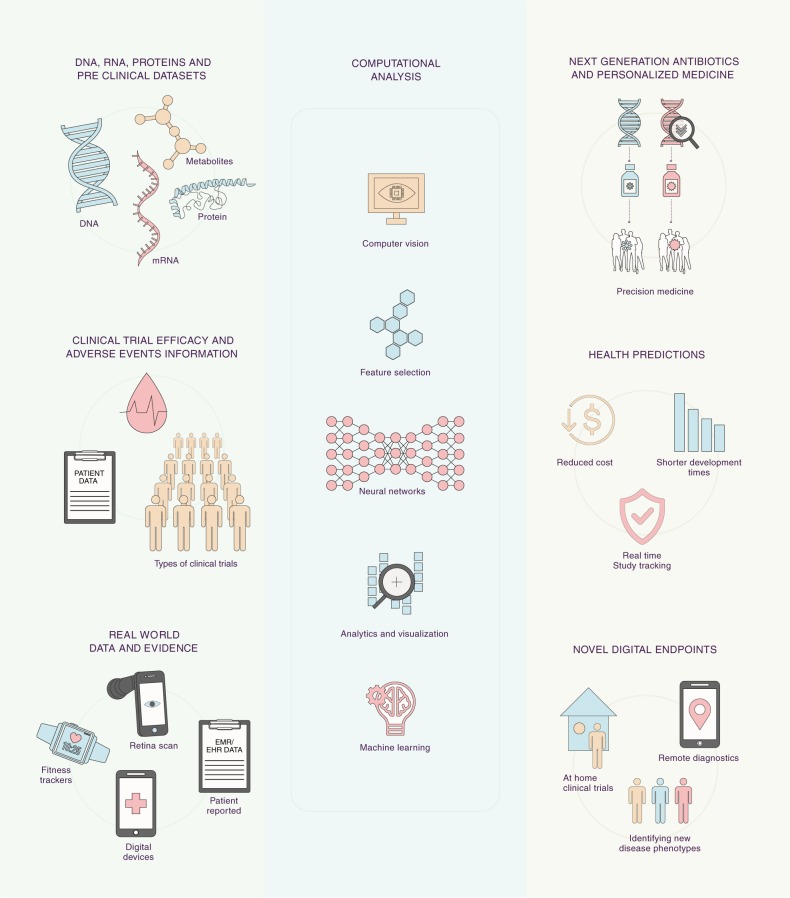
Future of clinical development is on the verge of a major transformation due to convergence of large new digital data sources, computing power to identify clinically meaningful patterns in the data using efficient artificial intelligence and machine-learning algorithms, and regulators embracing this change through new collaborations. This perspective summarizes insights, recent developments, and recommendations for infusing actionable computational evidence into clinical development and health care from academy, biotechnology industry, nonprofit foundations, regulators, and technology corporations. Analysis and learning from publically available biomedical and clinical trial data sets, real-world evidence from sensors, and health records by machine-learning architectures are discussed. Strategies for modernizing the clinical development process by integration of AI- and ML-based digital methods and secure computing technologies through recently announced regulatory pathways at the United States Food and Drug Administration are outlined. We conclude by discussing applications and impact of digital algorithmic evidence to improve medical care for patients.
由于大量新的数字数据源不断汇聚、具备利用高效人工智能和机器学习算法在数据中识别具有临床意义模式的计算能力,以及监管机构通过新的合作方式接纳这一变革,临床开发的未来正处于重大变革的边缘。本观点总结了来自学术界、生物技术行业、非营利基金会、监管机构和科技公司的见解、近期进展以及将可操作的计算证据融入临床开发和医疗保健的建议。讨论了通过机器学习架构对公开可用的生物医学和临床试验数据集、来自传感器的真实世界证据以及健康记录进行分析和学习。概述了通过美国食品药品监督管理局最近宣布的监管途径,整合基于人工智能和机器学习的数字方法与安全计算技术,使临床开发过程现代化的策略。我们通过讨论数字算法证据在改善患者医疗护理方面的应用和影响来结束本文。