Grupo Química-Física Molecular y Modelamiento Computacional (QUIMOL), Facultad de Ciencias, Universidad Pedagógica y Tecnológica de Colombia (UPTC), Avenida Central del Norte, Tunja 150001, Boyacá, Colombia.
Grupo de Investigación en Ciencias Básicas (NÚCLEO), Facultad de Ciencias e Ingeniería, Universidad de Boyacá, Tunja 150001, Boyacá, Colombia.
Molecules. 2019 Jul 11;24(14):2531. doi: 10.3390/molecules24142531.
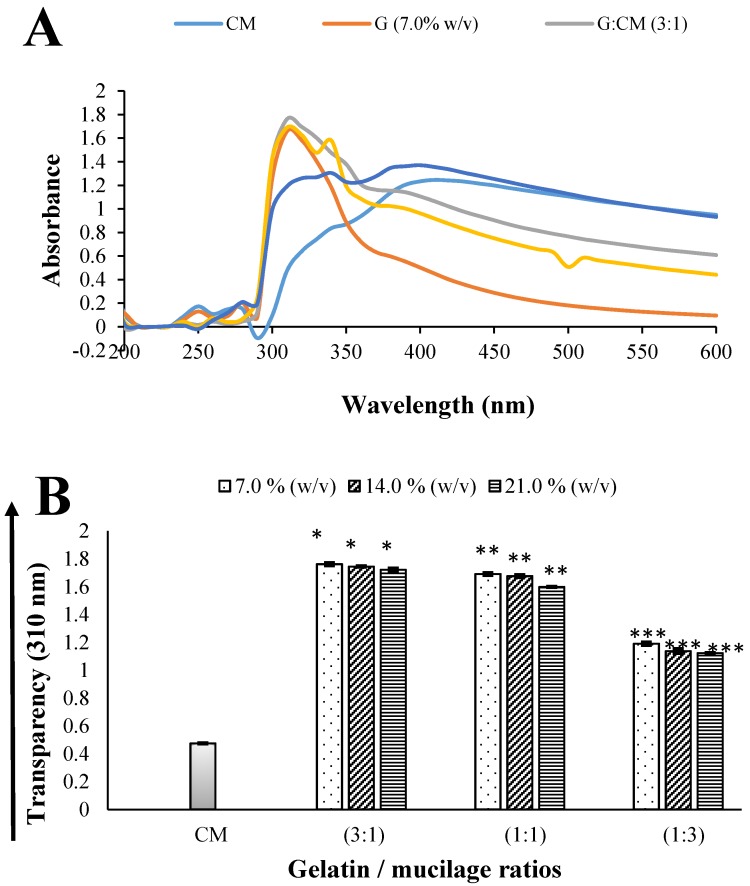
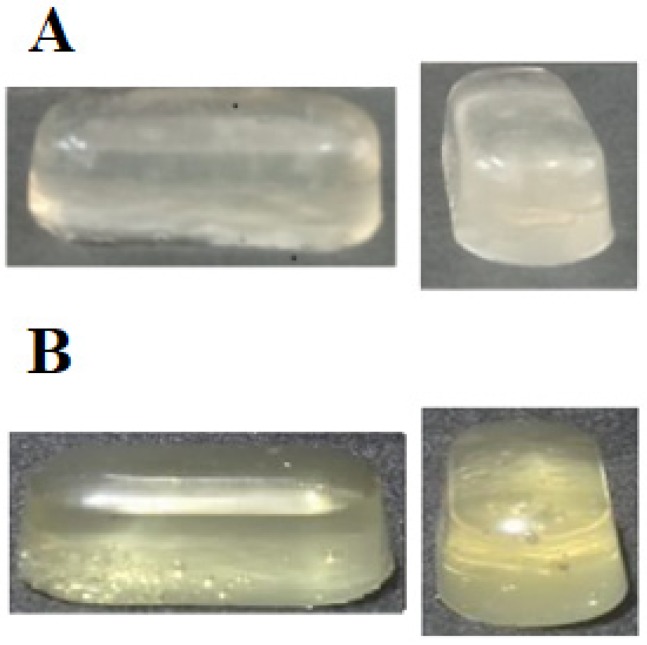
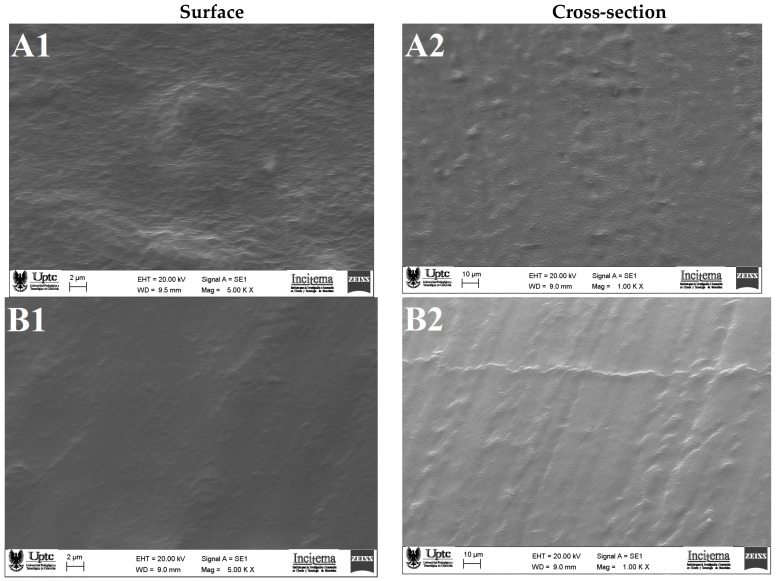
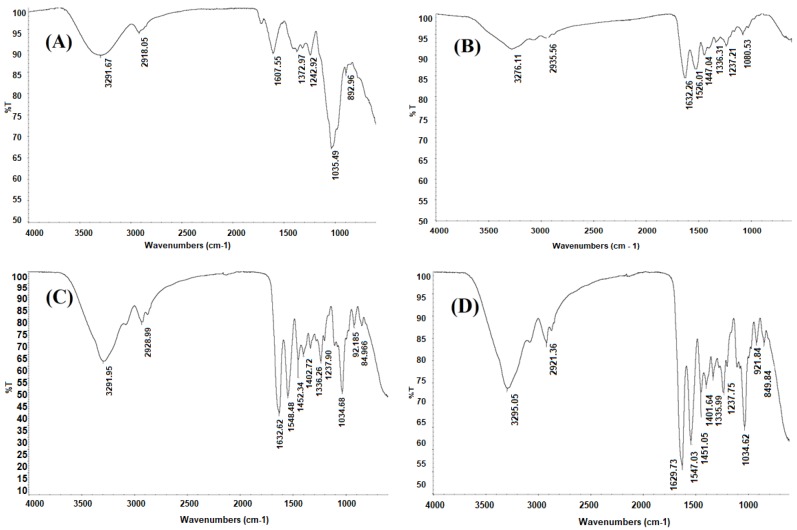
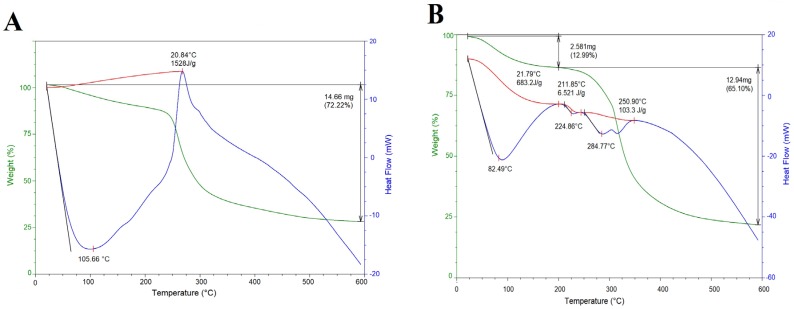
A new crosslinking formulation using gelatin (G) and cactus mucilage (CM) biopolymers was developed, physicochemically characterized and proposed as an alternative wall material to traditional gelatin capsules (softgels). The effect of G concentration at different G/CM ratios (3:1, 1:1 and 1:3) was analyzed. Transparency, moisture content (MC), solubility in water (SW), morphology (scanning electron microscopy, SEM), vibrational characterization (Fourier transform infrared, FTIR), color parameters (CIELab) and thermal (differential scanning calorimetry/thermogravimetric analysis, DSC/TGA) properties of the prepared composite (CMC) capsules were estimated and compared with control (CC) capsules containing only G and glycerol. In addition, the dietary fiber (DF) content was also evaluated. Our results showed that the transparency of composite samples decreased gradually with the presence of CM, the G/CM ratio of 3:1 being suitable to form the softgels. The addition of CM decreased the MC, the SW and the lightness of the capsules. Furthermore, the presence of polysaccharide had significant effects on the morphology and thermal behavior of CMC in contrast to CC. FTIR spectra confirmed the CMC formation by crosslinking between CM and G biopolymers. The addition of CM to the softgels formulation influenced the DF content. Our findings support the feasibility of developing softgels using a formulation of CM and G as wall material with nutritional properties.
一种使用明胶(G)和仙人掌黏液(CM)生物聚合物的新交联配方被开发出来,其物理化学性质得到了表征,并被提议作为传统明胶胶囊(软胶囊)的替代壁材。分析了不同 G/CM 比(3:1、1:1 和 1:3)下 G 浓度的影响。评估了制备的复合(CMC)胶囊的透明度、水分含量(MC)、在水中的溶解度(SW)、形态(扫描电子显微镜,SEM)、振动特性(傅里叶变换红外,FTIR)、颜色参数(CIELab)和热特性(差示扫描量热法/热重分析,DSC/TGA),并与仅含有 G 和甘油的对照(CC)胶囊进行了比较。此外,还评估了膳食纤维(DF)的含量。我们的结果表明,随着 CM 的存在,复合样品的透明度逐渐降低,G/CM 比为 3:1 适合形成软胶囊。CM 的添加降低了 MC、SW 和胶囊的明度。此外,与 CC 相比,多糖的存在对 CMC 的形态和热行为有显著影响。FTIR 光谱证实了 CM 和 G 生物聚合物之间交联形成了 CMC。CM 对软凝胶配方的添加影响了 DF 的含量。我们的研究结果支持使用 CM 和 G 作为壁材的配方开发具有营养特性的软胶囊的可行性。