Feng Yan-Mei, Wan Dong, Guo Rui
Department of Respiratory and Critical Care Medicine.
Department of Critical Care Medicine, the First Affiliated Hospital of Chongqing Medical University, Chongqing, PR China.
Medicine (Baltimore). 2019 Aug;98(31):e16678. doi: 10.1097/MD.0000000000016678.
The benefits of prolonged endotracheal intubation (ETI) in comparison to early tracheotomy is still over the controversy. Little information is available in concern to prolonged ETI more than years. We report the consequence of oral ETI in a 95-year old man for 839 days.
This patient was transferred to the intensive care unit due to sputum asphyxia and respiratory arrest. Timely ETI was performed. However, as a neurological insult, extubation had a high risk of failure due to the insufficient ability of sputum clearance. In addition, his family members refused further surgical interventions including tracheotomy.
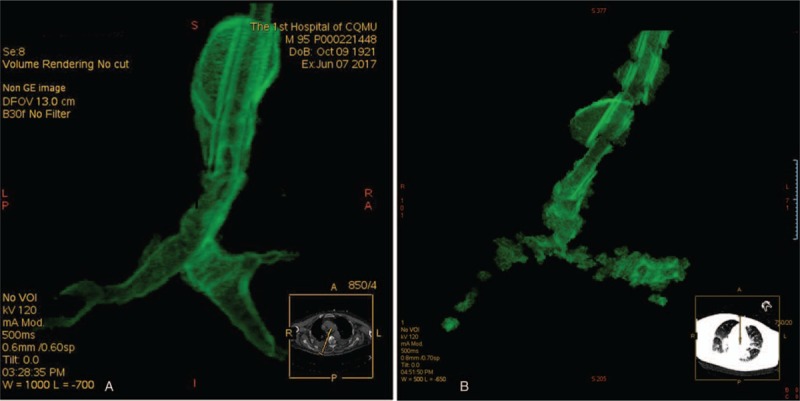
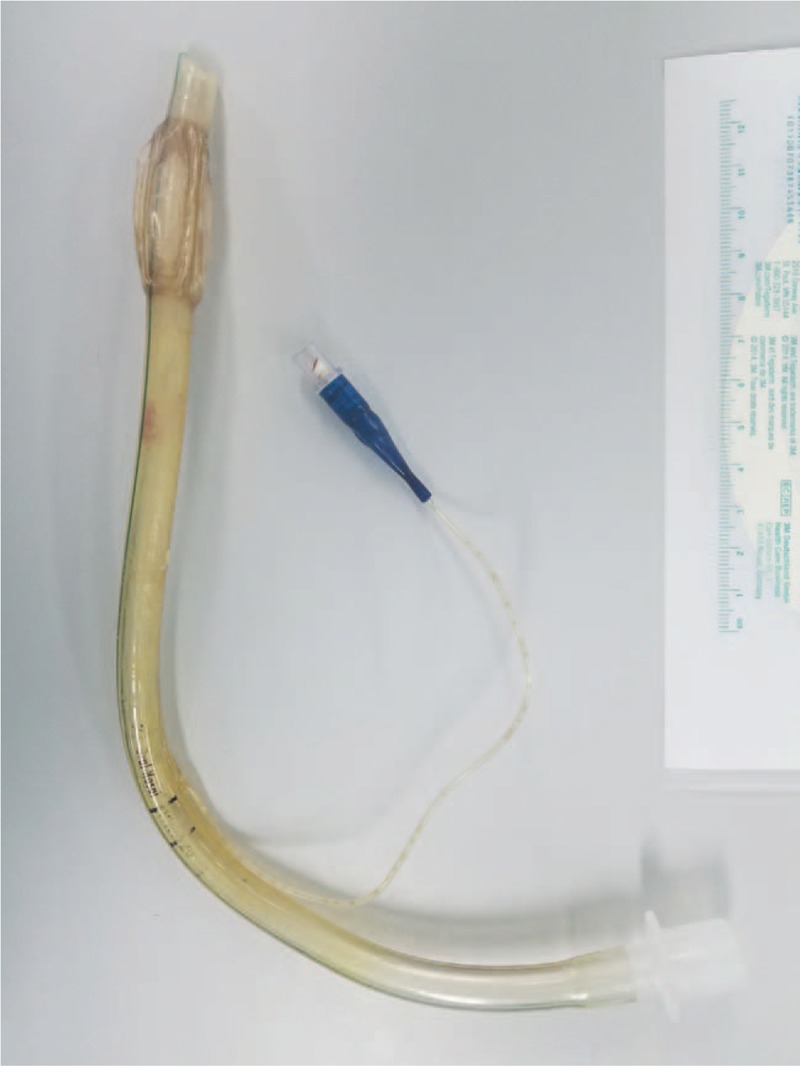
Prolonged ETI occurred in this patient. On day 240 and 329 after ETI, 3D airway image did not reveal laryngeal stenosis or laryngeal lesions. On day 459 and 662, ET tube (ETT) exchanged was performed and the balloon became stiff and inelasticity.
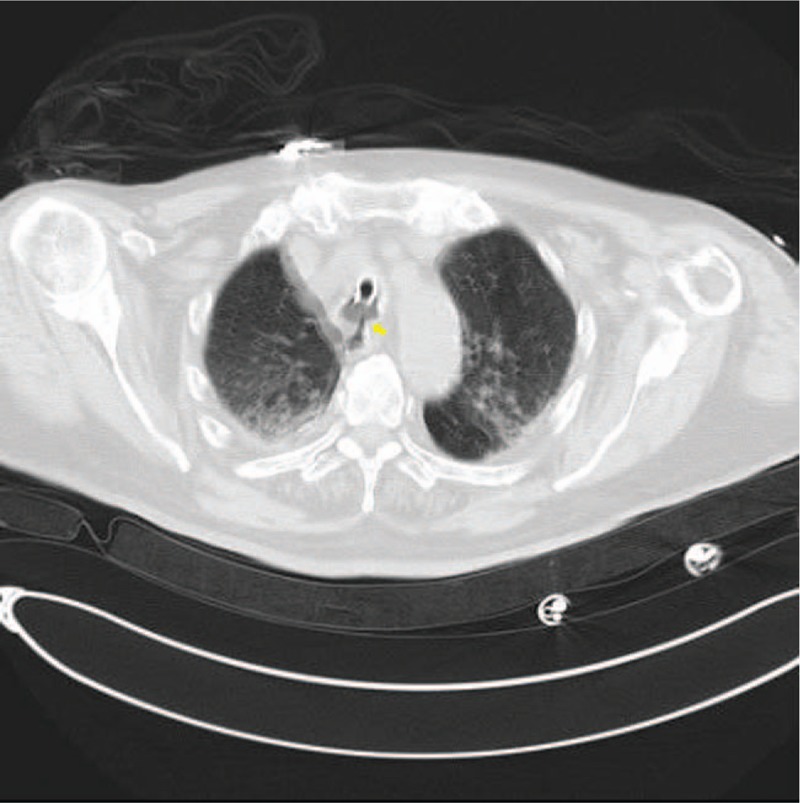
Although a possible tracheoesophageal fistula was suspected by imaging findings on day 547, the gastroscopy did not reveal the fistula on the esophagus. Enteral nutrition was delivered through the gastric tube, while the mediastinal infection was not observed during subsequent follow-up of computed tomography.
He received tracheostomy due to acute sputum obstruction within ETT and abrupt oxygen desaturation on day 839.
During prolonged ETI, more attention should focus on airway humidification, proper cuff pressure and optimal time for tube exchange in order to avoid severe complications.
与早期气管切开术相比,长期气管插管(ETI)的益处仍存在争议。关于超过数年的长期ETI的信息很少。我们报告了一名95岁男性进行口腔ETI 839天的结果。
该患者因痰液窒息和呼吸骤停被转入重症监护病房。及时进行了ETI。然而,由于神经损伤,因痰液清除能力不足,拔管失败风险很高。此外,他的家人拒绝包括气管切开术在内的进一步手术干预。
该患者发生了长期ETI。在ETI后的第240天和329天,三维气道图像未显示喉狭窄或喉部病变。在第459天和662天,进行了ET管(ETT)更换,球囊变硬且无弹性。
尽管在第547天通过影像学检查怀疑可能存在气管食管瘘,但胃镜检查未发现食管瘘。通过胃管给予肠内营养,在随后的计算机断层扫描随访中未观察到纵隔感染。
在第839天,由于ETT内急性痰液阻塞和突然的氧饱和度下降,他接受了气管切开术。
在长期ETI期间,应更多关注气道湿化、合适的套囊压力和最佳的换管时间,以避免严重并发症。