Lysogor Ivan, Voskov Leonid, Rolich Alexey, Efremov Sergey
Laboratory of the Internet of Things and Cyber-physical Systems, National Research University Higher School of Economics, Moscow 101000, Russia.
Department of Computer Engineering, National Research University Higher School of Economics, Moscow 101000, Russia.
Sensors (Basel). 2019 Aug 1;19(15):3384. doi: 10.3390/s19153384.
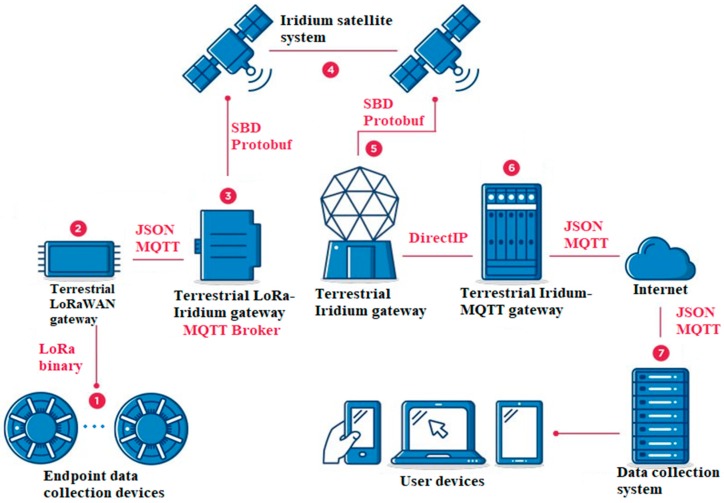
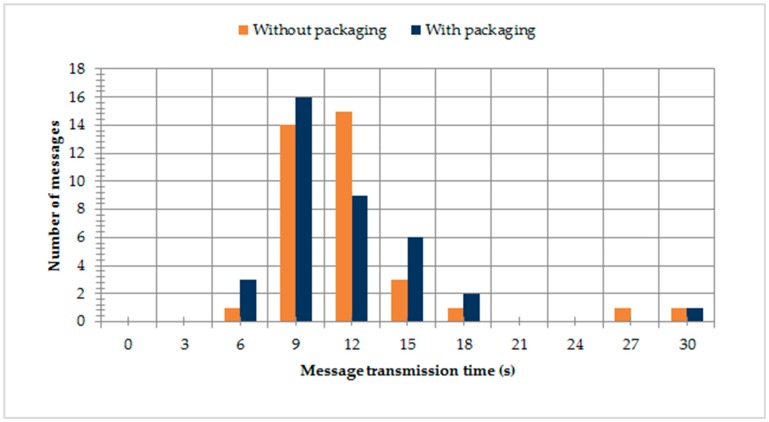
In the absence of traditional communication infrastructures, the choice of available technologies for building data collection and control systems in remote areas is very limited. This paper reviews and analyzes protocols and technologies for transferring Internet of Things (IoT) data and presents an architecture for a hybrid IoT-satellite network, which includes a long range (LoRa) low power wide area network (LPWAN) terrestrial network for data collection and an Iridium satellite system for backhaul connectivity. Simulation modelling, together with a specialized experimental stand, allowed us to study the applicability of different methods of information presentation for the case of transmitting IoT data over low-speed satellite communication channels. We proposed a data encoding and packaging scheme called GDEP (Gateway Data Encoding and Packaging). It is based on the combination of data format conversion at the connection points of a heterogeneous network and message packaging. GDEP enabled the reduction of the number of utilized Short Burst Data (SBD) containers and the overall transmitted data size by almost five times.
在缺乏传统通信基础设施的情况下,在偏远地区构建数据收集和控制系统时可供选择的可用技术非常有限。本文回顾并分析了用于传输物联网(IoT)数据的协议和技术,并提出了一种混合物联网-卫星网络架构,该架构包括用于数据收集的长距离(LoRa)低功耗广域网(LPWAN)地面网络和用于回程连接的铱星卫星系统。通过仿真建模以及一个专门的实验平台,我们得以研究在通过低速卫星通信信道传输物联网数据的情况下不同信息呈现方法的适用性。我们提出了一种名为GDEP(网关数据编码与打包)的数据编码和打包方案。它基于异构网络连接点处的数据格式转换和消息打包的结合。GDEP能够将所使用的短突发数据(SBD)容器数量以及总体传输数据大小减少近五倍。