Section of Psychiatry, Department of Neurosciences, Biomedicine and Movement Sciences, University of Verona, Verona, Italy.
Department of Pathophysiology and Transplantation, University of Milan, Milan, Italy; Department of Neurosciences and Mental Health, Fondazione IRCCS Ca' Granda Ospedale Maggiore Policlinico, Milan, Italy; Posit Science Inc., San Francisco, CA, USA.
J Affect Disord. 2019 Oct 1;257:691-697. doi: 10.1016/j.jad.2019.07.059. Epub 2019 Jul 19.
Bipolar disorder (BD) is characterized by cognitive impairments that are known to predict psychosocial functioning and quality of life. While cognitive remediation (CR) was originally developed to directly target cognitive symptoms in traumatic brain injury and psychotic illnesses, the efficacy of CR in BD has begun to emerge only in the last decade. Functional Remediation (FR) is an integrated intervention that has been developed to restore psychosocial functioning by means of ecological neurocognitive techniques that involve psychoeducation about cognitive dysfunctions and their impact on the general functioning. Because of the heterogeneity of treatment targets and mechanisms of actions, here we aim to illustrate the effects induced by existing CR/FR approaches in BD.
In this systematic review, we evaluated cognitive and functional outcomes after CR/FR in studies conducted in BD.
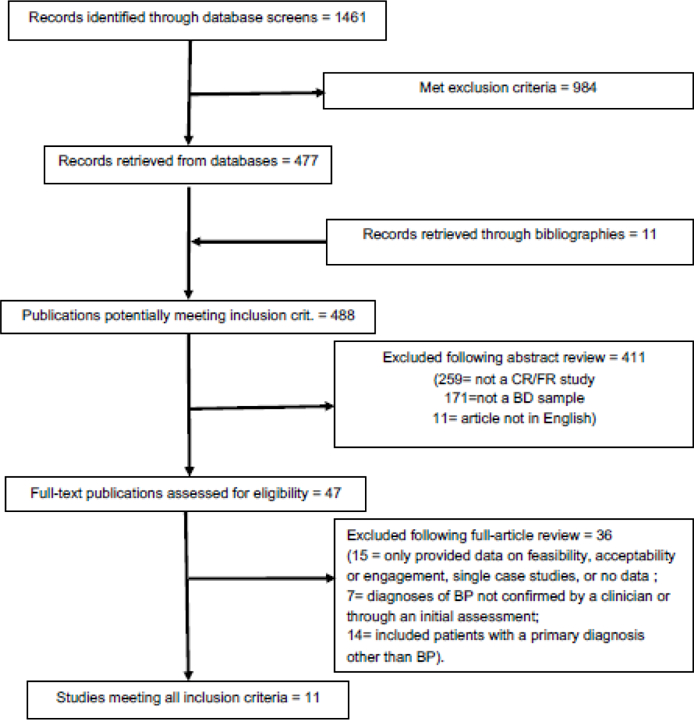
Eleven studies met inclusion criteria: 3 RCTs that compared CR/FR to one or more control condition (n = 354), 5 secondary analyses that further examined data from these trials, 2 single-arm studies, and 1 naturalistic study. While features such as the use of computerized training tools and a group-based format recurred across studies, CR/FR paradigms targeting different cognitive and functional domains showed specificity of training focus to outcomes. Effect sizes were in the medium-large range, suggesting that patients with BD respond to treatment at or above the level reported in psychotic patients. Integrated approaches that combined cognitive exercises with group-based experiences were associated with both cognitive and functional improvements.
In this review, we found support for the use of CR/FR paradigms in patients with BD with evidence of cognitive and functional improvements. The scarcity of currently published RCTs as well as of data examining mechanisms of action and neural correlates limits the generalizability of our findings.
双相情感障碍(BD)的特征是认知障碍,这些障碍已知会预测社会心理功能和生活质量。虽然认知矫正(CR)最初是为了直接针对创伤性脑损伤和精神病患者的认知症状而开发的,但 CR 在 BD 中的疗效仅在过去十年中才开始显现。功能修复(FR)是一种综合干预措施,旨在通过涉及认知功能障碍及其对一般功能影响的心理教育的生态神经认知技术来恢复社会心理功能。由于治疗目标和作用机制的异质性,我们在这里旨在说明现有 CR/FR 方法在 BD 中引起的效果。
在这项系统评价中,我们评估了 CR/FR 治疗后在 BD 中进行的研究中的认知和功能结果。
符合纳入标准的有 11 项研究:3 项 RCT 将 CR/FR 与一种或多种对照条件进行比较(n=354),5 项二次分析进一步检查了这些试验的数据,2 项单臂研究和 1 项自然研究。虽然诸如使用计算机化训练工具和基于小组的格式等特征在研究中反复出现,但针对不同认知和功能领域的 CR/FR 范式表现出对结果的特定培训重点。效应量处于中到大的范围,表明 BD 患者对治疗的反应处于或高于报告的精神病患者的水平。将认知练习与基于小组的经验相结合的综合方法与认知和功能改善相关。
在本综述中,我们发现支持在 BD 患者中使用 CR/FR 范式的证据,有认知和功能改善的证据。目前发表的 RCT 以及检查作用机制和神经相关性的数据稀缺限制了我们研究结果的普遍性。