Perra Alessandra, Galetti Alessia, Zaccheddu Rosanna, Locci Aurora, Piludu Federica, Preti Antonio, Primavera Diego, Di Natale Lorenzo, Nardi Antonio Egidio, Kurotshka Peter Konstantin, Cossu Giulia, Sancassiani Federica, Stella Giusy, De Lorenzo Valerio, Zreik Thurayya, Carta Mauro Giovanni
International PhD in Innovation Sciences and Technologies, University of Cagliari, 09124 Cagliari, Italy.
Department of Medical Sciences and Public Health, University of Cagliari, 09124 Cagliari, Italy.
J Clin Med. 2023 Mar 9;12(6):2142. doi: 10.3390/jcm12062142.
Cognitive impairment is a frequent consequence of bipolar disorder (BD) that is difficult to prevent and treat. In addition, the quality of the preliminary evidence on the treatment of BD through Cognitive Remediation (CR) with traditional methods is poor. This study aims to evaluate the feasibility of a CR intervention with fully immersive Virtual Reality (VR) as an additional treatment for BD and offers preliminary data on its efficacy.
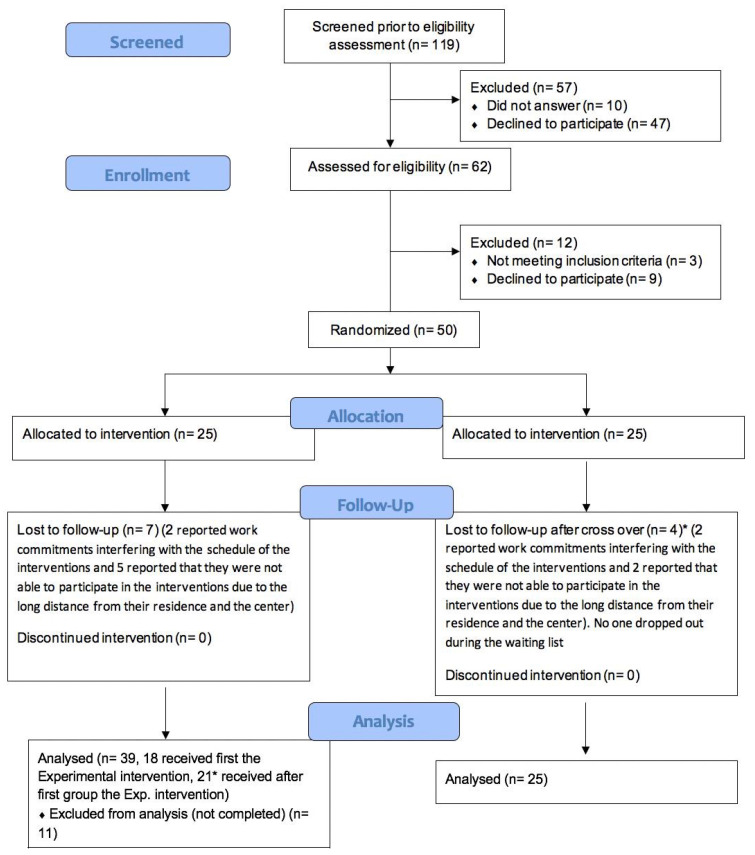
Feasibility randomized controlled cross-over clinical study, with experimental condition lasting three months, crossed between two groups. Experimental condition: CR fully immersive VR recovery-oriented program plus conventional care; Control condition: conventional care. The control group began the experimental condition after a three months period of conventional care (waiting list). After the randomization of 50 people with BD diagnosis, the final sample consists of 39 participants in the experimental condition and 25 in the control condition because of dropouts.
Acceptability and tolerability of the intervention were good. Compared to the waitlist group, the experimental group reported a significant improvement regarding cognitive functions (memory: = 0.003; attention: = 0.002, verbal fluency: = 0.010, executive function: = 0.003), depressive symptoms ( = 0.030), emotional awareness ( = 0.007) and biological rhythms ( = 0.029).
The results are preliminary and cannot be considered exhaustive due to the small sample size. However, the evidence of efficacy, together with the good acceptability of the intervention, is of interest. These results suggest the need to conduct studies with larger samples that can confirm this data.
ClinicalTrialsgov NCT05070065, registered in September 2021.
认知障碍是双相情感障碍(BD)常见的后果,难以预防和治疗。此外,传统方法通过认知康复(CR)治疗BD的初步证据质量较差。本研究旨在评估采用完全沉浸式虚拟现实(VR)进行CR干预作为BD辅助治疗的可行性,并提供其疗效的初步数据。
可行性随机对照交叉临床研究,实验组为期三个月,两组交叉进行。实验组:以康复为导向的CR完全沉浸式VR项目加常规护理;对照组:常规护理。对照组在三个月的常规护理期(等候名单)后开始进入实验组。在对50名BD诊断患者进行随机分组后,由于失访,最终样本包括39名实验组参与者和25名对照组参与者。
干预的可接受性和耐受性良好。与等候名单组相比,实验组在认知功能(记忆:=0.003;注意力:=0.002,语言流畅性:=0.010,执行功能:=0.003)、抑郁症状(=0.030)、情绪意识(=0.007)和生物节律(=0.029)方面有显著改善。
由于样本量小,结果是初步的,不能认为是详尽无遗的。然而,疗效证据以及干预的良好可接受性令人关注。这些结果表明需要进行更大样本的研究来证实这些数据。
ClinicalTrialsgov NCT05070065,于2021年9月注册。