Jovanovič Primož, Stojanovski Kevin, Bele Marjan, Dražić Goran, Koderman Podboršek Gorazd, Suhadolnik Luka, Gaberšček Miran, Hodnik Nejc
Department of Catalysis and Chemical Reaction Engineering , National Institute of Chemistry , Hajdrihova 19 , SI-1000 Ljubljana , Slovenia.
Department of Materials Chemistry , National Institute of Chemistry , Hajdrihova 19 , SI-1000 Ljubljana , Slovenia.
Anal Chem. 2019 Aug 20;91(16):10353-10356. doi: 10.1021/acs.analchem.9b01317. Epub 2019 Aug 6.
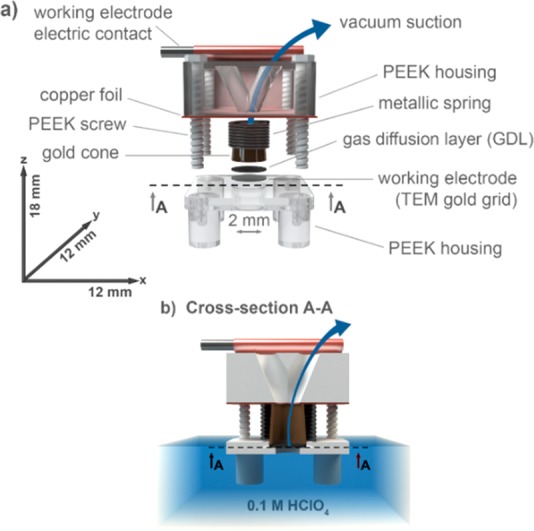
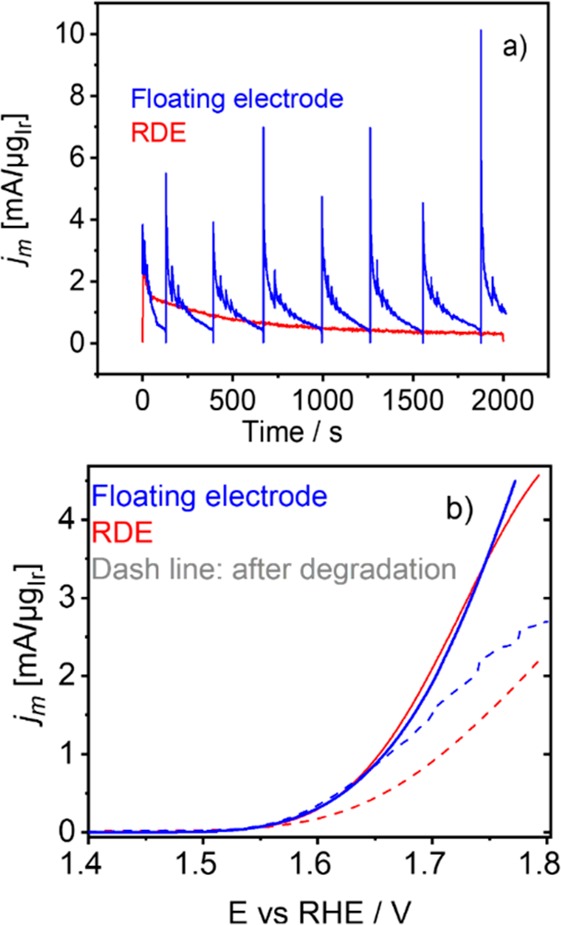
The future significance of energy conversion has stimulated intense investigation of various electrocatalytic materials. Hence electrocatalysts have become the subject of electrochemical characterization on a daily basis. In certain cases of interest, when measuring electrochemical reactions beyond the onset potentials, however, appropriateness of existing electroanalytical methods may be questioned and alternative approaches need to be developed. The present study highlights some shortcomings in the electrochemical investigation of gas evolving reactions. The oxygen evolution reaction (OER) is selected as a case example with a specific focus on the electrochemical stability of a nanoparticulate iridium catalyst. When conventional electrochemical methods, such as thin film rotating disc electrodes are employed to study the materials' stability, the intrinsic degradation is masked by oxygen bubbles, which are inherently being formed during the reaction, especially when high current densities are used. In this Letter, we present a solution to this issue, the so-called floating electrode arrangement. Its elegant usage enables fast and reliable electrochemical characterization of oxygen evolution electrocatalysts.
能量转换的未来意义激发了对各种电催化材料的深入研究。因此,电催化剂每天都成为电化学表征的对象。然而,在某些感兴趣的情况下,当测量超过起始电位的电化学反应时,现有电分析方法的适用性可能会受到质疑,需要开发替代方法。本研究突出了气体析出反应电化学研究中的一些缺点。以析氧反应(OER)为例,特别关注纳米颗粒铱催化剂的电化学稳定性。当采用传统的电化学方法,如薄膜旋转圆盘电极来研究材料的稳定性时,本征降解被反应过程中固有形成的氧气气泡所掩盖,尤其是在使用高电流密度时。在本信函中,我们提出了一个解决此问题的方案,即所谓的浮动电极装置。其巧妙的应用能够对析氧电催化剂进行快速可靠的电化学表征。