Nayak Ajay P, Shah Sushrut D, Michael James V, Deshpande Deepak A
Division of Pulmonary, Allergy and Critical Care Medicine, Center for Translational Medicine, Department of Medicine, Jane and Leonard Korman Respiratory Institute, Thomas Jefferson University, Philadelphia, PA, United States.
Front Physiol. 2019 Jul 16;10:884. doi: 10.3389/fphys.2019.00884. eCollection 2019.
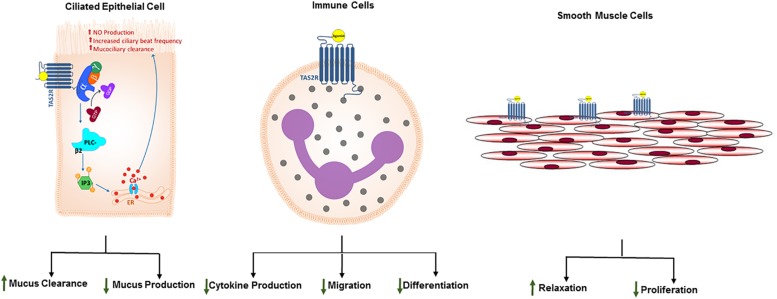
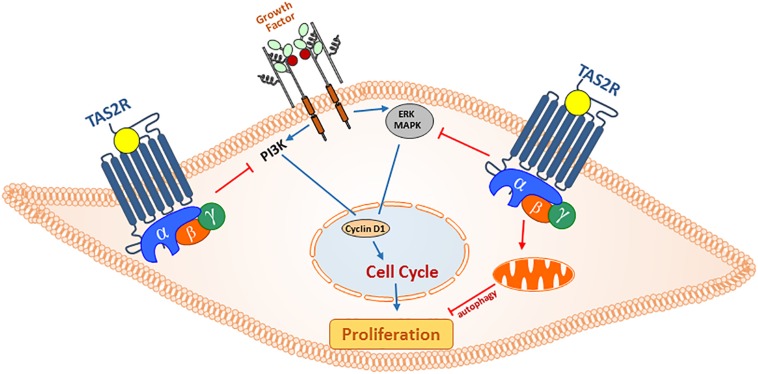
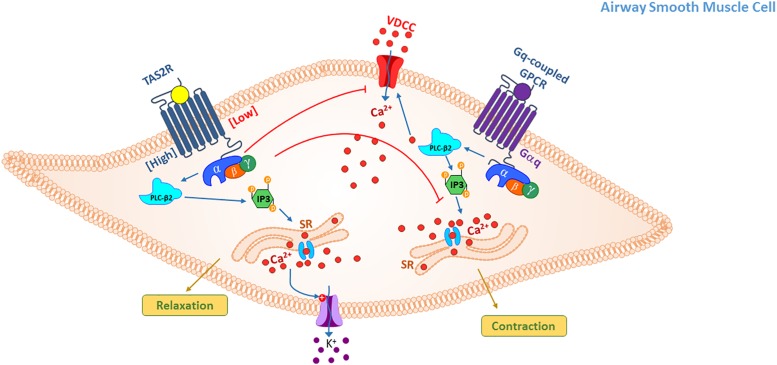
Clinical management of asthma and chronic obstructive pulmonary disease (COPD) has primarily relied on the use of beta 2 adrenergic receptor agonists (bronchodilators) and corticosteroids, and more recently, monoclonal antibody therapies (biologics) targeting specific cytokines and their functions. Although these approaches provide relief from exacerbations, questions remain on their long-term efficacy and safety. Furthermore, current therapeutics do not address progressive airway remodeling (AR), a key pathological feature of severe obstructive lung disease. Strikingly, agonists of the bitter taste receptors (TAS2Rs) deliver robust bronchodilation, curtail allergen-induced inflammatory responses in the airways and regulate airway smooth muscle (ASM) cell proliferation and mitigate features of AR and in animal models. The scope of this review is to provide a comprehensive and systematic insight into our current understanding of TAS2Rs with an emphasis on the molecular events that ensue TAS2R activation in distinct airway cell types and expand on the pleiotropic effects of TAS2R targeting in mitigating various pathological features of obstructive lung diseases. Finally, we will discuss specific opportunities that could help the development of selective agonists for specific TAS2R subtypes in the treatment of asthma.
哮喘和慢性阻塞性肺疾病(COPD)的临床管理主要依赖于使用β2肾上腺素能受体激动剂(支气管扩张剂)和皮质类固醇,最近还依赖于针对特定细胞因子及其功能的单克隆抗体疗法(生物制剂)。尽管这些方法能缓解病情加重,但它们的长期疗效和安全性仍存在疑问。此外,目前的治疗方法并未解决进行性气道重塑(AR)这一严重阻塞性肺病的关键病理特征。令人惊讶的是,苦味受体(TAS2Rs)激动剂在动物模型中可产生强大的支气管扩张作用,减少气道中过敏原诱导的炎症反应,调节气道平滑肌(ASM)细胞增殖,并减轻AR的特征。本综述的范围是全面系统地深入了解我们目前对TAS2Rs的认识,重点关注不同气道细胞类型中TAS2R激活后发生的分子事件,并详细阐述靶向TAS2R在减轻阻塞性肺病各种病理特征方面的多效性作用。最后,我们将讨论有助于开发用于治疗哮喘的特定TAS2R亚型选择性激动剂的具体机会。